
Species information
Life history
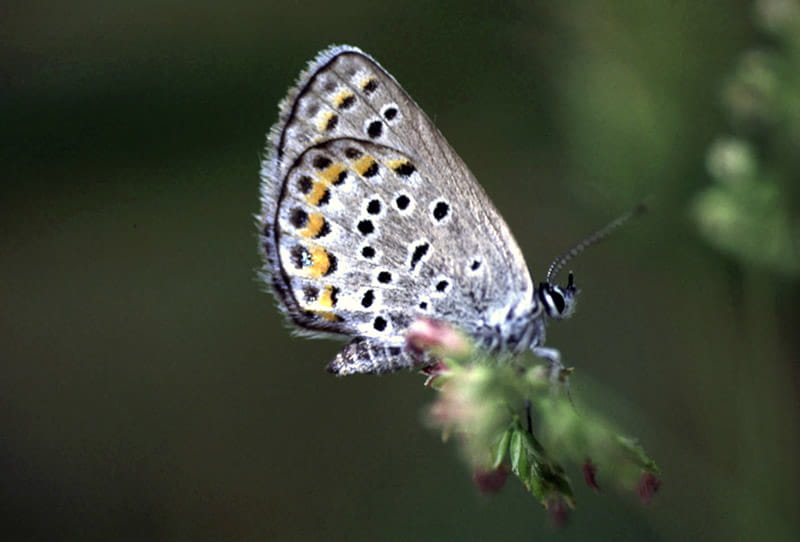
Karner blues are small butterflies about the size of a nickel. Males have a vibrant, silvery blue color on the upper surface of their wings. The upper surfaces of the females' wings are blue close to the body, fading to grayish-brown towards the edges. The wing undersides of both sexes is light gray to grayish-brown with rows of small black spots. A single row of metallic blue-green, orange, and black spots rims the outer edges of the underside of each wing, but is most distinct on the hind wings. Larvae (caterpillars) are small, green, soft-bodied caterpillars that feed only on wild or blue lupine (Lupinus perennis) leaves and flowers. The caterpillars have a mutualistic relationship with mound-building ants, which protect the caterpillars from predators and parasites. In exchange, the caterpillars excrete a sugary substance which is consumed by the ants.
Females only lay their eggs on or near lupine plants. After hatching, the young caterpillars feed on the lupine. After a few weeks of feeding, the caterpillars form a chrysalis. Adults emerge in about ten days. Two generations of Karner blues are produced every year. The first hatch occurs from mid-May through early June. These butterflies lay eggs which hatch and become adults for a second hatch from mid-July through early August. The adult Karner blue butterflies, during their short one to two-week life span, will feed on the nectar of a variety of flowers, such as blue lupine, New Jersey tea, dogbane, and butterfly weed.
Karner blues and lupine are found, along with many other rare and unique plant and animal species, in oak barrens (also called savannas), oak-pine barrens, dry sand prairies, and other open areas with sandy soil. These habitats are some of the rarest natural systems in the world, having slowly declined and becoming degraded since European settlement. Loss of these habitats is due to fire suppression efforts, incompatible land uses, and, most recently, human development. Before European settlers arrived, fire was an important process in maintaining prairies, savannas, and barrens. Periodic fires killed trees and shrubs that invade the open spaces and shade out the plants beneath. These fires allowed other ground forbs like wild lupine, butterfly weed, and coreopsis to grow. Today, such fires are very rare, and trees and shrubs invaded the Karner blues' habitat, shading out the ground plants. Reintroducing fire through prescribed burns can help maintain the remaining savanna areas where appropriate. Federal, state, and private landowners are partnering in various habitat management practices to maintain Karner blue habitat through prescribed fire and other habitat management efforts. In addition, the Toledo Zoo is studying techniques to reestablish Karner blues in restored habitat in the wild (see "Ohio Reintroduction Project" below).
Status in Michigan
The Karner blue butterfly is a federally listed endangered species and is listed as a Michigan threatened species. Endangered Species are animals and plants that are in danger of becoming extinct. Once ranging from Maine to Minnesota, the Karner blue butterfly has been reduced to small populations in Indiana, Michigan, Minnesota, New Hampshire, New York, and Wisconsin. In Michigan, the historical distribution of Karner blues was widespread in the western and southern Lower Peninsula, but populations declined as the amount of available habitat was reduced. Surveys completed by the Michigan Natural Features Inventory indicated that the butterflies are currently present in at least 10 southern Michigan counties – Allegan, Ionia, Kent, Lake, Mason, Mecosta, Montcalm, Muskegon, Newaygo, and Oceana - though other counties still contain potential habitat. This reduction in habitat resulted from development, incompatible land uses, and fire suppression. Without fire, the former open-canopy habitats that lupine requires have undergone succession to become overgrown or closed-canopy systems. Today the Karner blue persists in remnants of savanna and barrens, degraded openings, old fields, and utility and highway rights-of-way.
You can help protect the Karner blue butterfly by:
- Conserving or managing your property for Karner blue and other rare species Learning all about Karner blues and spreading the word.
- Supporting conservation efforts to protect endangered and threatened butterflies.
- Contacting MNFI or the local LIP biologist if you believe you have Karner blue present on your property in any county not mentioned above.
- Supporting use of prescribed fire to maintain prairies and savannas.
- Limiting or avoiding the use of pesticides in and around Karner blue butterfly habitat.
- Purchasing a wildlife habitat license plate.
Habitat conservation plan
The DNR recently received approval from the Us Fish and Wildlife Service of our statewide Habitat Conservation Plan (HCP) for the Karner Blue butterfly. The HCP, and associated Incidental Take Permit, is the culmination of a partnership with other state and federal agencies and private organizations to develop a HCP that will allow habitat management for the butterfly, utility right-of-way maintenance, and economic development in ways that will not endanger this federally endangered species.
The HCP is focused on ecosystem-based management practices that protect, enhance, or restore savanna, barrens, and other community types upon which the butterfly and other species-at-risk depend. Many current activities, such as gypsy moth spraying, right-of-way and private property maintenance, property development, forest management, and grazing, have the potential to result in the "incidental take" or killing of Karner blue butterflies.
The HCP is authorized under the federal Endangered Species Act, and through a permitting process, limited take of butterflies will be allowed if the participants in the HCP agree to manage lands under their control to ensure sustainable and persistent populations of the Karner Blue butterfly. This permit will allow otherwise lawful land management activities to continue with protection for the Karner Blue butterfly in place, and allow additional proactive management activities designed to enhance and restore habitats.
The incidental take permit applies to state lands, but the DNR will issue Certificates of Inclusion for other landowners to use the permit for activities on their own lands. Initial partners, who worked on development of the HCP, include the DNR Wildlife Division and Recreation Division, The Nature Conservancy, Consumers Energy Corporation, and the Huron-Manistee National Forest.
Ohio reintroduction
The DNR is assisting with habitat management and reintroduction of Karner blue butterflies into suitable savanna habitat in Ohio. Through a joint venture, including Federal and state agencies and private partners, the Karner blue eggs were raised in special propagation enclosures at the Toledo Zoo. The first placement of pupae and larvae into suitable habitat occurred in late June. Additional releases of adults were conducted in early July. Some adults will be maintained at the zoo to establish a breeding colony. Descendants of these captive butterflies will be released into the wild in Ohio over the next five years.
Releasing Karner blues into Buckeye country is really a test of our ability to restore an ecosystem. These butterflies depend upon the unique features of healthy savannas. Hopefully, the efforts of numerous dedicated professionals will result in the return of Karner blues to the Toledo area.
More information
- Species profile (U.S. Fish and Wildlife Service).
- Lycaeides melissa samuelis (University of Michigan, Museum of Zoology).