Recognition:
- Proposed for Legal Dedication (2),
- The Nature Conservancy Natural Areas Registry (2),
- Dedications by Natural Resources Commission Resolution (4)
Sizes:
- Natural Area - 2,582 acres
- Wilderness Area - 4,492 acres
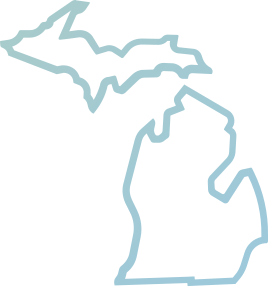
Location: 11 miles west of Mackinaw City, at the northern tip of the Lower Peninsula
Management: Wilderness State Park
Activities: Hiking, birding, swimming, cross-country skiing, hunting, fishing, outdoor education, and more!
Importance: The majority of the many miles of shoreline consist of wide sandy beaches with scattered cobble, backed by one of the best developed and most diverse forested dune and swale complexes in Michigan, with some spectacular wetland areas mixed throughout. The scattered cobble beach areas provide some of the best habitat in Michigan for the federally endangered piping plover. In fact, almost the entire shoreline of the proposed natural areas is designated as critical habitat for the piping plover.
The Great Lakes population of piping plovers was historically several hundred breeding pairs in size, but had declined to 17 breeding pairs by the time the species was listed as endangered by the federal government in 1986. Since then, the population has fluctuated between 12 and 50 breeding pairs with breeding areas largely confined to Michigan, and a large portion of those have been consistently at Wilderness State Park. During the 2002 nesting season, 16 of 52 active nests were at Wilderness.
Most of this area was cut-over prior to 1900, leaving only one small stand and scattered individual trees intact. Yet, the area has re-grown and now stands as it once did, providing its visitors an opportunity to experience a Michigan landscape as it occurred prior to European settlement. It supports fine populations of two Great Lakes endemic plant species - Pitcher's thistle and Houghton's goldenrod - and additional threatened plants - Lake Huron tansy, Pumpell's bromegrass, and butterwort. The proposed wilderness area encompasses the largest piece of contingent, undeveloped land in the Lower Peninsula of Michigan and offers outstanding opportunities for primitive recreation and solitude.