According to the North American Industrial Classification System (NAICS), the Utilities sector can be broken down into three subsectors: Electric power generation, transmission, and distribution; Natural gas distribution; and Water sewage and other systems. Three out of every four Utilities workers in Michigan are employed in the Electric power generation subsector. This subsector is also the largest provider of registered apprenticeships within the Utilities industry. This industry generates, transports, and delivers electricity to residential and commercial consumers across the state. Some of its work includes producing power from energy sources, operating the transmissions lines that deliver voltage, and managing distribution lines for local use.
Employment and Wages
In September 2025, the Electric power generation, transmission, and distribution industry employed 16,600 people in Michigan. This represented 0.4 percent of all private employment in the state, slightly higher than the national share of 0.3 percent. Over the 12 months preceding September 2025, the industry gained around 300 employees, an increase of 1.8 percent. The median hourly wage for this industry in 2024 was $51.75 in Michigan, which was well above the median wage for all occupations of $23.22. Michigan’s median wage was also 4.6 percent above the national median of $49.48 for this industry.
Number of Businesses
There were approximately 450 private establishments that were part of the Electric power generation, transmission, and distribution industry as of September 2025. There were 380 small establishments with fewer than 50 workers, employing around 2,300, or 13.7 percent of this industry’s workforce. Medium-sized establishments (defined as those with 50 to 499 workers) accounted for 60.2 percent of this industry’s employment, with roughly 70 establishments and employing approximately 10,000 employees. There were four large firms containing over 500 workers that employed 4,300 people, representing a 26.1 percent share in the industry.
Top Detailed Sectors with the Most Employees as of September 2025
• Electric power generation: 8,700 jobs
• Electric power transmission, control, and distribution: 7,900 jobs
Most Prevalent Occupations with the Most Workers in 2024
• Electrical power-line installers and repairers: 2,200 workers, median hourly wage: $54.87
• Electrical engineers: 1,110 workers, median hourly wage: $55.92
• Control and valve installers and repairers, except mechanical door: 1,110 workers, median hourly wage: $49.04
• Power plant operators: 1,010 workers, median hourly wage: $51.61
Industry Outlook
Although this article focuses on the Electric power generation, transmission, and distribution subsector, the projections for private employment in Michigan are drawn from the Utilities industry, where the Electric power generation sector accounts for roughly 83 percent of employment. Private employment in the Utilities sector is projected to lose 920 jobs from 2022 to 2032, a decrease of 4.3 percent. This translates to an average annual decline of 0.4 percent, lower than the overall statewide average growth rate of 0.1 percent. Long-term employment declines in the Electric power generation, transmission, and distribution industry have contributed to the sector’s current employment falling below projected employment levels.
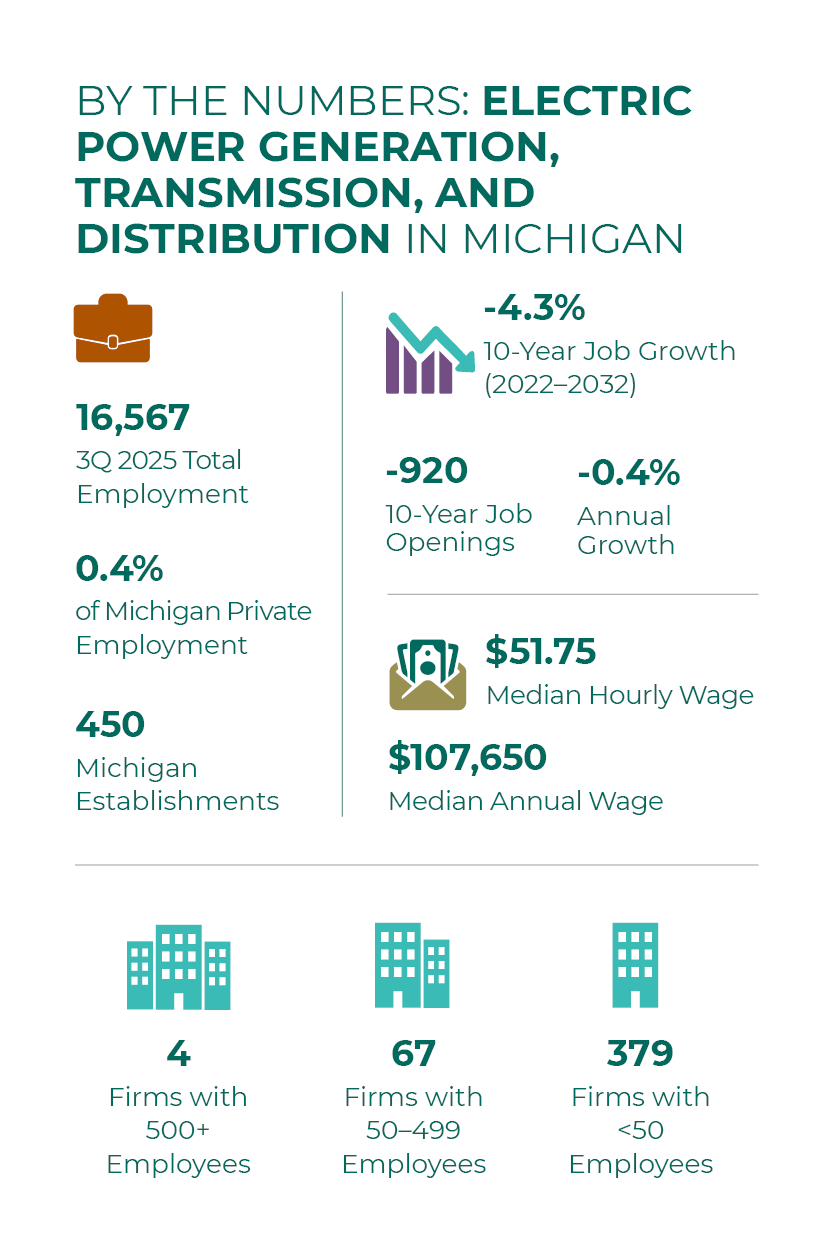
Source: 2022-2032 Michigan Long-Term Employment Projections, Michigan Center for Data and Analytics; Occupational Employment and Wage Statistics, U.S. Bureau of Labor Statistics; Quarterly Census of Employment and Wages, U.S. Bureau of Labor Statistics
View/Download Data Table