According to the U.S. Bureau of Labor Statistics, Economists conduct research, prepare reports, or formulate plans to address economic problems related to the production and distribution of goods and services or monetary and fiscal policy. They may collect and process economic and statistical data using sampling techniques and econometric methods. This occupation is mostly found in federal, state, and local government as well as scientific research and development services in the social sciences and humanities.
Employment and Wages
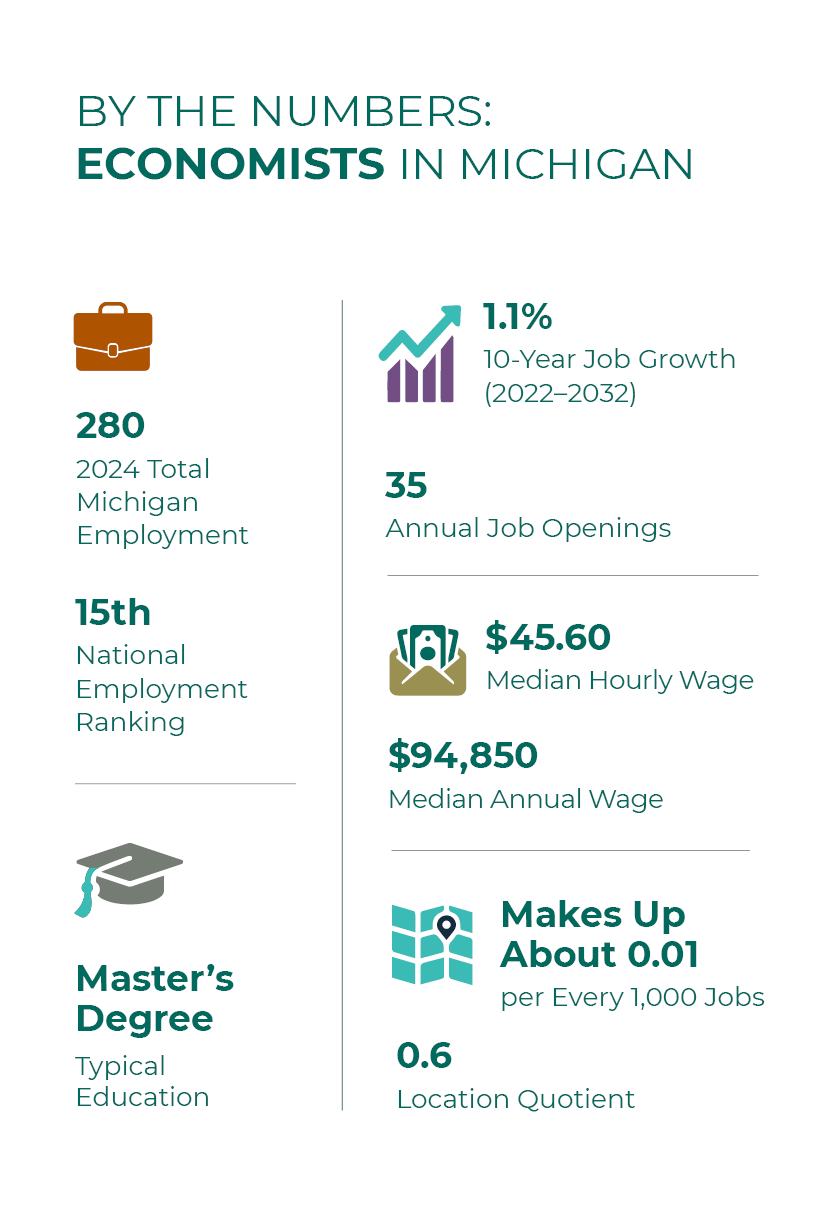
In 2024, there were 280 Economists in Michigan, compared to 15,880 nationally. This occupation accounted for around 0.01 percent of overall employment in Michigan and the U.S. The median hourly wage for this occupation in Michigan was $45.60 per hour in 2024. Nationally, the median hourly wage for Economists was higher at $55.50.
Common Job Titles
Examples of job titles encompassed by this position include:
- Economist
- Economic Advisor/Analyst/Consultant
- Research Economist
- Revenue Research Analyst
- Tax Economist
Some of the responsibilities of this occupation include:
- Studying economic and statistical data in area of specialization, such as finance, labor, or agriculture
- Compiling, analyzing, and reporting data to explain economic phenomena and forecast market trends, applying mathematical models and statistical techniques
- Studying the socioeconomic impacts of new public policies, such as proposed legislation, taxes, services, and regulations
- Explaining economic impact of policies to the public
- Reviewing documents written by others
Education and Skills
Over 73 percent of Economists have obtained a master’s degree or higher, which is the typical education requirement for entry-level positions, though some specialized positions may require additional credentials. Essential skills include critical thinking, mathematics, complex problem solving and systems evaluation. The technology requirements frequently listed in job postings are analytical or scientific software (SAS, MATLAB), business intelligence and data analysis software (Microsoft Power BI) and data base management system software (MySQL).
Most Related Occupations:
- Business Teachers, Postsecondary
- Economics Teachers, Postsecondary
- Environmental Economists
- Financial and Investment Analysts
- Political Scientists
Occupation Outlook
The long-term projected growth rate for Economists from 2022 to 2032 is 11.5 percent, which is much higher than Michigan’s projected 0.6 percent growth rate for all occupations. Economists are projected to have a total of 35 annual openings through 2032, mostly driven by the need to replace workers who transfer to different occupations or exit the labor force, such as to retire.