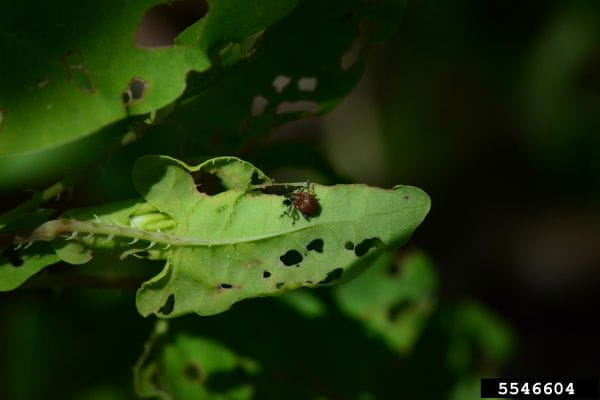
This summer, the Barry, Calhoun, Kalamazoo Cooperative Invasive Species Management Area will pilot the first release of the mile-a-minute weevil (Rhinoncomimus latipes) in Michigan as a biological control agent to reduce populations of invasive mile-a-minute weed in Calhoun County.
Biological control, or biocontrol, is an ecological and sustainable method of managing problematic plants or insects by using their natural enemies instead of pesticides. When biocontrol agents come from other countries, they are studied extensively in laboratory settings to ensure they don’t harm native or desirable species before the U.S. Department of Agriculture permits them to be released in monitored locations.
The Michigan Department of Agriculture and Rural Development issued the BCK CISMA a biocontrol permit to release the weevil, authorizing its introduction at specific sites under the oversight of qualified experts. Native to Japan, China, Korea, and Eastern Russia, this weevil reproduces exclusively on mile a minute weed—an invasive vine currently known only in a localized area in Calhoun County. Though this marks the first release in Michigan, the species has been used safely and effectively in the United States since 2004.
Four sites infested with mile-a-minute weed each will receive 1,000 adult weevils in a release planned for June 18. These locations will be monitored to measure the weevil’s ability to damage the invasive vine, to migrate to other areas of mile-a-minute weed infestation and to overwinter in Michigan.
What’s the problem?
The invasive mile-a-minute weed, Persicaria perfoliata, takes over forest and field edges essential to wildlife. It can invade agricultural sites such as hayfields, orchards, vineyards and Christmas tree farms.
“This highly invasive vine is on Michigan’s Watch List and is currently limited to Calhoun County in Michigan, making it crucial that we locate all occurrences and remove the plant,” said Katie Grzesiak, terrestrial invasive species coordinator for the Michigan Department of Natural Resources.
The mile-a-minute weed vine can be identified by bright green, triangular leaves and recurved barbs found on the underside of leaves and along its rounded stems. By mid-summer, clusters of round, pea-sized fruit are visible. Ranging in color from light green to purple, and finally metallic blue when ripe, each cluster is nestled in a circular leaf, called an ocrea. Seeds are black, BB-sized and can survive in the soil for six years. Seeds are spread by birds, water and human movement and may cling to boots and equipment.
What is being done?
Since the first detection of mile-a-minute weed in 2020, BCK CISMA has worked with private and public landowners to survey 34,000 acres. The BCK CISMA strike team assists landowners with treatment, covering around 480 infested acres across 119 sites. This work is funded by the Michigan Invasive Species Grant Program, which has allocated $390,750 since 2021 for mile-a-minute weed early detection and response efforts.
Of the 119 sites confirmed in Calhoun County, most are an acre or less, but a handful of sites have 10 to 100 acres of infestation. Small sites with a few plants are hand-pulled when found, while larger sites are treated with herbicide, following guidance from Pennsylvania State University Extension, where researchers have been working to curb mile-a-minute weed infestations present since the 1930s. Both postemergent herbicides that kill the plant on contact and pre-emergence herbicide, which targets sprouting seeds, are used.
“Mile-a-minute weed is an annual vine; it has to regrow each season, so preventing the plant from producing seed and depleting the seed bank is the path to successful management," said Sara Rahn, BCK CISMA coordinator.
How can the weevil help?
The mile-a-minute weevil, a tiny, black insect, was intentionally introduced into the United States in 2004 to assist in control of mile-a-minute weed in the northeastern United States. Adult weevils feed on the flower heads and leaves of mile-a-minute weed, while larvae bore into the stem to develop, killing small mile-a-minute plants and reducing seed production by adult plants.
Adults may feed on other plants in the Persicaria genus, but tests by the Animal and Plant Health Inspection Service during its initial evaluation showed that these weevils do not lay eggs or undergo larval development on any other plant species. The United States Department of Agriculture determined it safe for biocontrol within the United States in 2004.
“The introduction of this weevil will help slow the spread of mile-a-minute weed in large, infested sites while we aim to eradicate smaller infestations,” said April Savickas, BCK CISMA program specialist. “This will free up some time to survey new areas and contact more landowners in known infested areas.”
What’s next?
Landowner permission has been obtained to release the biocontrol weevils on four sites in Calhoun County with very large populations of mile-a-minute weed. These sites were selected to provide the best chance of the weevils assisting with invasive species management.
After release, BCK CISMA staff and researchers from Grand Valley State University will visit the four sites every two weeks for approximately one year to monitor plant damage, population size and spread from the release sites. This data will be used to determine if these weevils can overwinter and maintain population size for effective control in Michigan. BCK CISMA will continue to monitor the weevils after the study is complete, until the weevil population is depleted.
For more information about the mile-a-minute weed biocontrol project, contact Sara Rahn, BCK CISMA, at 269-908-4136.