Invasive red swamp crayfish have been found in southwest Michigan’s Cass County for the first time. Two crayfish carcasses were found in a private pond near the city of Niles by the SW x SW Corner Cooperative Invasive Species Management Area while conducting a snorkel survey for invasive aquatic plants in mid-September. Michigan Department of Natural Resources staff positively identified the specimens as invasive red swamp crayfish.
Though native to the southern U.S., red swamp crayfish have been prohibited in Michigan since 2014. They are considered invasive in the state because of their high reproductive rate and ability to aggressively outcompete native crayfish, amphibians, invertebrates and juvenile fish for food and habitat. They can be particularly destructive to aquatic plants, the loss of which can cause water quality and clarity issues. The crayfish’s destructive burrowing along shorelines can destabilize banks and infrastructure.
Populations of red swamp crayfish were first detected in Michigan in 2017, with discoveries in Sunset Lake in Kalamazoo and a retention pond in Novi. To date, isolated infestations have been confirmed in Kalamazoo, Livingston, Macomb, Oakland, Van Buren and Wayne counties. Infestations are believed to result from the release or escape of aquarium pets, live bait or live crayfish brought to Michigan for crawfish boils.
Report sightings
Anyone in the greater Niles area (Berrien and Cass counties) is asked to look for and report potential sightings of red swamp crayfish.
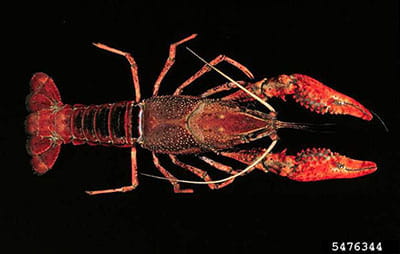
Look for large crayfish (2 to 6 inches in length), generally brown to red, with raised, often red bumps on the body and claws. The hourglass shape on the back of red swamp crayfish touches in the middle, and a dark triangle is visible on top of the tail. Note that red swamp crayfish in the pet trade can come in a variety of colors, including blue, orange and white.
If you suspect you have found a red swamp crayfish, if possible, collect the specimen, bag it and place it in the freezer. Otherwise, take one or more close-up photos focusing on the top, sides, underside and claws to aid in verification. Note the location, date and time of the observation. Report to Kathleen Quebedeaux, DNR Fisheries Division, QuebedeauxK@Michigan.gov or 734-780-5571.
Through the Michigan Invasive Species Program, the DNR, local CISMAs, Michigan State University, the U.S. Geological Survey, the Gun Lake Tribe and Auburn University have worked together to develop and deploy innovative trapping and treatment methods to limit red swamp crayfish populations and prevent their spread.
Because red swamp crayfish is a prohibited species in Michigan, it is illegal to knowingly possess, introduce, import, sell or offer the species for sale as a live organism. People can help prevent the spread of invasive species by knowing the laws, never releasing aquarium pets or plants into the wild, using bait only in the waters where it was captured and disposing of unused bait in the trash.
For more information on invasive red swamp crayfish, including identifying characteristics, visit Michigan.gov/Invasives.