Women in Michigan have increased their presence in the labor force since 1980. The labor force had around four women for every six men in 1980. By 2024, this ratio was near five women for every five men. Although it has happened over 44 years, women now represent nearly half of the labor force, approaching their statewide population share of 50.5 percent.
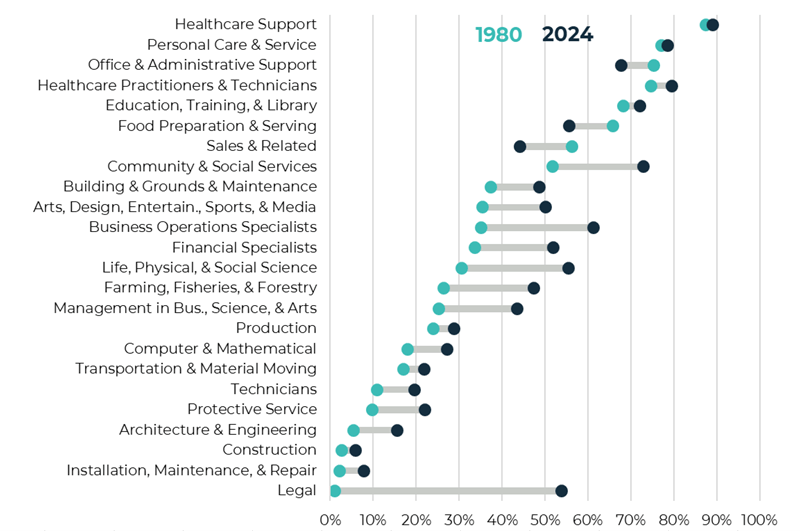
Between 1980 and 2024, women moved from minority to majority representation in several occupation groups: Legal; Business operations specialists; and Life, physical, and social science. At the same time, women’s employment shares declined notably in Sales and related; Food preparation and serving; and Office and administrative support. These shifts broadly indicate movement of women into more skilled roles but can also reflect the role of structural changes in the labor market, such as automation.
Women’s representation has grown remarkably in occupations they were previously underrepresented in, like Legal occupations.
Women’s Employment Shares in Occupational Groups in Michigan, 1980 and 2024
Source: One-Year Integrated Public Use Microdata Series, Current Population Survey, U.S. Census Bureau
View/Download Data Table
Women in Michigan working full-time continue to earn less than male counterparts.
In 2024, women working full-time, year-round, earned approximately 79 cents per dollar that men earned. This equated to roughly $13,700 less in annual earnings. The disparity is larger when including part-time workers, revealing a gap of nearly $14,900 per year for Michigan women, or 71 cents per dollar.
Median earnings for women who work full-time, year-round increased by 2.8 percent from $50,990 in 2023 to $52,390 in 2024. Comparable earnings for men in Michigan jumped by 5.9 percent to $66,130. This led to a slight widening in the gap among full-time earners from 82 cents on the dollar in 2023 to 79 cents in 2024. The gap in 2024 is comparable to that of 2021 (78 cents on the dollar).