Executive Summary
- The Census Bureau estimates that about half of Michigan’s counties (56.6 percent) grew from July 2024 to 2025 in the newest data release.
- Consistent with national trends, most Michigan counties (88.0 percent) had reduced international migration compared to the previous year.
- Net domestic gains were small but prevalent across northern Michigan counties.
- Seventy-one Michigan counties (85.5 percent) experienced natural decrease (more deaths than births) from 2024 to 2025.
- Natural decrease and reduced, low, or net negative migration place downward pressure on population growth in Michigan counties.
On March 26, the U.S. Census Bureau released new population estimates for counties. This release includes estimates of the population as of July 1, 2025, and is referred to as “Vintage 2025.” This release also includes revised annual estimates of the total population each year from 2020 to 2024, as well as revised components of change (births, deaths, and migration).
Michigan’s 83 counties had an average growth rate of 0.1 percent in this one-year period. Michigan’s counties can be compared to the nation and the four U.S. regions in the table below.
The average growth rate for Michigan counties was similar to the broader Midwest region.
Figure 1. Population Change for Counties in the United States, U.S. Regions, and Michigan, July 2024 to July 2025
| Region |
Number of Counties |
2024–25 Growing *Counties (%) |
2024–25 Average Percent Change |
| Northeast |
218 |
54.1% |
0.0% |
| Midwest |
1,055 |
55.7% |
0.1% |
| West |
449 |
59.0% |
0.2% |
| South |
1,422 |
62.7% |
0.4% |
| Michigan |
83 |
56.6% |
0.1% |
| All U.S. Counties and District of Columbia |
3,144 |
59.2% |
0.2% |
*Counties were not counted among growing counties when the numerical change was zero from July 2024 to July 2025.
Source: Vintage 2025, Population Estimates Program, U.S. Census Bureau
Michigan’s population grew by 27,922 from July 2024 to 2025. Approximately 72.1 percent of the state’s growth was concentrated in the five counties with the highest numeric gains from 2024 to 2025:
- Oakland (+5,788)
- Kent (+4,820)
- Macomb (+3,724)
- Wayne (+3,504)
- Ingham (+2,319)
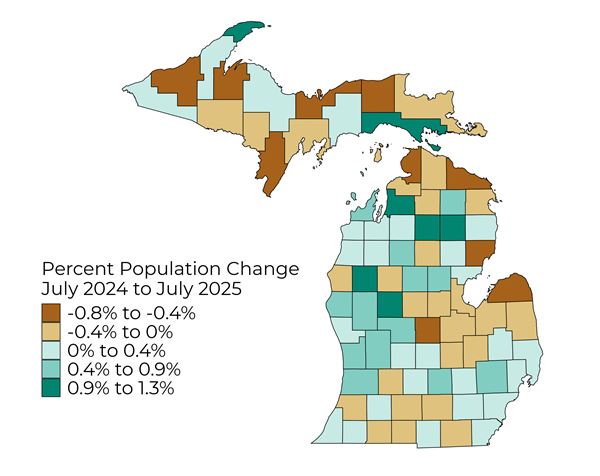
Northern Michigan counties grew at the fastest rate.
Figure 2. Percent Change in County Population, July 2024–July 2025
Source: Vintage 2025, Population Estimates Program, U.S. Census Bureau
View/Download Data Table
The five counties with the fastest growth rates between July 2024 and July 2025 were Lake, Mackinac, Oscoda, Antrim, and Keweenaw counties. The cumulative population gains are small for this group. Even when looking at change over a five-year period from July 2020 to 2025, this group only gained 3,372 people in total population.
At the national level, population growth slowed across the nation's counties when comparing change between the July 2023–July 2024 estimate and the July 2024–July 2025 estimate. Forty-nine Michigan counties (59.0 percent) experienced smaller numerical gains in the 2024-2025 estimate, flipped from growth to decline, or saw greater losses.
Consistent with national trends, most Michigan counties (88.0 percent) had reduced international migration compared to the previous year.
At the national level, reduced net international migration was a major contributor to the growth slowdown across U.S. counties. Reduced international migration also contributed to Michigan’s slowing growth from 2024 to 2025. Counties with high levels of international migration were among those most impacted in the newest release. For example, Wayne, Kent, Oakland, and Macomb counties experienced the greatest numerical growth slowdown between the 2024–2025 estimate and the previous year. These four counties absorbed 71.4 percent of the state’s total reduction in international migration from the previous year. When adding Washtenaw and Ingham counties to the group, these six counties absorbed 80.1 percent of the state’s total reduction in international migration.
It is important to note that the Congressional Budget Office estimates that net immigration to the U.S. declined in 2025. The July 1, 2024-June 30, 2025 estimate period in this release does not reflect changes to international migration patterns that occurred after June 30, 2025.
Net domestic gains were small but prevalent across northern Michigan counties.
Net domestic migration for counties is movement between states and other Michigan counties. The Census Bureau dataset in this release does not separate movement between Michigan counties from movement between states.
Sixty-two Michigan counties (74.7 percent) had net positive domestic migration from other states and Michigan counties from July 2024 to June 2025.
These five counties had the highest net numeric domestic gains from July 2024 to June 2025:
- Macomb (+1,680)
- Ottawa (+1,166)
- Muskegon (+731)
- St. Clair (+584)
- Allegan (+532)
Ottawa, Muskegon, and St. Clair counties have maintained net domestic gains from July 2020 to June 2025 as well. These three counties ranked in the top five domestic gains over that five-year period.
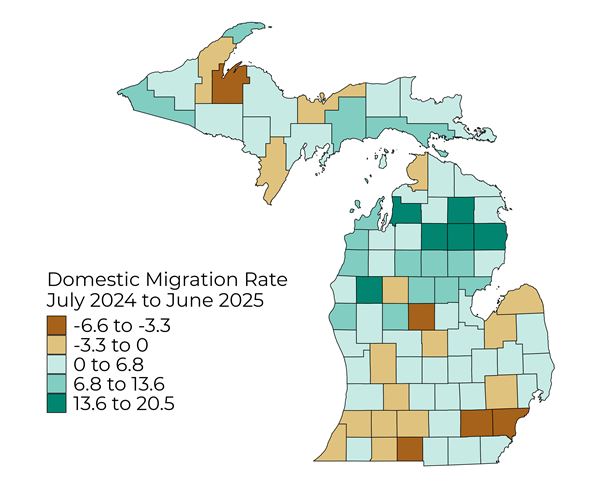
Counties in northern Michigan continued to experience net domestic gains at a high rate from July 2024 to June 2025.
Figure 3. Domestic Migration Rate for Michigan Counties, July 2024–June 2025
Source: Vintage 2025, Population Estimates Program, U.S. Census Bureau
View/Download Data Table
Lake, Montmorency, Antrim, Oscoda, and Crawford ranked in the top five for domestic migration in 2025. The cumulative net domestic gains (+1,188) were small for this group over the one-year period. However, they have also sustained their high domestic migration rate over the longer five-year period from July 2020 to 2025.
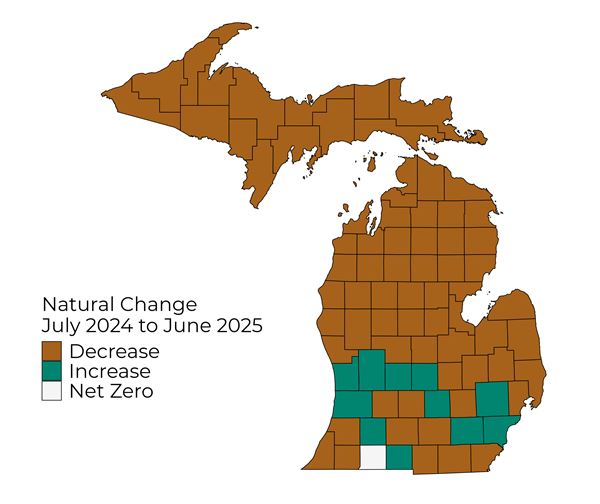
Seventy-one Michigan counties (85.5 percent) had more deaths than births (natural decrease) from 2024 to 2025.
Natural decrease is widespread throughout the state.
Figure 4. Natural Change in Michigan Counties, July 2024–June 2025
Source: Vintage 2025, Population Estimates Program, U.S. Census Bureau
View/Download Data Table
Like migration, births and deaths are represented in “estimates years,” which cover July 1 in the preceding year to June 30 in the following year.
There were only 11 Michigan counties that experienced natural increase (more births than deaths) from 2024 to 2025: Kent, Wayne, Oakland, Ottawa, Washtenaw, Ingham, Branch, Kalamazoo, Ionia, Allegan, and Clinton. St. Joseph County was estimated to have an equal number of births and deaths (i.e., “net zero” natural change).
Seventy-nine Michigan counties (95.2 percent) had more deaths in the most recent estimate (July 2024 to June 2025) than the previous year. Most counties experienced minimal change in the number of births in the most recent estimate than the previous year.
Natural decrease and reduced, low, or net negative migration place downward pressure on population growth in Michigan counties.
Despite slowing international migration the past two years, the Census Bureau migration estimates for Michigan are higher in the 2020s relative to previous decades. The Census Bureau also estimates that net domestic migration has improved for many Michigan counties, such as rural counties, in the 2020s.
However, net domestic gains are typically small. The small net gains paired with natural decrease explain why only 47 Michigan counties (56.6 percent) experienced growth in their total population from 2024 to 2025. Deaths will continue to increase as a large birth cohort, the baby boomers, age into high-mortality years. Increasing deaths and decreasing births are long-term historical patterns and are consistent with national trends. Consistent and higher levels of migration would be required to offset this steepening natural decrease.
The Census Bureau dataset used in this release does not distinguish between domestic migration from other Michigan counties and domestic migration from other states. However, it is important to monitor these trends to determine how much county migration is simply an internal reshuffling of the state’s population versus net gains from other states. It is also important to examine migration trends by age. For example, this will help determine whether counties in northern Michigan are experiencing domestic gains from baby boomer retirement migration versus domestic gains from working- and family-age adults.
Population estimates are revised every year as the Census Bureau updates its data and methodology.
The Census Bureau refines the data inputs and methods that it uses for its population estimates every year. This can result in revisions to estimates in prior years. The Census Bureau presented methods changes to the Vintage 2025 release on January 20, 2026. This presentation provides a full summary of changes to the population components of change (births, deaths, and migration) in Vintage 2025.
The Census Bureau’s revisions to international migration estimates have been substantial between this newest vintage release and last year’s vintage release. Among Michigan counties, the most substantial revision to international migration occurred in Oakland County’s international migration estimate for 2024. Oakland County’s international estimate for 2024 was revised downward from 18,153 in last year’s vintage release to 11,274 in this newest vintage release. This represents a downward revision of 6,879 (-37.9 percent) for Oakland County’s 2024 international migration estimate.
The Census Bureau’s most substantial revision to domestic migration occurred in Ottawa County’s domestic migration estimate for 2023. Ottawa County’s domestic estimate for 2023 was revised upward from 1,340 in last year’s vintage release to 1,539 in this newest vintage release. This represents an upward revision of 199 (14.9 percent) for Ottawa County’s 2023 domestic migration estimate.
Migration is the most challenging population component to estimate. Comparing trends across datasets can help determine if those trends are consistent. Since many counties population trajectories (up or down) are sensitive to migration, it will be important to monitor changes to migration estimates in upcoming data releases.