LANSING, MI – More than a decade ago, Michigan took a bold step in recognizing the sacrifices and aspirations of its citizen-soldiers. On July 1, 2014, then-Governor Rick Snyder signed into law Public Act 259, officially establishing the Michigan National Guard State Tuition Assistance Program — better known as MINGSTAP. This initiative was a game-changer, offering tuition assistance to members of the Michigan National Guard pursuing higher education or vocational training at in-state institutions. Since its inception, MINGSTAP has quietly but powerfully transformed lives. For over 11 years, it has empowered thousands of Guard members to reach personal and professional milestones, helping them move seamlessly from military service to meaningful careers.
But in 2023, the program took another important leap forward. On May 20, Governor Gretchen Whitmer signed Public Act 33 into law, amending the original legislation to extend MINGSTAP benefits to the dependents of Guard members. It was a move that many saw as long overdue — a recognition that service to country often involves the entire family. “This signals Michigan is serious about supporting military families who have made significant sacrifices on behalf of our state and nation,” said U.S. Army Maj. Gen. Paul D. Rogers, adjutant general and director of the Michigan Department of Military and Veterans Affairs.
The numbers speak volumes. To date, over 7,000 service members and approximately 400 family members have benefited from MINGSTAP. While these numbers look great on paper, they also represent real opportunities: a daughter attending her first year of college debt-free, a spouse gaining technical skills for a new career, a Guardsman finishing a degree and getting promoted.
In a time when the cost of education continues to rise, MINGSTAP stands out as a practical and heartfelt investment in the people who serve and those who stand beside them. Michigan has made it clear that the state values its military families, not just in words, but in action.
“MINGSTAP has been an amazing tool for our airmen and their families,” said Master Sergeant Sarah Descamps of the Michigan Air National Guard’s 110th Wing. “It offers a unique opportunity for Airmen to go to continue their civilian education supporting both their civilian and military careers.”
Throughout her career Master Sgt. Descamps has seen the positive effects that MINGSTAP has had on retention, with the addition of support for family members she noted that retention rates in Airmen with spouses and children have increased.
In September of this year, the Michigan Legislature introduced several bills to adjust MINGSTAP funding. Signed into law in December, Public Act 31 of 2025 created the Michigan National Guard Member Benefit Fund that continues MINGSTAP funding and provides funding for childcare assistance and TRICARE premium reimbursements for eligible Michigan National Guard service members. Under this new law the Michigan Department of Military and Veterans Affairs has established the Michigan Member Benefits Program to oversee all three programs. More information about the program; including eligibility requirements, restrictions, and application processes, can be found online at Michigan Member Benefits Program.
“I’m incredibly proud to see our elected representatives identify and support the evolving needs of our service members as they continue to serve our state and nation,” said Maj. Gen. Rogers. “MINGSTAP has helped numerous service members and their families achieve educational and career goals while continuing to serve and it is my hope that these new programs for childcare and healthcare will have that same effect.”
Childcare Assistance Program
To be eligible for the Childcare Assistance Program, the service member must have a dependent child 12 and under; be a single Soldier or Airman or a dual-military family and simultaneously drilling; and provide documentation that they have completed Advanced Individual or Technical Training. Title 10 or Title 32 AGR service members are not eligible for childcare assistance. This stipend will pay $60 per day, per dependent for weekend drills and annual training, up to a maximum of 39 days each year. For dual military drilling at the same drill period, only one member may submit for assistance. Service members with children enrolled in the Exceptional Family Member Program (EFMB) may submit an exception to the policy (ETP) waiving the age criteria.
Childcare concerns are one of the biggest issues raised by members of the MING as most childcare centers aren’t open over weekends, and if they are, rates are higher than normal. Relying on family and friends can be a challenge as well. First Lieutenant Molly Gonzalez of Headquarters and Headquarters Company, 3rd Battalion, 126th Infantry Regiment relies on a nanny to care for her one-year-old son Dallas during drill and annual training.
“I don’t have family close by, and my childcare center isn’t open on the weekends and doesn’t provide overnight care,” 1st Lt. Gonzalez said. “Luckily, I’m able to hire a nanny to watch Dallas when I’m away for training. This past year I spent around $3,000 for this alone.”
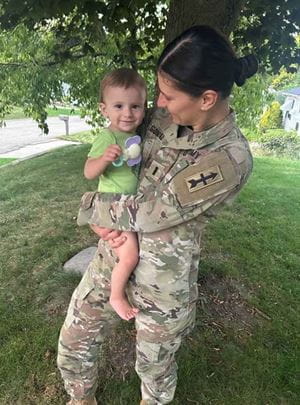
First Lieutenant Molly Gonzalez of Headquarters and Headquarters Company, 3rd Battalion, 126th Infantry Regiment
Unfortunately, for many service members spending $3,000 or more a year on childcare to attend training isn’t possible. Both Master Sgt. Descamps and 1st Lt. Gonzalez have had subordinates tell them that they’re choosing to end their service because of the challenges and costs associated with childcare.
TRICARE Premium Reimbursement Program
To qualify for the TRICARE Premium Reimbursement Program, the service member must be uninsured; the service member’s employer does not provide insurance; in traditional (non-full time) Michigan National Guard status; enrolled in and has paid for TRICARE coverage; not eligible for enrollment in employer-sponsored medical insurance through their own civilian employer; not eligible for enrollment in a spouse’s medical insurance program; not eligible to be enrolled on a parent’s health plan (for example, because they are age 26 or older on the first day of the month, or the parent’s plan does not offer dependent coverage, or the service member does not meet the plan’s dependent eligibility criteria); not enrolled in any other medical coverage that would duplicate the program’s benefits; has completed Advanced Individual or Technical Training; and are not eligible for Medicaid. This bridging program provides a reimbursement of up to the service member’s monthly member-only portion TRICARE premium for TRICARE Reserve Select Member only and TRICARE Dental member-only, for eligible Michigan National Guard traditional (M Day/DSG drill status) service members enrolled in member-only TRICARE coverage. Family coverage is not reimbursable. Reimbursements are paid only to the service member. The current cost for TRICARE Reserve Select Member only is $57.88 monthly and $8.65 monthly for TRICARE Dental.will cover the members’ portion of their TRICARE Reserve Select and/or TRICARE Dental program premiums. Uninsured or underinsured service members within the Michigan National Guard raise a concern for unit readiness when called upon to deploy. To deploy, a service member must meet certain medical readiness standards as established by the U.S. Army or U.S. Air Force and unlike their active-duty counterparts, members of the National Guard do not have access to military treatment facilities. By covering the TRICARE premium costs, the State of Michigan is ensuring that our Soldiers and Airmen can receive both routine and emergency medical care.
“Having our State Legislature recognize that the costs of childcare and health insurance are an issue for the Guard and work to fix it is encouraging,” Master Sgt. Descamps said.
As the program continues to grow, the Michigan Member Benefits Program remains a model for how states can tangibly support those who protect and serve. With continued support and strong leadership, the future looks promising —not just for today’s service members, but for the next generation as well.