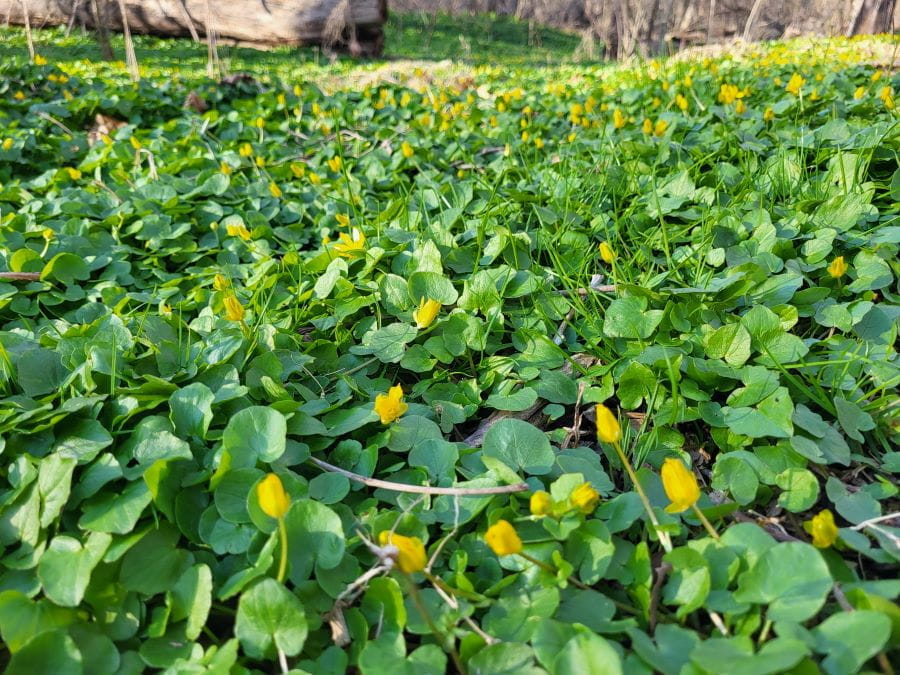
Lesser celandine (Ficaria verna), sometimes known as fig buttercup, is a short, perennial plant that is spreading in the Midwest. It is a watch list species in Michigan, meaning it has a limited known distribution in the state. It has shiny, dark green, heart-shaped leaves and small, bright yellow flowers. Natural resource professionals are asking for your help to prevent the spread of this invasive plant and protect our landscapes.
Lesser celandine is a spring ephemeral, meaning it emerges in early spring (March - April), then dies back when our native deciduous trees start to leaf out.
“There is only a short window of time when lesser celandine has emerged and is identifiable, so it’s critical to be on the lookout for this plant now” advises Michelle Beloskur, Director of the Midwest Invasive Plant Network.
Why be concerned?
Lesser celandine thrives in moist, lowland environments including forest floors, riverbanks and floodplains. It is also hardy enough to spread into lawns and other upland areas. Its early emergence allows it to expand as a groundcover and outcompete native spring wildflowers such as mayapple, spring beauty, dutchman’s breeches and trout lily. Over time, it forms dense carpets, greatly reducing the biodiversity and quality of natural areas. It is actively spreading in Lower Michigan and southeastern Wisconsin and is starting to make headway in parts of northern Wisconsin and southern Minnesota.
What's being done?
Several initiatives are underway to increase awareness of lesser celandine, monitor for new introductions and develop best practices for controlling its spread.
In Michigan, the Eyes on the Forest Priority Plant Patrol is training community scientist volunteers to monitor and report lesser celandine. In addition, several partner organizations have come together to form the Michigan Lesser Celandine Coalition. The Coalition is educating the public and recruiting volunteers to assess the spread of lesser celandine, particularly along the Grand River corridor, where the plant is already widely established. The Coalition is working closely with the Michigan Department of Natural Resources to develop best management practices for control.
Elsewhere in Michigan, lesser celandine’s populations are largely unknown. The Michigan Invasive Species Program is working to better understand where this plant is – and is not. This information can help managers prioritize work and protect sensitive ecosystems.
You can help!
“At this point, the information we have indicates that lesser celandine is mostly concentrated in mid-Michigan, but the plant’s short growing season means we can’t be sure,” said Katie Grzesiak, terrestrial invasive species coordinator for the Michigan DNR. “Reports from people who are out in the spring, particularly in the Upper Peninsula, northern Lower Peninsula, and outside of the Grand River corridor are critical to understanding this plant’s range.”
A variety of resources can help you learn to identify lesser celandine. In Michigan, the Priority Plant Patrol and Michigan Invasive Species Program encourage reports via the Midwest Invasive Species Information Network.
For information on common look-alike plants, visit MISP's lesser celandine webpage.
You can also contact Julie Crick, Michigan State University Extension Natural Resource Educator at (989) 275-7179. To learn more about the known distribution of lesser celandine and other watch list species in Michigan, use the Watch List Viewer.
Everyone can help prevent the spread of invasive plants like lesser celandine. When heading outdoors, “Play, Clean, Go,” by cleaning footwear, pets and recreational equipment before entering and leaving natural areas. Stay on designated walking paths. At home, avoid planting, moving or composting invasive plants.
In Wisconsin, lesser celandine has three main hot spots. These are mostly confined to urban areas in the southern portion of the state. In conjunction with partners and private landowners, management is taking place on most of the known populations to prevent further establishment and spread. In Minnesota, there are three sites known to have lesser celandine. The managers of each site are actively monitoring, managing and treating these plants with the goal of containment and eventual eradication.
Michigan's Invasive Species Program is cooperatively implemented by the Department of Environment, Great Lakes, and Energy; the Department of Natural Resources; and the Department of Agriculture and Rural Development.