The web Browser you are currently using is unsupported, and some features of this site may not work as intended. Please update to a modern browser such as Chrome, Firefox or Edge to experience all features Michigan.gov has to offer.
State Facts and Symbols
Facts About Michigan
State Name: Michigan
Name Origin: Derived from the native American word Michigama, meaning great or large lake.
Nickname: Wolverine State
Statehood: Jan. 26, 1837 (26th)
Capital: Lansing, since 1847; prior to that, Detroit. The Michigan State Capitol in Lansing opened Jan. 1, 1879, to great acclaim. Designed by architect Elijah E. Myers, Michigan’s Capitol holds a special place in American history as one of the first state capitols to be topped by a lofty cast iron dome. It was designated a National Historic Landmark in 1992.
State Motto: Si quaeris peninsulam amoenam circumspice, which translates, "If you seek a pleasant peninsula, look about you."
Population: According to U.S. Census Bureau 2020 State Population Estimates, the population of Michigan is 10,077,331. Michigan is the 10th most populous state in the nation.
Michigan's Great Seal and Coat of Arms
-
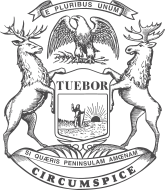
The Great Seal of Michigan
Great Seal
Michigan's Great Seal was designed by Lewis Cass, Michigan's second (non-acting) territorial governor. The seal was patterned after the seal of the Hudson Bay Fur Company. It was presented to the Constitutional Convention of 1835 and adopted June 2, 1835, as the official Great Seal of Michigan. The use of the Great Seal is regulated at some length by state law. -
Michigan Coat of Arms
Coat of Arms
The Michigan Coat of Arms was adopted at the Constitutional Convention of 1835. Michigan’s current coat of arms was adopted by the Legislature in 1911 and features the same imagery as the center of the Great Seal. Use of the coat of arms is less regulated than the use of the Great Seal.
Michigan's Flag
State Facts and Symbols
-
Photo of a Robin, the state bird.
State Bird
In 1931, the AMERICAN ROBIN (Turdus migratorius) was chosen the state bird. It had been favored by the Michigan Audubon Society. Sponsors called the robin “the bestknown and best-loved of all the birds in the state of Michigan.” -
Photo of a Brook Trout on a log.
State Fish
In 1965, the TROUT was designated as the state fish. In 1988, the Michigan Legislature specified the BROOK TROUT (Salvelinus fontinalis) as the state fish. The brook trout is native to Michigan and found throughout the state. -
Photo of state flower.
State Flower
In 1897, the SWEET CRABAPPLE (Malus coronaria, formerly Pyrus coronaria) was designated the state flower. Sponsors noted it was “one of the most fragrant and beautiful flowered species of apple.” It is native to the state. -
Photo of Mastadon bones at the Michigan History Center.
State Fossil
In 2002, the MASTODON (Mammut americanum) became the state fossil. Fossils of the prehistoric mammal have been found in more than 250 locations in the state. -
Photo of white tail deer in a field.
State Game Mammal
In 1997, the WHITE-TAILED DEER (Odocoileus virginianus) was designated the state game mammal after the successful lobbying efforts of a group of Zeeland fourth graders. Found in every Michigan county, the white-tailed deer is an important natural and economic resource. -
State Gem
State Gem
In 1972, CHLORASTROLITE (literally “green star stone”) was adopted as the state gem. Known as the Isle Royale greenstone, Chlorastrolite ranges in color from yellowgreen to almost black. It is primarily found in the Upper Peninsula. -
Seeding wild rice, part of the Wild Rice Initiative restoration outreach and education efforts at the 2019 Wild Rice Camp, Alberta, MI. Photo credit: Todd Marsee, Michigan Sea Grant.
State Native Grain
In 2023, Manoomin (Zizania palustris and Zizania aquatica), also known as Michigan wild rice, was designated as the official native grain of Michigan. Manoomin is a sacred and important component to many wetlands and a cultural significance to the indigenous people of the state. -
Photo of a painted turtle, the state reptile.
State Reptile
In 1995, the PAINTED TURTLE (Chysemys picta) was chosen as the state reptile after a group of Niles fifth graders discovered that Michigan did not have a state reptile. -
Photo of state sand.
State Soil
In 1990, KALKASKA SAND was chosen as the state soil. First identified as a soil type in 1927, Kalkaska sand ranges in color from black to yellowish brown. It is one of more than 500 soils found in the state. Unique to Michigan, Kalkaska sand covers nearly a million acres in 29 Upper and Lower Peninsula counties. -
Photo of a Petoskey Stone, courtesy of Petoskey Area Visitors Bureau.
State Stone
In 1965, the PETOSKEY STONE (Hexagonaria percarinata) was adopted as the state stone. The Petoskey stone is fossilized coral that existed in the northern Lower Peninsula about 350 million years ago. -
Photo of Eastern White Pine. Close up of needle and cone.
State Tree
In 1955, the towering WHITE PINE (Pinus strobus) was designated the state tree. It was chosen as a symbol of one of Michigan’s greatest industries. From 1870 to the early 1900s, Michigan led the nation in lumber production. -
Photo of Dwarf lake iris. Iris lacustris has a sky blue to deep blue to violet flower. The spreading sepals have a white signal bordered by a deep purple color. The inflorescence is one- to rarely two-flowered. The stiff upright leaves arise from narrow, creeping rhizomes that have an enlarged terminus with fibrous roots.
State Wildflower
In 1998, the DWARF LAKE IRIS (Iris lacustris) was designated as the state wildflower. Native to the state, the endangered flower grows along the northern shorelines of Lakes Michigan and Huron.