Gov. Whitmer Signs Education Budget to Help Every Kid Read, Eat, and Succeed
In addition to Education Budget, Governor Whitmer signs five bills to support literacy, expand child care, and provide more funding to kids with more needs
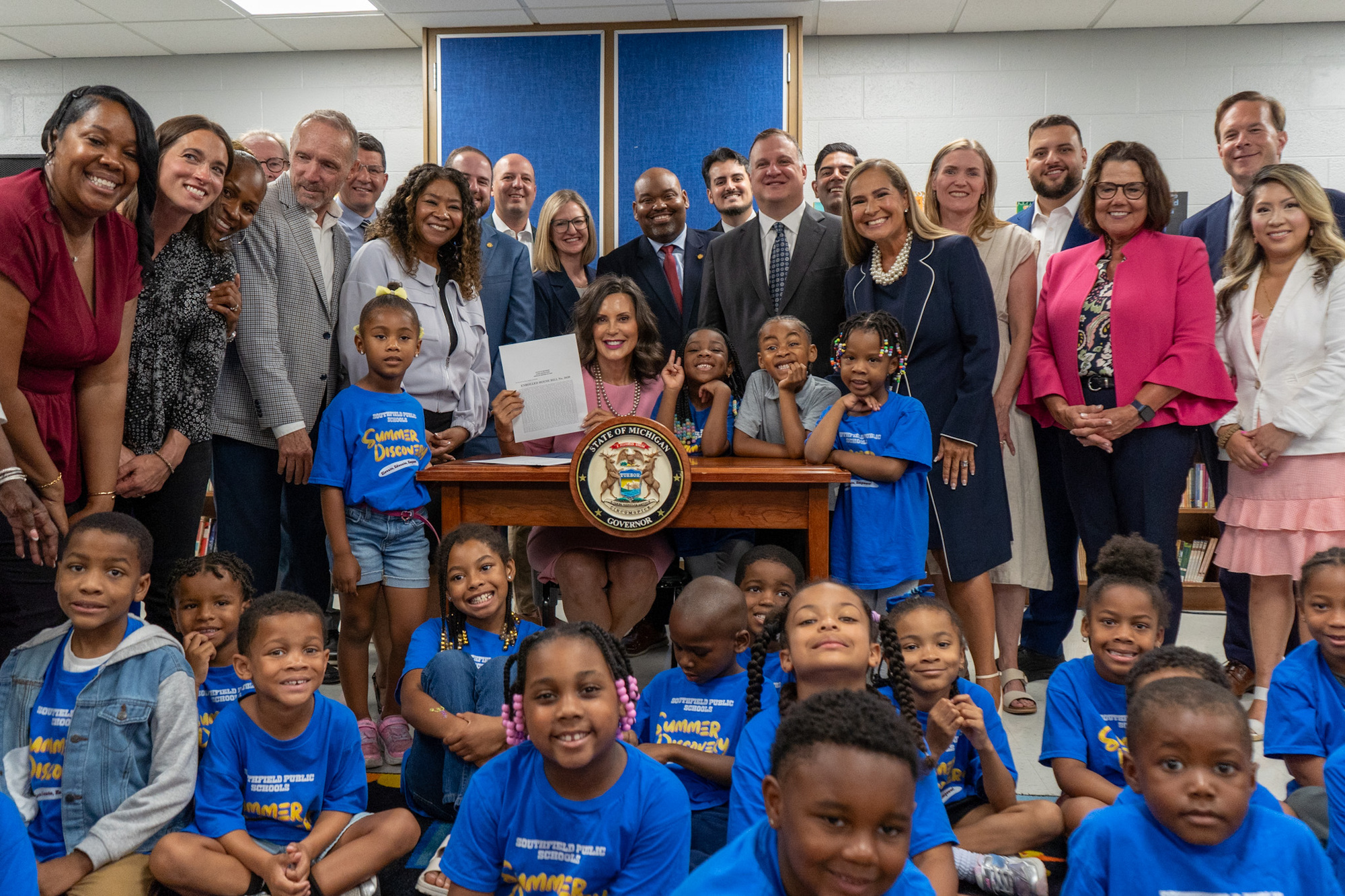
DETROIT, Mich. — Today, Governor Whitmer signed her eighth and final education budget into law. The balanced, bipartisan fiscal year 2027 (FY27) school aid budget delivers a historic investment in student literacy, with $502 million allocated toward literacy curriculum, literacy training for teachers, before- and after-school programs, literacy coaches, high impact tutoring, and more. It fulfills a key promise of the governor’s 2026 State of the State address. This budget also makes historic investments in public schools, free school meals, free pre-K for all, free community college, and lowers the cost of earning a skill certificate or college degree. The governor also signed five bills to train teachers, expand access to child care, and direct more resources to kids who need them most.
“This education budget will help every Michigan student succeed, from pre-K to postsecondary and beyond,” said Gov. Gretchen Whitmer. “This year, we’re making historic investments in early starts, proven methods, and extra help for our students so that Every Child Reads. I’m proud to sign this education budget which will invest in our educators, continue free school meals for all 1.4 million public school students, and deliver on the literacy plan laid out in my State of the State Address earlier this year. I’m also excited to sign policy bills that will train every reading teacher in the right methods and direct more resources to kids who need them most. Together, we’re building on the progress we’ve already made to close the school funding gap, expand college affordability and skills training, and support students with greater needs. Together, we’re investing in our students and preparing them for success.”
“The state school aid budget and Science of Reading legislation signed today by Governor Gretchen Whitmer put Students First,” said State Superintendent Dr. Glenn Maleyko. “The significant literacy investments, along with the many other education priorities included in this budget, demonstrate what we can accomplish when we work together in a bipartisan fashion. I am excited that we are making literacy achievement Michigan’s top education priority because we must ensure that Every Child Reads and that all Michigan students are prepared for success in school and in life. The budget also continues funding for every public-school student to receive free breakfast and lunch. It invests in our ongoing efforts to address the teacher shortage so that students are taught by highly qualified, certified educators. It increases support for students with the greatest needs, including children who are economically disadvantaged, English learners, and students with disabilities. It also supports Career and Technical Education, rural and isolated school districts, student transportation, and dual enrollment opportunities that expand access to college and careers. I thank Governor Whitmer and our legislative partners for working together to put Students First.”
“At a time when our politics too often reward division instead of solutions, today proves we can still come together to do what's right for our kids. This budget makes meaningful investments in Michigan's future by putting students at the center of school funding,” said state Senator Darrin Camilleri (D-Trenton), a former educator and Chair of the Senate PreK-12 Appropriations Subcommittee. “Senate Bill 903 finally moves Michigan to a weighted funding formula that directs more resources to the students and schools that need them most, while this budget also delivers record per-pupil funding, $150 million for educator bonuses, and greater funding stability for school districts. These investments build on our commitment to universal free school meals and continue our work to ensure every child, in every community, has the opportunity to succeed. Our work isn't finished, but today we've taken another important step toward building the education system our children deserve.”
“In 2023, Democrats gained the first Senate Majority in over forty years. Since then, Michigan’s education budgets have finally been led by former teachers who understand firsthand what our students, educators, and schools need to thrive — and this year’s budget is no different,” said Senate Majority Leader Winnie Brinks (D-Grand Rapids). “With another year of free school meals, a record per-pupil increase, more funding for literacy resources, educator bonuses, and a more equitable funding formula that supports the students that need it most — this bipartisan education budget invests in the future of our kids, our communities, and our entire state.”
This budget delivers historic investments in student literacy through the Every Child Reads plan, a promise made in Governor Whitmer’s 2026 State of the State address. Investments target literacy at multiple levels, through early starts, proven methods, and extra help. The budget includes:
- Early starts ($129.1 million)
- $96.1 million to continue free Pre-K for All, through the Great Start Readiness program, saving families $14,000 per year.
- $30 million to expand and support the early educator workforce, ensuring quality instruction begins at a young age.
- Proven methods ($146.1 million)
- $123.1 million to train teachers in the science of reading
- $75 million for every reading teacher to complete Language Essentials for Teachers of Reading and Spelling (LETRS), which trains educators in the “science of reading”—including strategies like phonics.
- $10.5 million to expand access to literacy coaches – a 4-fold increase since the Governor took office.
- $7.6 million to support Literacy Essentials as well as comprehensive professional learning about the science of reading for educators at all grade levels.
- $53 million to adopt proven, research-based strategies
- $50 million for incentives to districts to adopt science of reading-aligned curriculum and ensure teachers have tools to implement proven practices in their classrooms.
- $3 million for research and program evaluation activities supporting statewide literacy initiatives.
- Extra help ($195.6 million)
- $50 million for high-impact tutoring to provide students that need extra help with individualized, structured, evidence-based interventions, helping them catch up.
- $135 million to support students and parents with expanded before school, afterschool, and summer programming.
- $9.6 million to support adult education and ensure all Michiganders have the fundamentals they need to thrive and get good paying jobs.
- $1 million for specialized investments to support students with dyslexia.
House Bill 5697, sponsored by State Representative Nancy DeBoer, and House Bill 5646, sponsored by State Representative Tim Kelly, requires elementary teachers to complete intensive training in the science of reading, including phonics. Nearly 7,200 educators have already completed LETRS training and more than 5,700 are enrolled now. This professional learning will help bring proven methods of teaching reading to all Michigan classrooms.
"I’m proud to have participated in another historic education budget and particularly thrilled with the energy around literacy.” said state Rep. Tim Kelly (R-Frankenmuth), “We have provided a no excuses pathway to exponentially raise reading proficiency, and that’s great for Michigan."
“Today, we celebrate for the students of Michigan!” said state Rep. Nancy DeBoer (R-Holland). “Learning to Read will unlock their futures. We have come together to support our families, our dedicated educators, and our innovative business community. Michigan is worth it!”
The FY27 budget makes record investments in K-12 education, supporting students, educators, and parents to ensure that every student has the resources and opportunities they need to succeed. Investments include:
- $200 million to continue free school meals for all 1.4 million public school students, saving families around $1,000 per year, per child, and valuable time every morning.
- $325 million for a 2.5% increase in base per-pupil funding—an additional $250 per student, for a total of $10,300 per pupil. The per-pupil funding represents a 31% increase since the Governor took office. These funds are invested into every student, in every school, to lower class sizes, buy new textbooks, and install the latest equipment in classrooms and science labs.
- $278 million, to provide a 20% increase in funding to support academically at-risk students and English language learners, and a 10% increase in funding to support career and technical education students, as well as students in rural school districts. This budget moves to a true weighted foundation allowance formula that recognizes that higher-needs students require more resources.
- $150 million to continue educator bonuses and supports for teachers and educators across Michigan.
- $107 million to support the MI Future Educator Fellowship Program, teacher stipends, and Grow Your Own mentoring programs—all aimed to help attract, recruit, and retain high-quality educators.
- $321 million to support student wellness through mental health and safety grants to districts. This represents a twelvefold increase in mental health and safety funding since the Governor took office.
- $125 million to reimburse districts with exorbitant transportation costs, allowing them to devote more resources to the classroom.
- $123 million to continue expanded support for special education students.
- $40 million to reimburse eligible districts for dual enrollment costs, incentivizing districts to encourage more students to pursue college credit while still in high school.
Senate Bill 903, sponsored by state Senator Darrin Camilleri (D-Trenton), provides and codifies requirements for districts to receive weighted funding, a student-centered approach that allocates resources based on student need with a focus of improving outcomes in the classroom.
Senate Bill 989, sponsored by state Senator Dayna Polehanki (D-Livonia), modifies the interim teaching certification process to expand pathways for individuals training to become special education teachers. This will make training more accessible and help districts recruit and retain more special education teachers.
“Michigan is facing an education crisis, and we can’t afford to leave any student behind,” said state Sen. Dayna Polehanki (D-Livonia), a former educator and Chair of the Senate Education Committee. “My bill will help guarantee that every student, including those receiving special education services, gets the support they need while strengthening our teacher workforce and ensuring our schools have the qualified educators every child deserves.”
Preschool to Postsecondary
This budget supports education efforts outside of K-12 classrooms by investing in both early learning opportunities and postsecondary degrees and training, making sure every Michigan student has the resources they need beyond the classroom. The FY27 budget includes:
- $30 million to support early learning partnerships, ensuring students and families access to high-quality early learning and updated GSRP programs statewide.
- $5 million ongoing deposit into a new childcare fund to help more families access childcare.
- $2.4 million increase for Early On services, bringing total funding to $26.1 million, an over five-fold increase since the Governor took office. Early On is Michigan’s system that connects families of infants and toddlers from birth to age three who have, or are at risk for, developmental delays or disabilities with coordinated social, health, and educational services to support early development.
- $2.2 billion to sustain university and community college operations—advancing Michigan’s Sixty by 30 goal of having 60% of working adults with a degree or skills certificate by 2030.
- $532 million, and more than $1.7 billion to date, for the Michigan Achievement Scholarship, which provides a tuition free pathway for full-time community college students through the Community College Guarantee, and up to $27,500 for full-time students at public or private 4-year universities. Since Governor Whitmer took office, state scholarship investment has increased by 512%. Last school year, nearly 90,000 students from all 83 counties received a Michigan Achievement Scholarship.
- $25 million to support expanding Michigan Reconnect to adult learners ages 21 and older, giving adult learners a tuition-free pathway to earn an associate degree or skills certificate. More than 66,500 students have enrolled in community college with Michigan Reconnect since it was created in 2021.
Tri-Share Child Care Program
House Bill 6043, sponsored by State Representative Greg VanWoerkom, codifies the Michigan Tri-Share Child Care Program into law and expands its use across the state. MI Tri-Share splits the cost of an employee’s licensed child care equally among the employer, the employee, and the state, making child care more affordable for working families and helping businesses retain employees.
“A few years ago, I was proud to establish the MI Tri-Share Child Care Program to help working families afford childcare through a partnership between the state, employers, and employees, said State Rep. Greg VanWoerkom. “Now, I'm proud to say the next step is complete. Expanding Tri-Share from a pilot program into a permanent, statewide program, will help working parents, strengthen our workforce, and provide greater certainty for families and employers across Michigan.”
“As a working mom, I know the challenges families face every day,” said State Rep. Mai Xiong. “Too many parents are forced to choose between caring for their children and staying in the workforce. I’m proud to have supported legislation that codifies and expands MI Tri-Share and Care-Share, giving Michigan families real relief by making child care more affordable and providing tools for employers to retain and recruit workers.”
"Governor Whitmer's signature today on the School Aid Fund budget punctuates a legacy of transformative investments in Michigan's public education system. Throughout her tenure, she has championed initiatives that directly support student success, including free school meals, teacher recruitment and retention, early childhood education expansion, and the statewide implementation of the Science of Reading to name a few,” said Kevin Polston, superintendent at Kentwood Public Schools. “This budget represents the next transformational step by modernizing Michigan's school funding system through a weighted student funding formula. This change aligns funding with student needs, not just enrollment, creating a more student-centered, stable, and predictable model that will strengthen initiatives like Every Child Reads. This long-needed change will have a lasting impact on students across Michigan. Today marks a defining moment for the future of public education in our state."
"Increased per-pupil funding in the final Fiscal Year 2027 School Aid budget reflects a continued investment in K-12 education,” said Jenn Garland, Vice President for Children’s Advocacy, Michigan PTA. “Michigan PTA appreciates the dedicated funding for mental health and school safety grants, transportation, early learning, and dual enrollment programs. Michigan PTA lauds the targeted funding to help every child read, including investments in interventions, literacy programs and coaches, LETRS training, and ongoing literacy support. Michigan PTA is also thrilled that the final Fiscal Year 2027 School Aid budget includes intent language advancing a weighted student funding formula for students with disabilities. This is a significant development because it moves Michigan closer to a system where funding reflects student need, rather than relying on the same flat reimbursement rate for every district. Now Michigan must turn intent into implementation."
"As parents, we're excited to see Michigan's budget provide the resources children need to succeed, from continuing to make PreK available at no cost to all Michigan families to free meals for all students to robust support for literacy and math,” said Jennifer Tuksal, a parent advocate with the Michigan Parent Alliance for Safe Schools. “We applaud Gov, Whitmer and legislators from both parties for working in a bipartisan way and investing in our children's futures. For families, this budget will have a positive impact now and for years to come."
"Our momentum toward the state’s Sixty by 30 goal is accelerated by the State’s signed FY27 budget, said Ryan Fewins-Bliss, Executive Director of the Michigan College Access Network (MCAN). “As Governor Whitmer signs the final state education budget of her administration, Michigan College Access Network celebrates a tenure defined by historic investments in education, financial aid, and an unwavering commitment to expanding postsecondary opportunity for all Michigan learners including students of color, low-income students, first-generation college-going students and boys and men. This budget builds on years of progress to strengthen pathways to education and training beyond high school, helping more students prepare for, access, and complete a postsecondary degree or certificate. Governor Whitmer, in partnership with our Senate and House leadership, has demonstrated that investing in education is a bipartisan priority for Michigan’s current workforce and future economy.”
"Once again, Governor Whitmer has demonstrated an unwavering dedication to our earliest learners and our educators alike. Significant investments in Early On, GSRP, and the creation of early learning partnerships all set children up for success,” said Dr. Scott Koenigsknecht, superintendent at Clinton County RESA. “These investments, coupled with additional funding for research based professional learning for our teachers and additional learning opportunities like before and after school programs and high impact tutoring, will most definitely move us toward our Every Child Reads goal. We appreciate the Governor’s commitment to Michigan’s children."
"This budget builds on years of meaningful investments in Michigan's community college students,” said Brandy Johnson, President of the Michigan Community College Association. “From launching Michigan Reconnect to creating the Community College Guarantee, expanding Reconnect to younger adult learners, and making the state's first dedicated investment in dual enrollment, Governor Whitmer has helped expand access to affordable postsecondary education for learners at every stage of life. These investments will continue opening doors for students and strengthening Michigan's workforce for years to come."
“The FY27 education budget backs up its promise to Michigan's youngest learners with real dollars to make Great Start Readiness PreK available to an estimated 68,000 children and it reinvests in a local early childhood infrastructure through the Early Learning Partnerships,” said Alicia Guevara, CEO of the Early Childhood Investment Corporation. "This is exactly the kind of investment that pays off for Michigan's kids and the economy for decades to come. Paired with continued support for early intervention, early learning infrastructure, and family literacy, ECIC applauds Michigan’s lawmakers for sending a clear signal that a child's earliest years are a priority worth investing in."
"With this budget, Michigan is recognizing what families have always known: learning doesn't end when the school bell rings. The $135 million investment in before-school, afterschool, and summer programs means hundreds of thousands of young people will have safe places to practice reading, get individualized help, and build the skills and confidence that carry into the classroom and workforce, while parents and caregivers can stay on the job with peace of mind,” said Erin Skene-Pratt, executive director, Michigan After School Partnership. “Every Child Reads succeeds when children have more hours of opportunity, and we're grateful to Governor Whitmer and legislators from both parties for making Michigan a national leader in out-of-school time.”
"The Northern Enterprise Center is a very exciting project for NMU and we appreciate the support of Governor Gretchen Whitmer and the Michigan Legislature,” said NMU President Chris Olsen. “NMU’s College of Business is home to some of our most successful, and growing programs. Providing new, cutting-edge teaching and collaboration space for students and faculty will promote even greater collaboration between education, business, and economic development agencies that are critical for building the region’s future workforce."
“The State of Michigan's FY2027 budget reflects a continued investment in the power of community colleges to transform lives, strengthen our workforce, and drive regional prosperity. At Bay College, we are grateful for the 1.2% increase in our state appropriations and the approval of our capital outlay construction authorization. These investments represent more than funding—they are an investment in our students, our communities, and the future of Michigan, said Bay de Noc Community College President Nerita Hughes. “We appreciate Governor Whitmer, the Legislature, and our local legislative partners for recognizing the critical role community colleges play in expanding opportunity, meeting workforce needs, and building stronger communities across our state."
“We are grateful to Governor Whitmer and the State Legislature for a balanced, bi-partisan budget that continues to expand opportunities for Michigan students with the Community College Guarantee and Michigan Reconnect, while also investing in the facilities that prepare students for the future," said Peter Provenzano, Jr., Chancellor, Oakland Community College (OCC). "The transformational investment of $27 million in capital funding for OCC will modernize our skilled trades and industrial building, creating a state-of-the-art, hands-on learning environment that supports both academic and workforce training, prepares students for high-demand, high-wage careers, strengthens Michigan's workforce and enhances the state's long-term economic competitiveness."
“This year’s school budget invests in programs that are essential to expanding educational opportunity and helping our residents thrive,” said Macomb Community College President Lori M. Gonko, Ed.D. “Dedicated state funding for dual enrollment removes cost as a barrier for school districts, fostering more opportunities for students to participate. We know that students who participate in dual enrollment are more likely to graduate from high school, enroll in college and complete a degree. Continuing the Michigan Achievement Scholarship and expanding Michigan Reconnect to include adults ages 21 and older are game-changing programs for our residents that ensure higher education is within their reach.”