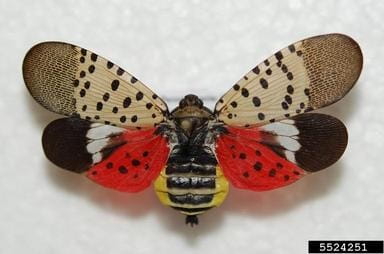
The Michigan Department of Agriculture and Rural Development, in collaboration with the U.S. Department of Agriculture, has confirmed a population of spotted lanternfly (Lycorma delicatula) in Berrien County.
The population was identified through monitoring conducted by the Southwest x Southwest Corner Cooperative Invasive Species Management Area with funding provided by MDARD to support spotted lanternfly trapping and surveillance efforts. Spotted lanternfly generally does not kill plants, but heavy infestations can stress plants and cause localized damage, thus potentially impacting crop yields if infestations occur.
“While spotted lanternfly can impact plants and cause crop damage when populations are high, it does not pose a risk to human or animal health,” said MDARD Director Tim Boring. “MDARD, in partnership with Michigan State University Extension, has been working with fruit growers to help prepare them for spotted lanternfly and understand how to spot this invasive pest.”
Berrien County is a major grape-producing region of Michigan. Although this detection was not found in a vineyard, MSU Extension urges producers in the area to remain vigilant and alert for spotted lanternfly.
“The recent detection of spotted lanternfly in Berrien County highlights the importance of continued monitoring by growers in this region,” said Rufus Isaacs, MSU Extension “Tree-of-heaven, grapevines and hops are among spotted lanternfly’s preferred hosts. Growers should report any spotted lanternfly detections through the Michigan DNR’s Eyes in the Field tool or to their local MSU Extension office."
In addition to the Berrien County spotted lanternfly detection, a new population of spotted lanternfly was also recently confirmed in Washtenaw County, which borders counties with previously confirmed populations. As of September 2026, spotted lanternfly populations have been confirmed in Berrien, Jackson, Lenawee, Macomb, Monroe, Oakland, Washtenaw and Wayne counties.
What to do if you see spotted lanternfly in counties with known infestations
- Squish it! You do not need to report the sighting. MDARD is already aware confirmed populations of spotted lanternfly in these counties.
- Focus pest management in areas where spotted lanternfly is most abundant. Traps or insecticidal soaps and oils can be effective and limit residual effects.
- Consider contacting a certified pesticide applicator for information about appropriate treatment methods if there is a large infestation on your property.
- Be diligent if you choose to apply pesticide yourself. Always follow the instructions on the pesticide label and wear appropriate personal protective equipment.
If you see spotted lanternfly in any other Michigan county:
- Take photos. Photos are necessary to verify a report and aid in identification.
- Provide details. Note the date, time and location of the sighting.
- Report it. Submit a report of your sighting online using the Eyes in the Field tool.
- Squish it!
Michigan’s Invasive Species Watch List Viewer enables residents to see where spotted lanternfly has been confirmed in the state. Reports from areas without known infestations help track its spread and prioritize monitoring efforts.
Since the first detection of spotted lanternfly in Michigan in 2022, MDARD and its partners, including the Michigan Department of Natural Resources, MSU Extension, CISMAs and USDA, have monitored more than 100 locations across Michigan.
For additional information on identifying, reporting and managing spotted lanternfly, visit the State of Michigan’s spotted lanternfly web page. You can also learn more at Michigan State University’s spotted lanternfly website.