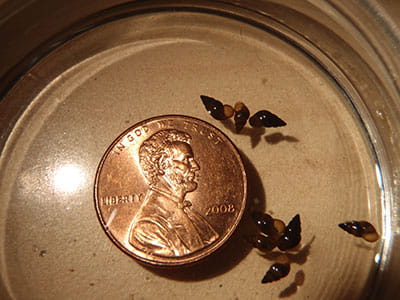
Invasive New Zealand mudsnails have been found in Bear Creek, a small, coldwater tributary of the Thornapple River in Kent County. First detected in Michigan in 2015, the tiny, aquatic invasive snail now inhabits the Au Sable, Boardman, Grass, Pere Marquette, Pine and Upper Manistee rivers in northern Michigan. The Bear Creek detection is the first in the southern Lower Peninsula, approximately 75 miles south of the closest infestation in the Pere Marquette River.
Coldwater River Watershed Council volunteers collected the snails during routine aquatic macroinvertebrate monitoring. Aquatic macroinvertebrates, small creatures near the bottom of the food chain, provide a good indication of water quality and stream health. The CRWC sent photos to the Michigan Department of Environment, Great Lakes, and Energy for identification. The photos and samples were then shared with experts from Oakland University and Trout Unlimited for verification.
Because the snails reproduce by cloning, the university will perform genetic testing on collected samples to attempt to identify source populations.
What harm can a snail do?
This brown to black, one-eighth-inch-long mudsnail, a native of New Zealand, is considered invasive and is prohibited in Michigan due to the environmental harm it can cause to rivers, streams and lakes. All of the snails are female and develop complete embryos without fertilization, making it possible for a single snail to start an entire population.
One snail can produce over 200 young in a year. Since few natural predators or parasites of this species exist in North America, its numbers grow rapidly each year. In some locations in Western states, researchers have documented snails reaching densities of 300,000 per square meter. With that many mudsnails, food for other stream invertebrate populations can become scarce.
Fish that feed on native invertebrates like mayflies and caddisflies may find it more difficult to forage in rivers invaded by New Zealand mudsnails. Fish will consume New Zealand mudsnails, but due to the snail’s thick shell – equipped with a tightly closing “hatch” called the operculum – they are difficult for fish to digest, offer the fish little nutritional value and can be excreted alive. Substituting mudsnails for native food sources can reduce the growth, condition and ultimately the abundance of key sport fish including trout.
What is being done?
Michigan Invasive Species Program biologists are gathering more information about the detection and will conduct additional sampling at the site and other Thornapple River tributaries in Barry, Kent and Ionia counties. Informational signs will be posted at recreational access points on affected creeks and rivers.
Currently, no effective treatments are available to manage populations or eradicate the New Zealand mudsnail from affected areas, which means it is important to educate recreational users about their role in preventing the snail’s spread to new locations.
Program staff will enlist the help of local organizations including the Coldwater River Watershed Council, Thornapple River Watershed Council and cooperative invasive species management areas to share information about the New Zealand mudsnail and techniques to prevent its spread.
What can you do?
The most important means of prevention is practicing good recreational hygiene. After a visit to one of Michigan’s lakes, rivers or streams, be sure to clean, drain and dry your boat, trailer and equipment before heading to a new destination.
The New Zealand mudsnail’s small size requires careful examination and cleaning of places where plants, mud or debris can be found on poles, nets, waders, boots, buckets, kayaks, canoes and flotation devices. Anything that has been in the water or at the water’s edge should be inspected before it is packed or loaded.
The NZMS Collaborative offers these simple steps for cleaning boots and waders:
- Stomp and inspect as soon as you leave the water to remove attached debris.
- Spray boots and waders thoroughly, including laces and soles, with a disinfecting agent.
- Brush waders and boots thoroughly to work in the disinfectant.
- Rinse after 10 minutes.
- Dry waders thoroughly before next use when possible.
The short video “New Zealand mudsnails and didymo: A protocol for decontaminating the gear of wading anglers” provides a demonstration of this cleaning technique and information about the New Zealand mudsnail and didymo, a harmful microscopic alga often called rock snot.
Additional information on the New Zealand mudsnail, including how to report a suspected discovery of the snail, can be found at Michigan.gov/Invasives.
Michigan's Invasive Species Program is cooperatively implemented by the Department of Environment, Great Lakes, and Energy; the Department of Natural Resources; and the Department of Agriculture and Rural Development.