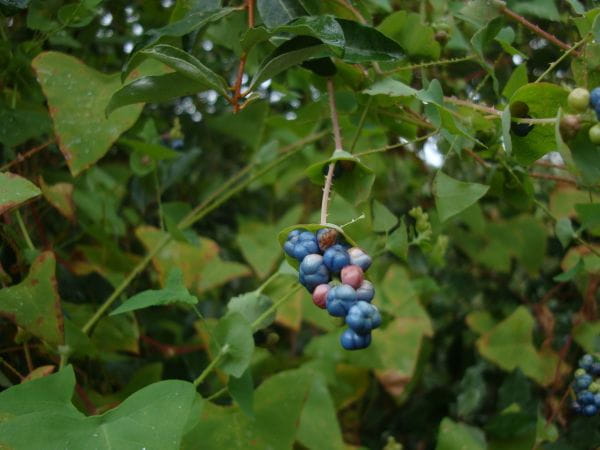
Mile-a-minute weed, a highly invasive vine that can smother trees and vegetation, has been confirmed in Jackson County following a landowner’s report to the Michigan Invasive Species Program through the Midwest Invasive Species Information Network’s online reporting system.
The report was verified following a site visit by staff members from the Jackson, Lenawee, Washtenaw Cooperative Invasive Species Management Area, who found several established patches of the plant on the property.
Mile-a-minute weed was first detected in Michigan in 2020 at Albion College’s Whitehouse Nature Center in Calhoun County. Since then, the Barry, Calhoun, Kalamazoo Cooperative Invasive Species Management Area has been conducting outreach, surveys and treatment of infested properties in the vicinity of Albion and Homer in eastern Calhoun County.
The new detection in Jackson County is in Concord Township, approximately 4 miles from the Whitehouse Nature Center and less than 2 miles from the nearest known mile-a-minute weed site in Calhoun County.
The vine’s dense growth and ability to climb tall trees make traditional herbicide treatment difficult. Though it is an annual vine, its numerous berries reseed infested areas and are spread by birds, other wildlife and human movement to new locations.
Mile-a-minute weed can be removed by hand, but seeds can persist in the soil for up to six years, so infested sites need to be monitored regularly for regrowth. New shoots can be mowed or tilled in the spring or early summer before fruiting, as even immature, green fruits can carry viable seeds and create new plants.
What is mile-a-minute weed?
Mile-a-minute weed (Persicaria perfoliata) is an annual vine that gets its name from its ability to grow up to 6 inches per day, or 25 feet in six to eight weeks. Its light green leaves are shaped like equilateral triangles, and both the stems and leaf blades are lined with small, recurved barbs that help it climb over other vegetation.
Small, inconspicuous white flowers appear in spring, developing into spikes of pea-sized, blue fruits in mid-summer. Unusual circular leaves called ocreae clasp the stems below the fruits.
Mile-a-minute weed thrives in full sun and wet soils, but it can grow in a variety of conditions. Like many invasive plants, it takes advantage of open space and disturbed areas including roadsides, stream banks, forest edges and fence lines.
Why is it a problem?
The vine’s fast growth and climbing habits allow it to overtake native and landscape vegetation, eventually smothering plants and trees under dense, prickly thickets.
“Mile-a-minute weed can displace native plants, disrupt the food web and alter forest regeneration after harvest or natural disturbance,” said Katie Grzesiak, terrestrial invasive species coordinator for the Michigan Department of Natural Resources.
Because of the risk to Michigan’s agriculture and habitats and the plant’s limited distribution, mile-a-minute weed is on the state’s invasive species watch list.
What is being done?
JLW CISMA has joined forces with BCK CISMA to encourage landowners around the infested area to request mile-a-minute weed surveys. Since the new detection, the two CISMAS have worked together to survey approximately 3,000 acres in Jackson County and an additional 2,600 acres in Calhoun County. No additional infestations have been found in Jackson County.
Herbicide treatment was initiated on the Jackson site shortly after the detection was confirmed. CISMA staff will continue to monitor the site and work with the landowner to conduct follow-up treatment.
The two CISMAs are able to provide treatment assistance and free survey services through support from the Michigan Invasive Species Grant Program and other grant funds.
Earlier this year, the BCK CISMA, in collaboration with Grand Valley State University, initiated a trial release of the mile-a-minute weevil (Rhinoncomimus latipes) in four test plots in Calhoun County as a biological control agent to reduce populations of the invasive vine. Study of the weevil’s feeding activity and survival rates is ongoing.
How can people help?
Anyone encountering a vine that could be mile-a-minute weed should visit Michigan.gov/Invasives to review identification information. If the plant appears to be mile-a-minute weed, take photos, note the location and report the find using one of these methods:
For more information on mile-a-minute weed and other invasive species of concern in Michigan, visit Michigan.gov/Invasives. Use the Invasive Species Watch List Viewer to see a map of infested areas.
Michigan's Invasive Species Program is cooperatively implemented by the Department of Environment, Great Lakes, and Energy; the Department of Natural Resources; and the Department of Agriculture and Rural Development.