When the landscape is colored with vivid red, gold and orange, it’s a good time to think about the importance of trees and what we can do to protect them. That’s why October is Firewood Month, when the Michigan Invasive Species Program partners with DontMoveFirewood.org to remind everyone to leave firewood at home and help keep destructive forest pests at bay.
Whether you’re planning a leaf-peeping tour, a hunting trip, a fishing adventure or just some time at the cabin, choose to use that space in the trunk or trailer for something other than firewood.
Firewood is a beneficial forest product, but did you know that untreated firewood can harbor pests and diseases that can infest and even kill other trees?
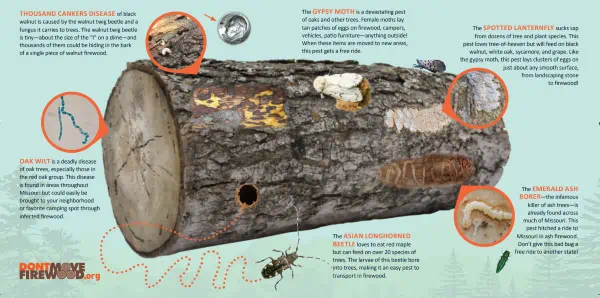
- Firewood movement helped to spread the emerald ash borer throughout Michigan, killing an estimated 40 million trees since 2002.
- The oak wilt fungus, which can kill oaks in a matter of months, easily can be moved to new locations on infested firewood.
- Spotted lanternfly, now in Michigan’s southern Lower Peninsula, can find its way northward more rapidly by hitchhiking or laying egg masses on firewood.
- More tree killers like Asian longhorned beetle and mountain pine beetle are only a road trip away from Michigan.
- Even wood that looks clean and healthy can harbor tiny insects, eggs or microscopic fungi spores that can start a new and deadly infestation.
While most pests and diseases cannot move too far on their own, they can be transported unknowingly on untreated firewood, starting new infestations hundreds of miles away.
Michigan is taking steps to protect forests and landscapes from the risks posed by firewood movement.
In 2026, the Michigan Invasive Species Program initiated a firewood certification program to boost the availability of certified, heat-treated wood throughout the state. Firewood producers now can have their production processes certified by the state to ensure heat treatment at the proper level and duration to effectively kill invasive insects and diseases. Michigan-certified firewood will bear a state certification seal equivalent to that provided by the U.S. Department of Agriculture for heat-treated firewood.
Beginning Jan. 1, 2027, when the Michigan Department of Agriculture and Rural Development’s External Firewood Quarantine becomes effective, it no longer will be permissible for anyone to bring untreated firewood into Michigan. Only firewood that has been heat-treated and certified will be permitted to enter the state.
How to keep the fire burning
You can still have a roaring campfire or a cozy night in front of the fireplace if you know how to choose safe wood.
- Buy certified, heat-treated firewood that comes with a government stamp or seal proving it’s safe to move long distances. Since the wood’s been treated, you don’t have to worry about invasive species hitching a ride.
- Collect or purchase wood at your destination. Firewood should never be moved more than 10 miles from where it was originally cut – unless it’s been heat-treated!
- Aged or seasoned wood is not safe to move. Just because it is dry doesn’t mean it’s clean. A recent study showed insects continued to emerge from firewood even three years after it had been cut.
- If you buy or collect firewood and don’t burn it all, don’t bring it home or to your next destination.
- Tell your friends not to bring wood with them – everyone needs to know they should not move firewood.
We’ve got a lot to protect
More than half of our state is forested – with an estimated 14 billion trees! Trees are part of every landscape we enjoy, from fall-hued forests to river corridors to shady sidewalks and parks. Making safe, informed firewood choices helps to protect the diversity and health of Michigan’s forest resources.
Learn more about protecting trees from invasive species at Michigan.gov/DontMoveFirewood.
Michigan's Invasive Species Program is cooperatively implemented by the Department of Environment, Great Lakes, and Energy; the Department of Natural Resources; and the Department of Agriculture and Rural Development.