Agency Assessments

Agency Assessment Process

The agency assessment process helps ensure Michigan law enforcement agencies meet established standards for the selection, training and employment of licensed officers. Through annual assessments, the Commission works collaboratively with agencies to promote consistency, accountability and compliance with statewide requirements. Assessments focus on key areas including employment history records, comprehensive background investigations, active-duty firearms standards, and training and policy requirements. The Commission also provides guidance and resources to help agencies understand and meet statutory requirements, including those established under Public Act 128 and comprehensive background investigation standards.

  • Section I Report

  • Section II Report

  • Section III Report

  • Section IV Report

  • Overview and Authority

    The agency assessment process helps ensure recognized law enforcement agencies comply with Michigan’s selection, training, employment, licensing, reporting, and funding requirements, supporting consistent statewide standards and public trust in law enforcement.

    The Commission conducts annual assessments of at least 10% of recognized law enforcement agencies. Agencies may be selected randomly from the active agency list in MITN, including review of license transactions and Law Enforcement Distribution records. Agencies may also be selected based on annual registration concerns, hiring or selection issues, or other compliance-related matters.

    Agency assessments focus on four primary areas:

    • Employee history records
    • Comprehensive background investigations
    • Active-duty firearms standards
    • Training and policy standards

    Selected agencies will participate in a virtual pre-assessment meeting with Commission agency representatives to review the process, expectations, and required documentation. Following the meeting, agencies will receive an overview email with assessment resources, applicable forms, and the names of officers whose records have been selected for review.

    On-site assessments are typically scheduled within two to three weeks of the pre-assessment meeting at a mutually agreed-upon date. During the assessment, Commission agency representatives will review selected employee history records to verify compliance with required standards, licensing documentation, and Public Act 128 requirements, when applicable. Any deficiencies identified will be discussed with the agency, along with corrective actions and timelines for resolution. Once the review is complete, a final Agency Assessment Report will be issued to the agency head

    Assessment ratings include:

    • Yes: The category meets current standards.
    • N/A: The category was not reviewed or was not required at the time of review.
    • No: One or more items are missing or not in compliance. A “No” rating will include either Corrected During Assessment (CDA) or Corrective Action Required (CAR).

    The Commission's authority to conduct annual inspections of recognized law enforcement agencies is granted under Public Act 203 of 1965 and Public Act 302 of 1982. Additional authority and requirements are outlined in administrative rules related to PA 203 employment documentation, PA 302 financial documentation, comprehensive background investigations, and employee history records.

  • Agency Representatives

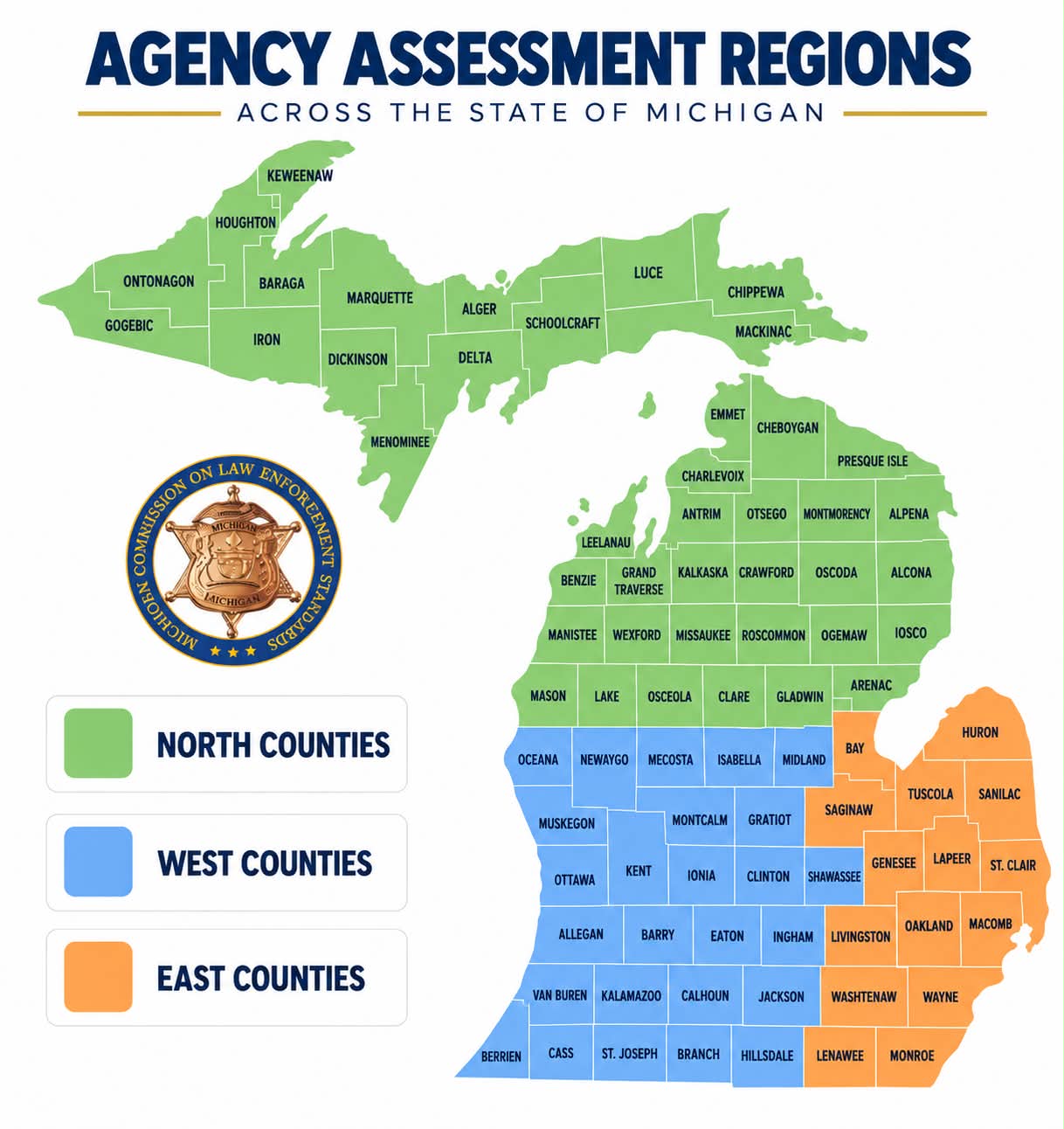
    Commission agency representatives serve law enforcement agencies across Michigan’s North, West and East county regions. The map highlights each region and the counties served by each representative.


    NORTH REPRESENTATIVE
    Rob LaMarche
    LaMarcheR@michigan.gov
    517-224-6934 

    WEST AREA REPRESENTATIVE
    Matt Krumbach
    KrumbachM@michigan.gov
    517-242-7324

    EAST AREA REPRESENTATIVE
    Joel Allen
    Allenj59@michigan.gov
    517-855-1783

  • ASSESSMENT SECTION I: Employee History Records

    Under Administrative Rules R 28.14502 and R 28.14504, recognized law enforcement agencies must maintain an employment history record for each employed law enforcement officer, subject to Commission inspection. Records must document compliance with minimum licensing standards and applicable license activation requirements.

    Required documentation includes:

    • Completed Commission Personal History Statement and Affidavit (PHSA) for all new hires.
    • Completed Comprehensive Background Investigation narrative report.
    • Supporting licensing and activation documentation, based on the type of license activation.
    • Public Act 128 documentation, when applicable.

    Assessment Process: A Commission Agency Representative will conduct a pre-assessment virtual meeting with agency leadership to review the process, provide assessment resources, and identify the officer records selected for review.

    An on-site assessment is typically scheduled within two to three weeks of the meeting. Agencies must have the selected records available for review to verify compliance with licensing and documentation requirements.

  • ASSESSMENT SECTION II: Comprehensive Background Investigation

    Under Administrative Rule R 28.14203 (Rule 203), law enforcement officer candidates must demonstrate good moral character through a favorable comprehensive background investigation, including school and employment records, home environment, personal traits, integrity, and relevant legal history.

    Licensing Standards Verification

    Agency heads must attest under oath that candidates meet all applicable licensing standards. Comprehensive background investigations must establish documented, factual support for that determination, including verification of applicant information and identification of omissions, false statements, or discrepancies.

    Minimum Qualifications and Documentation:

    • Age: Certified birth certificate.
    • Citizenship: Certified birth certificate or certificate of naturalization.
    • Education: Official transcripts sent directly from the educational institution.
    • Criminal History: Live Scan fingerprint-based background check in compliance with CJIS policy and certified court records, as applicable. Unresolved adjudications require follow-up with the court of jurisdiction.
    • Character Fitness: Review of school, employment, police, and other relevant records, including home environment, personal traits, integrity, and applicable legal history.

    Assessment Process: Commission Agency Representatives review selected background investigation reports and supporting documentation to verify compliance with Rule 203. Findings are recorded using the Agency Assessment Comprehensive Background Investigation Report, and investigations are evaluated using the Commission Background Investigation Assessment Rubric. Results are shared with agency leadership.

  • ASSESSMENT SECTION III: Active-Duty Firearms Standard

    Law enforcement agencies must maintain compliance with the Commission Active-Duty Firearms Standard and report compliance for officers on their agency roster through the annual registration process in the Commission Information and Tracking Network (MITN).

    Assessment Process: Commission Agency Representatives review firearms training records from the current and previous training cycles, along with agency training plans, to verify completion of required training.

    Representatives also review training curricula or consult with firearms instructors to determine whether required knowledge and skills performance standards are being met.

  • ASSESSMENT SECTION IV: Training and Policy Standards

    Commission Agency Representatives review required training records, plans, and agency policies in four areas:

    1. Continuing Professional Education (CPE)

    CPE establishes annual in-service training requirements to maintain and enhance the knowledge, skills, and professionalism of licensed law enforcement officers.

    Representatives review agency training records and plans, compare completed training with MITN records, reconcile discrepancies as necessary, and verify plans for completing outstanding requirements within the applicable training cycle.

    2. Domestic Violence Policy Requirements

    Under MCL 776.22, law enforcement agencies must maintain policies governing responses to domestic violence incidents, including misdemeanor and felony arrest procedures.

    Representatives review agency policies for required arrest procedures, personal protection order procedures, training, and disciplinary measures for noncompliance. Findings are documented using the Commission Assessment Summary Report for Response to Domestic Violence.

    3. Active Violence Response Training

    Under MCL 28.609e, licensed law enforcement officers must complete active violence response training emphasizing coordinated tactical responses to rapidly developing violent incidents.

    Representatives review agency training records and plans, compare completion records with MITN, reconcile discrepancies as necessary, and verify plans to meet outstanding training requirements.

    4. Audiovisual Recording of Custodial Interviews

    Under MCL 763.8, law enforcement agencies must make time-stamped audiovisual recordings of custodial interrogations involving certain felonies.

    Representatives review agency interview policies and procedures and visually assess interview facilities for compliance with applicable standards. Agencies without their own interview room must obtain a written agreement to use another agency’s facility.