How MPART evaluates and samples drinking water wells as part of investigations

A wellhead to a private residential well nestled among ornamental grass

How MPART evaluates and samples drinking water wells as part of investigations

A PFAS drinking water investigation may begin when:

  • MPART agencies receive new groundwater or drinking water PFAS results, or
  • MPART becomes aware of known or suspected PFAS sources or releases, or
  • If any MPART agency has a need to sample residential drinking water wells or non-regulated commercial drinking water wells

For any PFAS drinking water investigation...

Step 1: Creation of project team

The Michigan Department of Environment, Great Lakes, and Energy (EGLE) summarizes the information they have and sends an email to Michigan Department of Health and Human Services (MDHHS) to start the project team creation process.

Once MDHHS receives the email from EGLE:

  1. MDHHS assigns staff to be part of a project team.
  2. Local health department staff are contacted and become members of the team.
  3. Other MPART agencies are notified and included in the project team if applicable

Step 2: Project team determines if sampling is needed

The project team determines if any private drinking water wells need to be sampled.

If so, the scope of that sampling will follow the "MPART PFAS Site Coordination and Communication Protocol for New PFAS Investigations".

The "MPART PFAS Site Coordination and Communication Protocol for New PFAS Investigations" dictates the project team:

  • Meets to discuss available data, geology, and topography, and determine whether any private drinking water wells need to be sampled.
  • Evaluates the following:
    1. Known or assumed direction of ground water flow.
    2. Drinking water well records in Wellogic that might be downgradient of the site or potential source (publicly available). This includes:
      • Depth of the wells.
      • What soils the drinking water wells are in (because, for example, sand doesn’t protect a well from contamination as well as clay).
      • How close each well is to the site, potential source or self-sampled well.
    3. If municipal water is available in the area, the team identifies any homeowners that may still have an active private well and are potentially not connected to municipal water. If needed, the project team may contact the municipality to confirm connections.
    4. Other location-specific or well characteristics that may inform the investigation.
  • Identifies and compiles a list of names and addresses with private drinking water wells in need of sampling.
  • Develops a drinking water well sampling and data evaluation plan, which summarizes the sampling effort, notes that all addresses in the investigation area have a recommendation for using a filter and notes the conditions where a point-of-use filter could be provided by public health or another party.
  • The project team will also determine if MDHHS will mail an informational packet to all addresses in the investigation area before EGLE’s sampling request letters go out or after. This packet includes the statewide recommendation that all Michiganders reduce their exposure to all PFAS when and wherever possible, and a recommendation to use a certified PFAS-reducing filter because their home is in a PFAS drinking water investigation area. The packet will also share how eligible residents can get a free filter.

Step 3: Sample private drinking water

EGLE mails a letter to identified homeowners offering to test their well water for PFAS for free and informs them that they were selected because their home is near a location where PFAS may have been used or released.

The letter mailed to homeowners includes contact information for EGLE, MDHHS and local health if the homeowner has any questions. An access agreement form is included in the letter, which is required to be completed and submitted for drinking water to be sampled.

For private drinking water sampling, EGLE uses a contractor, AECOM, for coordination. 

  • AECOM tracks the access agreements and schedules sampling with homeowners
  • If response rates are low, the project team will discuss other ways to reach residents (like phone calls, sending a second letter, knocking on doors, etc.).
  • Drinking water samples are collected and delivered to the EGLE lab for analysis. Analysis typically takes 2 - 4 weeks.
  • Lab results are shared with the project team for review.

Sampling is typically done via the outdoor spigot. The access agreement form allows the homeowner to permit AECOM to sample their spigot without the homeowner being home.
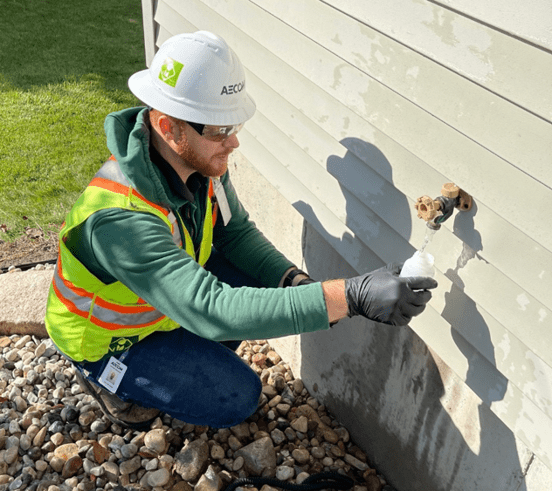

A person wearing a reflective vest and a hardhat kneeling outside a house at a faucet filling up a sample bottle

Step 4: Receive sampling results

After sampling:

 Resident

The resident will receive their results and informational materials by mail.

  • They may also receive a phone call by a member of the project team in certain circumstances (for example, if results should be shared as soon as possible or a mailing packet was undeliverable).
  • If not done previously, MDHHS mails an informational packet to all addresses in the investigation area at a time agreed upon by the project team. This packet includes:
    • The statewide recommendation that all Michiganders reduce their exposure to all PFAS when and wherever possible
    • A recommendation to use a certified PFAS-reducing filter because their home is in a PFAS drinking water investigation area
    • How eligible residents can get a free filter

 Project Team

The project team meets to discuss the drinking water sample results.

  • If PFAS was detected in wells targeted in the first phase of sampling, a second phase of sampling may be expanded to include more homeowners.
  • If there was a lack of responses to EGLE’s initial letter, the project team will discuss alternatives to obtain more responses.

Step 5: Communicate investigation details to the public

Initial summaries of PFAS investigations are posted to the MPART website for public awareness, local officials are notified, and additional communication of updates as needed.

  • EGLE notifies local officials by email of new PFAS investigations, including a summary and map of the investigation. 
  • Initial summaries of PFAS investigations are posted to the MPART website for public awareness and includes contact information for questions.
  • Depending on the nature of the investigation, strength of the source, impact to the environment and community, local interest, and staff resources additional communication may be necessary.
    • This could include MPART giving investigation updates online, at a public meeting presented by the project team, or via community email distribution.

Step 6: Evaluate as needed

The project team continues to evaluate new data as it becomes available.

  • As needed, EGLE continues to lead the environmental investigation to determine the nature and extent of the contamination. For example, EGLE will work with liable parties to ensure they investigate environmental contamination at the site.
  • MDHHS continues to evaluate future data and share information on PFAS with the community.