The web Browser you are currently using is unsupported, and some features of this site may not work as intended. Please update to a modern browser such as Chrome, Firefox or Edge to experience all features Michigan.gov has to offer.
Ishpeming-Negaunee Landfill (Ishpeming, Marquette County)
EGLE site lead
Bjorn Lysne, LysneB@Michigan.gov, 906-631-7123
Background
The Ishpeming Negaunee Landfill is a municipal solid waste landfill spanning 36-acres, which served the cities of Ishpeming, Negaunee, and Negaunee Townships. The landfill closed in 1990. EGLE has record that a tire fire occurred on the site in 1989 that was extinguished using firefighting foam.
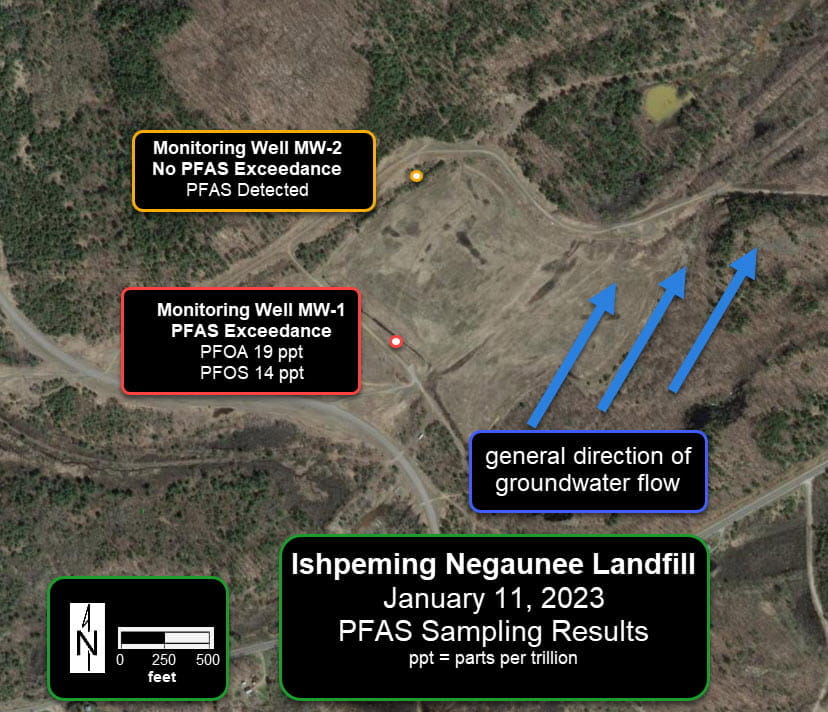
EGLE requested that the landfill sample monitoring well locations for PFAS contaminants due to the likelihood that some of the materials deposited in the landfill and the firefighting foam contained PFAS.
The highest result from the collected samples contained 19 ppt PFOA (compared to 8 ppt).
Content posted October 2026.
-
Ishpeming-Negaunee Area of Interest
Drinking water
The nearby cities of Ishpeming and Negaunee are serviced by municipal water. The regional groundwater generally flows in an east-northeast direction beneath the landfill towards Lily Pond and Teal Lake. There are several drinking water wells in the area including a campground and residential wells. EGLE, DHHS, and the Marquette County Health Department (MCHD) are coordinating efforts to sample area drinking water wells.
Because of its proximity to the landfill, the Brasswire Campground is required to sample quarterly for PFAS, for both on-site wells. The first quarterly sample was collected on June 21, 2023. The North Well had 4 ppt PFHxA (compared to Michigan MCL of 400,000 ppt for PFHxA). The South Well had no detectable level of any tested PFAS analytes.
Anticipated activities
EGLE plans to conduct additional groundwater and drinking water well sampling in the area. EGLE, DHHS, and the MCHD will evaluate results when received to determine next steps. Additional sampling may be conducted to further define the location, nature and extent of contaminated groundwater.