The web Browser you are currently using is unsupported, and some features of this site may not work as intended. Please update to a modern browser such as Chrome, Firefox or Edge to experience all features Michigan.gov has to offer.
How has the MPSC saved money for Michigan utility customers?
-
The MPSC has saved Michigan customers more than $3.3 billion since 2020 by closely examining and reducing utility rate increase requests—disallowing an average of 50% of requested rate increases. Without this disciplined regulatory scrutiny, customer bills would be significantly higher than they are today.
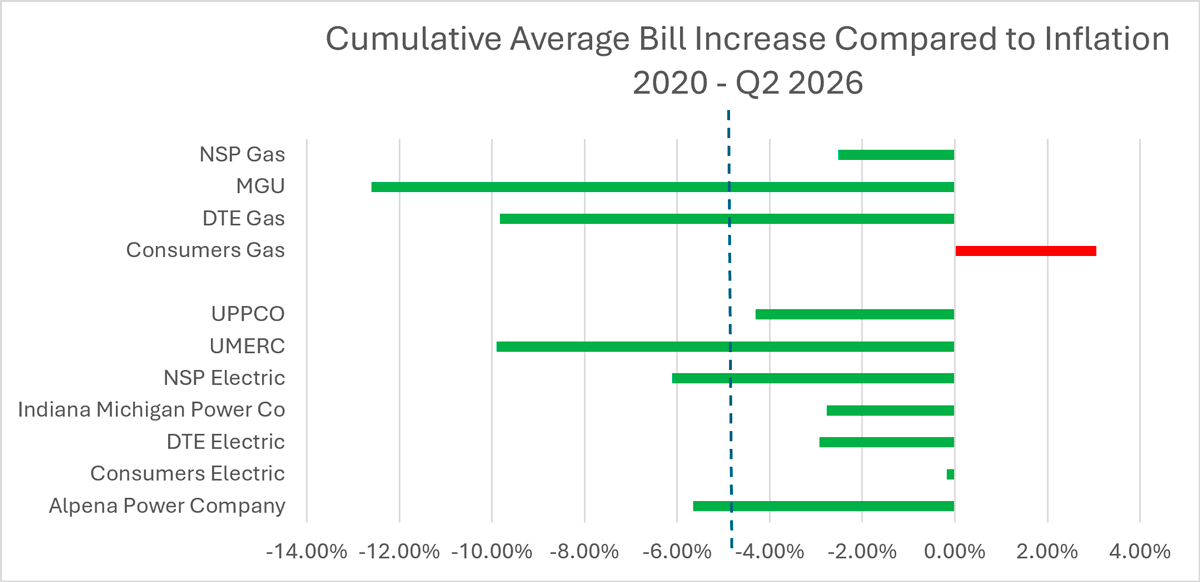
Residential rate increases have remained below the overall rate of inflation from 2020 through July 2026. When accounting for inflation, the average Michigan customer’s utility bill is 4.9% lower than it was in 2020, meaning electricity and natural gas costs make up a smaller percentage of household budgets than did before the pandemic. Bill increases for all regulated utilities in Michigan have been below cumulative inflation since 2020, with one exception shown below.

-
Michigan is a national leader in energy efficiency. According to national 2025 data, Michigan ranked:
- No. 1 for natural gas savings
- No. 2 for electricity savings
Key savings impacts:
- Since 2020, $2.6 billion in EWR spending is estimated to result in more than $6.8 billion in lifecycle customer savings.
- In 2024, every $1.00 invested in EWR generated $2.40 in customer savings.
In 2024, utilities invested $142.5 million in EWR programs for income qualified customers—over 20% of total utility EWR budgets.
-
Fuel costs are a key driver of utility costs, typically comprising around one third of total utility costs. The Commission has saved hundreds of millions of dollars in fuel costs for Michigan customers.
Lower Natural Gas Transportation Costs
The MPSC advocates for lower natural gas transportation costs in cases before the Federal Energy Regulatory Commission helping to save more than $790 million for Michigan customers since 2020.
Most of the natural gas consumed in Michigan is imported from other states. Michigan customers pay transportation costs to deliver the natural gas by pipeline to the utilities and those rates are regulated by the Federal Energy Regulatory Commission.
Renewable Energy Delivers Fuel Savings
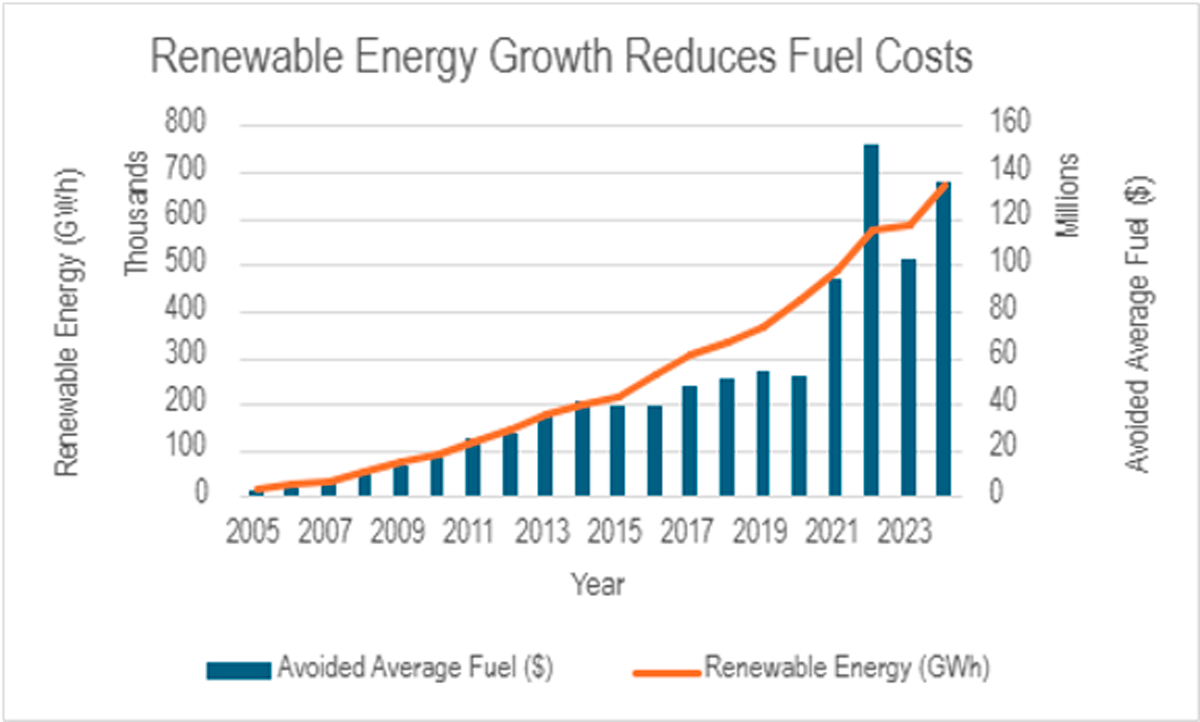
The MPSC has authorized Michigan utilities to scale up renewable energy in accordance with Michigan laws which has resulted in more than $948 million in fuel cost savings in the last 20 years, because the majority of renewable energy produced in Michigan is from zero-fuel cost wind and solar.

The avoided average fuel costs are calculated as the actual wind and solar production in Michigan as reported to EIA, the cost of coal and natural gas fuel and reagents in MPSC power supply cost recovery cases, and the actual coal and natural gas generation in Michigan as reported to EIA.
-
The MPSC has approved discounted off-peak rates, opening the door for Michigan customers to shift their energy use and benefit from significant savings on their monthly bill.
Michigan utility customers can expect to save more than $80 through the summer (June – September) by shifting their electricity usage outside of the utility’s on-peak period (typically 2:00 pm – 7:00 pm). Comfort can be managed by pre-cooling earlier in the day at the off-peak rate, utilizing fans, closing blinds, and taking other actions during the on-peak period. (Actual savings are dependent on the approved utility rate, home size, air conditioner size, weather, and other factors.)
The MPSC has approved several alternative rate options that provide different levels of savings depending on when you use electricity. The more flexibility you have to shift your energy use to off-peak times, the lower your bill will be. Visit your utility’s website and choose a rate that fits your situation.
Long-Term Resource Planning
The MPSC authorizes long-term plans for utilities that are “the most reasonable and prudent” as required by Michigan law. In integrated resource plans, the MPSC is required to evaluate the affordability of the utility’s plan as a part of the decision-making process.
Renewable energy is consistently selected as a low-cost resource in utility long-term plans. Through December 31, 2025, Michigan’s rate-regulated utilities combined totaled 7,580 MW of approved renewable energy projects, an increase of 1,698 MW, or 22%, of the approved renewable energy projects at the end of 2024. Renewable energy (wind and solar) remains the cheapest new source of electricity to build today, even without federal tax incentives.