
The Commission is in the midst of a broad effort to improve the reliability of the state’s power grid and to make it more resilient against the increasingly frequent and severe storms. While there is still work to do, the Commission’s efforts are leading to measurable improvements.
Michigan’s Average Length of Outages is Trending in the Right Direction
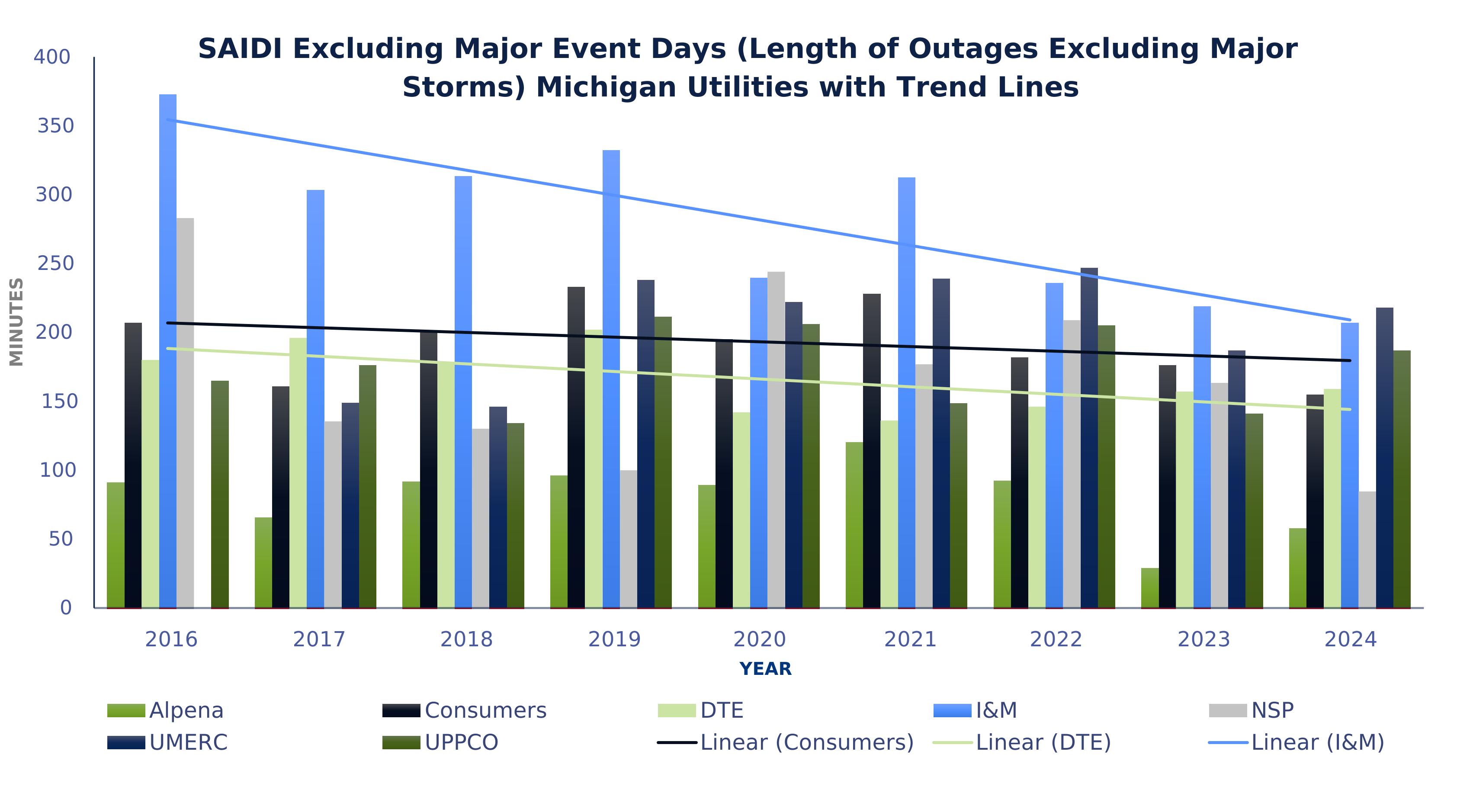
Source: Data through 2024 publicly available on MPSC’s website for regulated utilities.
The length of power outages (excluding major event days that could occur due to major storms) of the utilities regulated by the Commission as shown above has decreased by a combined average of 26 minutes since 2019. Michigan customers expect their electric service to be restored quickly and additional improvements are needed, however, the trend lines are headed in the right direction.
The Commission’s Work to Improve Distribution Reliability
2017: The Commission launched an initiative focused on transparent and long-term electric distribution planning and directed DTE Electric, Consumers Energy and Indiana Michigan Power Company to file distribution plans focused on initiatives aimed at reducing power outages and improving safety.
2018: DTE Electric and Consumers Energy filed the first iteration of their respective electric distribution plans as directed by the Commission.
2018: The Commission provided additional guidance on filing future electric distribution plans and emphasized the Commission’s standing objectives for distribution planning: safety, reliability, resiliency, cost-effectiveness and affordability, and accessibility.
2019: Indiana Michigan Power Company filed the first iteration of its electric distribution plan as directed by the Commission.
Line clearing, or tree trimming, is important because falling tree limbs are the leading cause of power outages in Michigan.
- In 2019, the Commission authorized an enhanced tree trimming program, or surge, for DTE Electric and requires an annual report on DTE’s trees trimmed. DTE has trimmed an average of 51% more miles annually from 2019 - 2024 compared to pre-2019.
- In 2020, the Commission authorized increases in Consumers Energy’s vegetation management, or line clearing, program and requires an annual report on Consumers Energy’s trees trimmed. Consumers Energy has trimmed an average of 50% more miles annually from 2020 – 2024 compared to pre-2020.
2021: Following severe storms, the Commission initiated an investigation of the utilities’ storm response in Case No. U-21122 and held a two-part technical conference on Emergency Preparedness, Distribution Reliability, and Storm Response. The Commission held that “ratepayers have a right to expect the utilities to anticipate extreme weather events, to provide a hardened grid that can withstand extreme weather, and to be prepared to restore power expediently when the grid fails.”
2021: DTE Electric, Consumers Energy, and Indiana Michigan Power Company filed the second iteration of their respective long-term electric distribution plans.
2022: The Commission ordered a first-of-its-kind, comprehensive. independent third-party audit of DTE Electric’s and Consumers Energy’s electric distribution systems to map out a path forward in the wake of persistent reliability and safety challenges.
2022: To increase transparency, the Commission directed the collection of additional data from Michigan utilities related to electricity outages and power restoration. The new reliability reporting requirements mandate that all utilities provide monthly reliability data broken down by circuit beginning with January 2023, as well as broken down by zip code and census tract. This data is publicly available upon request.
2023: The Commission held three town hall meetings to hear directly from utility customers experiencing prolonged outages during severe winter storms.
2023: Consumers Energy, DTE Electric, and Indiana Michigan Power filed revised iterations of their respective distribution plans as directed by the Commission.
2023: The Commission launched new Distribution System Reliability webpages which provide more detailed reliability data and outage information for customers than has been publicly available previously.
2023: The Commission hosted a 4.8 kilovolt (kV) technical conference in March exploring issues involving the 4.8 kV electric system in the Detroit area, including the Detroit Public Lighting Department’s arc wire system, and opportunities, benefits, challenges, and alternatives to the 4.8 kV hardening program
2023: The Commission approved updated Service Quality and Reliability Standards and increased the outage accommodation credit provided to customers experiencing lengthy or frequent outages from $25 to $35 and made the credit automatic so that qualified customers would not have to ask the utility for it. The Commission approved another increase to $38 later in the year.
2023: The Commission hosted a two-day resilience technical conference examining the interconnectedness of resilience and critical infrastructure, communications with customers, resilience challenges and opportunities, the unique challenges faced by vulnerable customers, and enhanced coordination between utilities and local governments.
2023: The Commission approved a 2-year investment recovery mechanism (IRM) that is designed to help track investments in DTE Electric’s distribution system and ensure continued investment in the distribution grid to improve reliability and resilience. The Commission authorized dedicated improvements for circuit conversion, sub-transmission redesign and rebuild, breaker replacement, and 4.8 kV circuit automation. The IRM ensures that DTE will spend the dollars approved only for reliability investments, and if not are refunded to customers. The Commission approved a 1-year extension of DTE Electric’s IRM in 2025.
2023: The Commission directed the Staff to convene a Financial Incentives and Disincentives workgroup to develop metrics for electricity distribution performance and requested comments on initial proposed distribution performance metrics aimed at improving the reliability of Michigan’s electric grid.
2024: The Commission continued to focus on tree trimming as evidenced by approvals in utility rate cases, as well as accounting measures approved in Case No. U-21128 and Case No. U-21799. Tree contact with electric lines remains one of the top causes of power outages in Michigan.
2024: The Commission approved a 2-year investment recovery mechanism (IRM) that is designed to help track investments in Consumers Energy’s electric distribution system and ensure continued investment in the distribution grid to improve reliability and resilience. The Commission authorized dedicated improvements for low-voltage distribution line improvements, resilience improvements aimed at shortening the outage duration during major storms, and system protection. The IRM ensures that Consumers Energy will spend the dollars approved only for reliability investments, and if not are refunded to customers. The Commission approved an expansion for Consumers Energy’s IRM in 2025.
2024: The Commission held engagement sessions throughout 2024 to inform refinements to proposed financial incentives and disincentives aimed at reducing electricity outages and improving restoration times.
2024: The Commission presented new distribution system reliability web pages in a public Commission meeting adding additional transparency to utility reliability performance.
2024: The Commission increased the amount of the bill credit that customers who endure lengthy or frequent power outages automatically receive to $40 as an accommodation for those who lose electric service while incentivizing utilities to improve reliability and shorten the length of outages.
2024: Alpena Power Company and Northern States Power Company filed their first distribution plans as directed by the Commission.
At the close of 2024, Consumers Energy and DTE Electric announced improvements in electric system reliability and resilience:
- Consumers Energy announced that the average customer experienced 21 fewer power outage minutes in 2024 compared to 2023 and over 93% of customers experiencing power outages had their power restored in less than 24 hours in 2024, up from 87% in 2023.
- DTE Electric announced that its customers experienced nearly 70% improvement in time spent without power in 2024 compared to 2023, due in part to grid improvements and in part to less extreme weather.
2025: The Commission directed Consumers Energy and DTE Electric to file applications to implement a financial incentive/disincentive mechanism addressing seven metrics focused on outage restoration time during varying types of weather conditions and the frequency of power outages. The Commission directed that data collection to establish baselines for the metrics should begin in 2026 with implementation of the financial incentive/disincentive mechanism to begin in 2027.
2025: The Commission held a townhall meeting in northern Michigan to hear directly from community members and utility customers experiencing prolonged outages during severe winter storms.
2025: The Commission ordered electricity distribution reliability improvements of Consumers Energy and DTE Electric as a result of the independent third-party audit of their distribution systems. The results of the audit will continue to inform the Commission’s work to reduce power outages, shorten the time for restoration of power after storms, and keep residents safe as work to implement the reliability improvements will continue in future electric rate cases and electric distribution plan filings.
2025: The amount of the bill credit that customers who endure lengthy or frequent power outages automatically receive increased again on October 1, 2025 to $42 per day, as an accommodation for those who lose electric service while incentivizing utilities to improve reliability and shorten the length of outages.
2025: Following the public forum on the ice storm impacts in northern Michigan, the Commission solicited comments on an MPSC Staff proposal with recommendations to improve the reliability and resilience for critical facilities. It directed the MPSC Staff to hold a technical conference on underground electric line (Case No. U-21388).
2025: The Commission approved performance-based financial incentive and penalty mechanisms for DTE Electric (Case No. U-21909) and for Consumers Energy (Case No. U-21911).
2025: The Commission took steps in improve electric service reliability for critical and priority community facilities such as schools, hospitals, nursing homes, police and fire stations, 911 call centers, and more. This was accomplished by approving 13 recommendations from MPSC Staff to strengthen reliability requirements for important critical and priority facilities important to a community's health and safety and to better align the MPSC's service quality rules and technical standards with industry requirements for resilience of specific critical facilities (Case No. U-21388).
The Commission remains focused on making continued improvements to electric reliability and resilience for utility customers in Michigan.
Last Updated: Feb 2026