New recommendations aim to help more Michigan students earn college credit before graduation
LANSING, Mich. – Michigan students who earn college credit while still in high school are more likely to continue their education after graduation, yet too few students across the state have access to these opportunities. Today, the Michigan Department of Lifelong Education, Advancement, and Potential (MiLEAP) released the final report of its Michigan Dual Enrollment Task Force, outlining recommendations to make dual enrollment more accessible, equitable and aligned across Michigan’s K–12 and postsecondary education systems.
“Expanding dual enrollment is about more than increasing participation—it is about building a system that makes opportunity accessible, sustainable and meaningful,” said Dr. Beverly Walker-Griffea, executive director of MiLEAP. “These recommendations provide a path to strengthen how Michigan funds, supports and aligns dual enrollment.”
The recommendations come as Michigan continues to strengthen its support for dual enrollment, including a $40 million appropriation in the FY2027 state budget to reimburse eligible school districts for dual enrollment costs. The investment represents an important step toward expanding participation, while the Task Force’s recommendations identify additional steps needed to make dual enrollment more accessible and sustainable statewide.
Dual enrollment allows eligible high school students to take college-level courses and earn postsecondary credit before graduating from high school. During the 2022–23 school year, 77.1% of Michigan dual enrollment students enrolled in a postsecondary institution within one year of high school graduation, compared to 55.8% of students who did not participate.
Yet only 7% of Michigan public high school students participate in dual enrollment, placing Michigan among the lowest-participating states nationally. The Task Force found that financial pressures on school districts, test-based eligibility requirements and additional costs such as transportation, parking, technology and course materials prevent students from participating.
“Every Michigan student deserves the opportunity to see themselves in a postsecondary pathway while they are still in high school,” said Sarah Szurpicki, deputy director of MiLEAP’s Office of Higher Education. “Dual enrollment can help students build confidence, earn college credit and make progress toward a degree or credential. These recommendations give Michigan a path to expand that opportunity to more students.”
Established under Section 706 of 2025 Public Act 22, the Dual Enrollment Task Force brought together state and legislative leaders, education organizations and subject matter experts to study Michigan’s dual enrollment landscape and recommend policies to improve access, oversight and alignment. The Task Force met six times during the 2025–26 fiscal year to examine the state’s current funding structure, eligibility requirements, data systems, transferability of credits and opportunities to expand participation.
- Strengthening state support for dual enrollment. Establish ongoing funding and a consistent reimbursement structure to provide greater predictability for school districts and expand opportunities for eligible students, building on the state’s $40 million FY27 investment.
- Removing barriers to participation. Use multiple measures to determine eligibility and cover costs directly tied to participation, helping more students access dual enrollment, particularly students facing greater financial or geographic barriers.
- Making college credit count. Provide clearer statewide guidance and strengthen data systems so students can understand how the credits they earn in high school apply to their future education and career goals.
- Incentivizing participation. Give students greater flexibility to participate, including protecting families from repayment requirements for failed or withdrawn courses and recognizing summer terms within the dual enrollment window.
Together, the recommendations are intended to create a more consistent dual enrollment experience across Michigan, so more students can benefit from the opportunity to earn college credit while still in high school.
“It’s important to put Students First by providing more opportunities for youth across Michigan to dual enroll in college courses while they are in high school,” said State Superintendent Dr. Glenn Maleyko. “The department is happy to work with local school districts, MiLEAP, Governor Whitmer, and the Legislature to expand dual enrollment, which moves us toward multiple goals in Michigan’s Top 10 Strategic Education Plan. That includes Goal 4, to expand secondary learning opportunities for all students, and Goal 6, to increase the percentage of adults with a postsecondary credential. Rigorous high school programs such as dual enrollment prepare our students for higher education and rewarding and well-paying careers. We appreciate the work by MiLEAP and the task force and support their efforts to give more high school students a chance to earn college credits.”
The Task Force’s work supports Michigan’s broader Sixty by 30 goal of increasing the share of working-age Michiganders with a postsecondary degree or credential to 60% by 2030. By helping students earn a college credit earlier, stronger dual enrollment pathways can put students on a faster, more affordable path toward a postsecondary credential while strengthening connections between K–12 education, postsecondary institutions and Michigan’s workforce.
The Task Force’s recommendations are intended for legislative consideration and reflect the group’s shared vision for a dual enrollment system that is accessible, equitable and coordinated across Michigan.
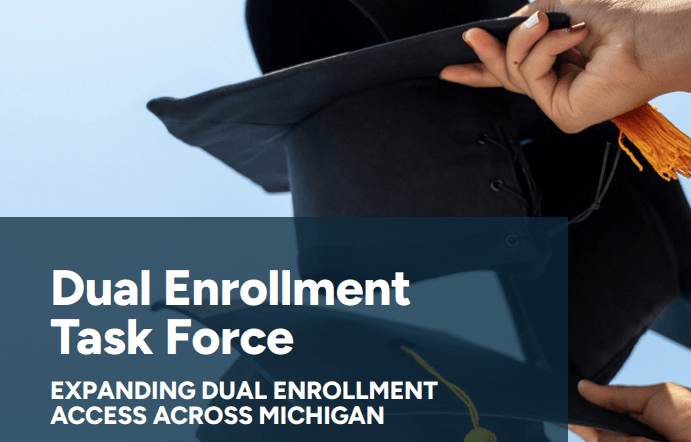
The full Dual Enrollment Task Force report, Expanding Dual Enrollment Access Across Michigan, is available on MiLEAP's Dual Enrollment Task Force webpage.
For more information about the Dual Enrollment Task Force and Michigan’s efforts to expand opportunities for Michiganders from birth through postsecondary and beyond, visit Michigan.gov/MiLEAP.
###
About MiLEAP:
Established by Governor Whitmer in 2023, MiLEAP’s mission is to improve outcomes from birth to postsecondary so anyone can ‘make it in Michigan’ with a solid education and a path to a good-paying job. To learn more about MiLEAP, go to Michigan.gov/MiLEAP.