State, national leaders highlight new report that examines need to expand opportunities for men while ensuring every Michigander has a pathway to earn credentials
LANSING, Mich. – Michigan leaders are raising awareness of the growing gap between men and women in education, emphasizing the need to better understand the barriers keeping men from pursuing postsecondary degrees and credentials — and the consequences for Michigan’s workforce, families and long-term economic competitiveness.
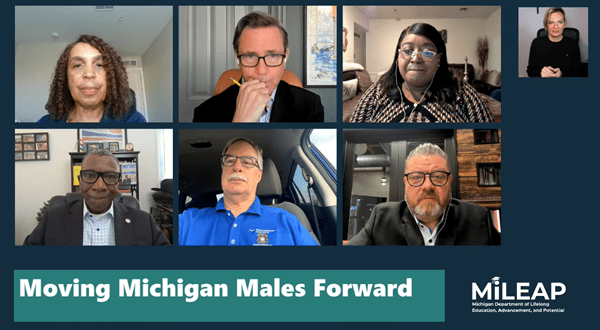
A new study by the Michigan Department of Lifelong Education, Advancement, and Potential (MiLEAP), Moving Michigan Males Forward: The Next Steps, examines these challenges and opportunities to strengthen engagement in educational and career pathways amongst boys and men. The report’s findings were discussed during a virtual panel discussion today featuring MiLEAP, Gov. Gretchen Whitmer; state representatives, partners from the American Institute of Boys and Men (AIBM); and leaders from the Michigan Departments of Education (MDE); and Labor and Economic Opportunity (LEO).
The Next Steps report builds on Gov. Whitmer’s Executive Directive 2025–2 and MiLEAP’s ongoing work to better identify gaps and ways Michigan can respond, as highlighted in the 2026 Office of Strategic Talent Preparation (OSTP) Vision and Impact report.
“Every Michigan resident deserves the opportunity to build a successful future, and we cannot afford to overlook the barriers that are keeping too many boys and men from pursuing education and training after high school,” said Dr. Beverly Walker-Griffea, executive director of MiLEAP. “When we help more men see a clear path from education to a meaningful career, we strengthen families, support employers and build a more resilient Michigan economy. Understanding the challenges is the first step toward developing solutions that work.”
While Michigan has made significant progress in expanding access to higher education and career training, women continue to outpace men in several key measures of educational participation and attainment.
According to the Michigan Center for Data and Analytics, approximately 50% of Michigan women ages 25 to 64 held an associate degree or higher, compared with just over 41% of men in the same age group. The center’s analysis of federal education data also found that more women than men completed postsecondary programs at every award level during the 2023-24 academic year.
Nationally, women earned approximately 58% of bachelor’s degrees in 2021, while men earned 42%, according to AIBM’s analysis. Through research examining trends in school achievement, college enrollment, degree completion and access to career pathways, AIBM has highlighted these disparities and called for greater attention to contributing factors and for evidence-based strategies to help boys and men succeed.
“Understanding why boys and men are falling behind in education is essential if we want to develop solutions that actually work,” said Richard Reeves, president of AIBM. “We need to look carefully at the entire educational journey — from early learning and K-12 achievement to college enrollment, completion and career preparation. Supporting boys and men who are struggling does not come at the expense of girls and women. It is about making sure everyone has a fair opportunity to develop their talents and contribute to their communities.”
Through statewide data, interviews and focus groups with men across Michigan, the Next Steps report looks beyond the numbers to understand where these connections are being lost and what can help rebuild them.
Researchers and education leaders point to a range of factors that may influence men’s decisions to pursue education after high school, including financial pressures, uncertainty about career options, limited exposure to postsecondary pathways and the need to enter the workforce quickly. These challenges can be particularly significant for first-generation students, adult learners and individuals who have not found a clear connection between education and their career goals.
Addressing the barriers requires understanding how they differ across communities, age groups and populations, as well identifying approaches that help men enroll, persist and complete a credential.
As Michigan employers seek qualified workers to fill high-demand jobs, engaging more men in postsecondary education and training is also critical to strengthening the talent pool and ensuring more Michiganders can access good-paying careers.
Workforce development leaders say this work must include clear connections between credentials, career opportunities and employer demand.
“When men face barriers to education and training, the impact reaches beyond the individual – it affects families, employers and communities that depend on a strong talent pipeline,” said Susan Corbin, director of LEO. “By working together with partners in education, workforce development and industries across our state, we can help more men identify opportunities, gain the skills employers are seeking and build sustainable careers here in Michigan.”
State lawmakers on both sides of the aisle also recognize the importance of ensuring boys and men have the opportunity to reach their full potential.
“There is no shortage of promise in Michigan’s boys and young men,” said state Rep. Amos O’Neal (D-Saginaw). “We’ve made progress, and this report gives us a clearer picture of where opportunity is still out of reach. The talent is there. Our responsibility is to help it find its way.”
“When boys and men are left behind in education, the consequences reach far beyond the classroom. We’re talking about future workers who may miss out on good-paying careers, families that may struggle to achieve financial stability and communities that lose out on the talent and potential of their residents,” said state Rep. John Roth (R-Interlochen). “Throughout Michigan, we have a responsibility to make sure every young man has a fair opportunity to succeed. Investing in their education is an investment in stronger families, stronger communities and a stronger future for our state.”
Michigan has several programs designed to make postsecondary education and skills training more accessible. Michigan Reconnect helps eligible adults 21 and older pursue community college credentials tuition free at this local community college, while the Michigan Achievement Scholarship and Community College Guarantee help reduce the cost of education for eligible recent high school graduates. These programs offer important pathways for students who may otherwise find the financial cost of education prohibitive.
However, affordability alone may not be enough to close the gender gap. Outreach, career exploration, advising, mentoring and support services can also help students understand their options and navigate the transition from high school or employment into education and training.
“We must begin by helping students recognize their strengths, understand the opportunities available to them and see how their education can lead to a future they want to build,” said Dr. Delsa Chapman, deputy superintendent of the Division of Assessment, School Improvement, and Systems Support at MDE. “That means engaging students early; strengthening partnerships among schools, colleges and employers; and ensuring young men have access to the guidance and support they need to make informed decisions about their futures. Every student should be able to see a pathway forward, whether that leads to a university, a community college, a technical program, an apprenticeship or another valuable credential.”
The discussion also highlighted the importance of hearing directly from men navigating these pathways. “I got kicked out of high school after running with the wrong crowd. When I was 21 or 22, I went back and got my GED, then started attending LCC, but I still didn’t finish,” said Cornelius Hawkins, a 51-year-old Michigan Reconnect student attending Lansing Community College. “Life got harder. I was raising kids and working different jobs that stopped me from coming back to school. When I found out about Michigan Reconnect and had a chance to come back, with my kids grown and only grandbabies at home, I decided I was going to finish this time. What really made me turn the page was having sons. I didn’t want them to go down the same road I went down. I wanted to be a good example for them.”
Education and workforce leaders stress that the goal is not to diminish the progress women have made in education but to ensure that men are not left behind as the qualifications required for many careers continue to evolve.
Expanding educational opportunities for men also supports Michigan’s Sixty by 30 goal – to ensure that 60% of working-age adults have a postsecondary degree or credential by 2030 – and broader efforts to increase household economic stability, address talent shortages and prepare the state for changes in technology, manufacturing, healthcare and other industries.
Watch the virtual panel discussion on MiLEAP's Youtube page.
To learn more about MiLEAP’s work to identify and support Michiganders who face barriers to education and career advancement, visit the Office of Strategic Talent Preparation (OSTP) webpage.
###
About MiLEAP:
Established by Gov. Whitmer in 2023, MiLEAP ensures every Michigander has a path to prosperity from birth to earning a postsecondary credential that leads to high-wage careers. To learn more about MiLEAP, go to Michigan.gov/MiLEAP.
About AIBM:
AIBM (AIBM.org) conducts nonpartisan research on issues that affect the well-being of boys and men across the United States and designs programs and policies to help them thrive.

