The web Browser you are currently using is unsupported, and some features of this site may not work as intended. Please update to a modern browser such as Chrome, Firefox or Edge to experience all features Michigan.gov has to offer.
June 2026 Newsletter
June 2026, Issue 19
Thank you for your interest in Michigan’s Elder Abuse Task Force (EATF) – an alliance representing more than 55 different organizations in the public, private and non-profit sectors – all working together to reduce barriers facing our aging population.
Please take a few minutes to catch up on what the Task Force has been up to since our last issue in March 2026.
If you want this information sent regularly to your email inbox, it’s as easy as signing up using the link below.
Sign Up to Receive Future Elder Abuse Task Force Newsletters
The Elder Abuse Task Force Celebrates Elder Abuse Awareness Month
Elder Abuse Awareness Month
This month, we’re focused even more keenly on educating Michiganders on the issue of elder abuse in all its forms.
June has been observed as Elder Abuse Awareness Month since 2023 when Senators Chuck Grassley and Richard Blumenthal introduced their resolution. It designated June as the month to shine a light on the abuse of seniors.
Grassley said, “We should look up to, respect and protect our nation’s senior citizens. Yet America’s 55,000,000 seniors are often targets of scams, abuse and exploitation.”
Elder abuse takes many forms. It can be physical, emotional, sexual, or financial. Neglect is also a form of abuse. Our Elder Abuse page details these forms of abuse. It also explains how to report abuse. Take action anonymously to protect our seniors from harm.
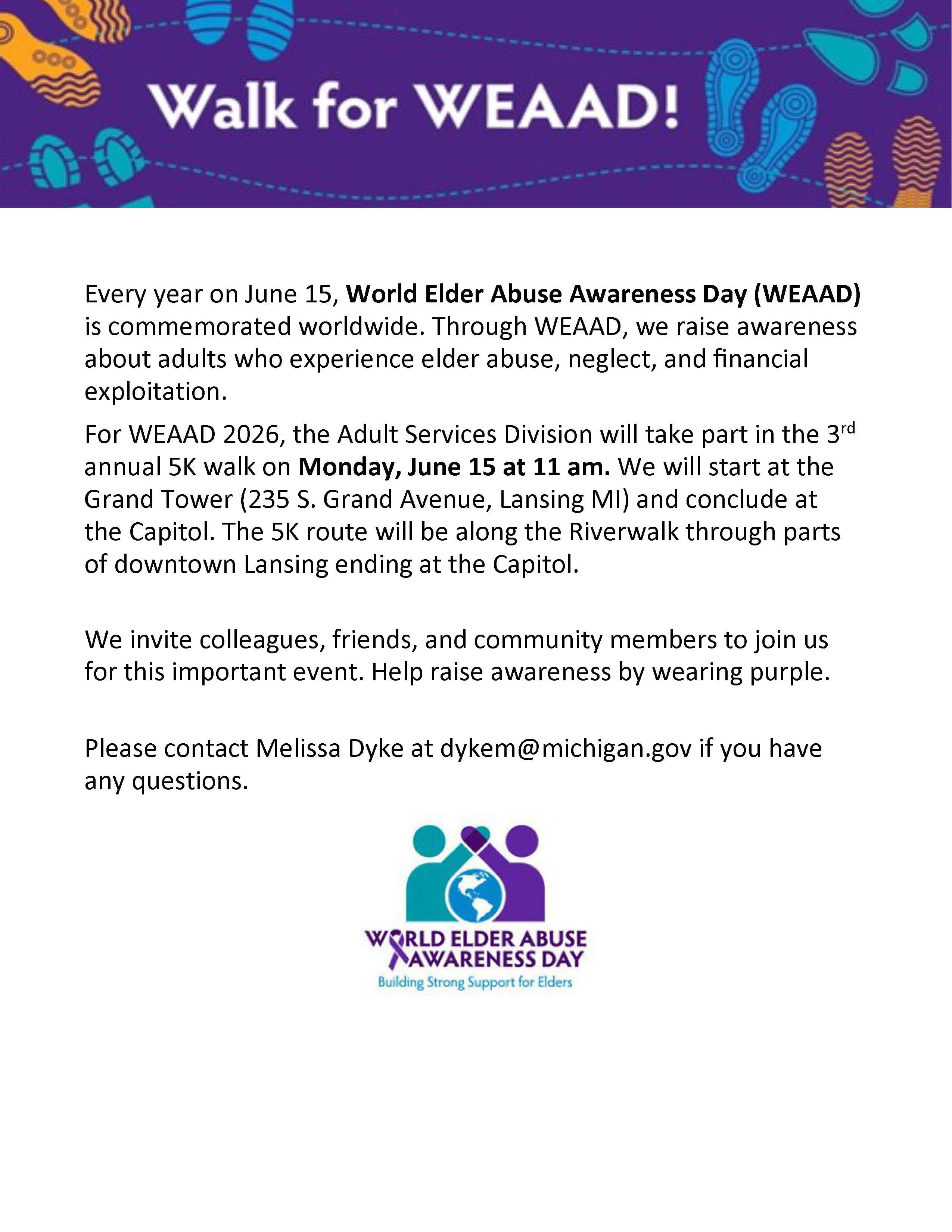
The highlight of World Elder Abuse Awareness Month will be on June 15. That's the day of the World Elder Abuse Awareness Day (WEAAD) 5K Walk.
Michigan has several other Elder Abuse Day events scheduled for June. Check with your county’s Commission on Aging for more information.
World Elder Abuse Awareness Day Walk
The 3rd Annual World Elder Abuse Awareness Day 5K Walk will take place June 15 at 11 a.m. The walk will start at the Grand Tower at 235 S. Grand Ave. in Lansing. It will end at the Capitol.
The walk will be hosted by the Michigan Adult Services Division. The purpose of the walk is to raise awareness about elder abuse.
Walk participants are encouraged to invite others to join them. Let’s let our collective feet do the walking. Let's walk to support Michigan’s older adults. Don’t forget to wear purple. And take lots of photos to post online using the #WEAAD2026 hashtag!
-
Surrogate Consent
-
SB 111: A PPO for Vulnerable Adults
-
SB 112: Cracking Down on Racketeering
-
SB 113: Amending Embezzlement from a Vulnerable Adult
-
SB 114: Building Community Response Teams
Legislative Package Update
HBs 4418-4419
This package of bills awaits action by the full Senate. It has passed from the House of Representatives and the State Senate committee.
This package would:
- Create a patient surrogate consent statute to help families make health care decisions. This reduces the need for hospitals to go to court.
- Amend the Estates and Protected Individuals Code (EPIC). The amendment adds a new Part 6 to Article V (protection of people under disability and their property). It enables certain people to make healthcare decisions for a patient when the patient is unable to do so.
- Identify the classes and priority of people who can serve as surrogate medical decision-makers. It provides guidance in the event there are multiple people who qualify.
- Permit a patient to choose or disqualify people from serving as a surrogate medical decision-maker.
- Require healthcare professionals to tell the patient what decision was made by a family member/surrogate. The patient must also be told who made the decision.
- Provide protection from civil/criminal liability to healthcare providers who act in good faith.
Modeled after Michigan’s Domestic Violence and Anti-Stalking PPOs, this bill would:
- create a new personal protection order (PPO)
- specifically for adults aged 60 or older,
- those with developmental disabilities, or individuals legally defined as vulnerable
- allow court to block abusive behavior—physical violence, threats, stalking, and financial exploitation
- offer added protections, like freezing access to the victim’s assets.
SB 112 would amend Michigan's racketeering laws. The amendment would add embezzlement from a vulnerable adult to the list of offenses defined as racketeering.
Exploitation doesn’t always stop after death. SB 113 allows prosecution of financial abuse that occurs during a vulnerable adult’s lifetime.
- Amends the Embezzlement from a Vulnerable Adult statute
- If the exploitation occurs during the vulnerable adult’s lifetime,
- but the transfer of money or property is triggered by the death of the vulnerable adult.
Creates a statutory definition of multidisciplinary teams in Michigan
- to coordinate services,
- to investigate abuse, and
- raise awareness to protect vulnerable adults.
These teams would include experts from law enforcement, health care, and social services, all working together to keep vulnerable adults safe. The investigation meetings of these teams would be exempt from the Open Meetings Act and the Freedom of Information Act.
Tools for Success
EATF Training Videos
The Elder Abuse Task Force continues its work. The task force teaches Michigan residents how to spot elder abuse. It also teaches residents how to stop abuse.
We have recent training videos available on our website. The videos are from the 2025 Michigan Elder Justice Conference.
The subjects of the videos include:
- Spotting fraud schemes that target the elderly.
- Best practices to help vulnerable adults;
- What the Financial Exploitation Prevention Act has changed; how banks and law enforcement now treat suspected abuse; and
- Changes in the brain as we age.
The new videos include a presentation from Scott Teter. Teter is the head of the Elder Abuse Task Force. He discusses the task force’s successes with its first set of initiatives. He looks forward to the second set of initiatives. He also provides an update on the status of those initiatives.
Each video from the conference is approximately 1 hour in length.
2026 MDT Survey Report
The Elder Justice Initiative has released the report of its 2026 Multidisciplinary Team (MDT) Needs Assessment Survey. The purpose of the survey was to evaluate elder abuse MDTs.
The report’s most encouraging findings were:
- MDTs are a valuable; they are important to any elder abuse response system.
- Collaboration between agencies works well; but agencies must communicate and have regular opportunities to engage.
- The people surveyed said they had success in handling complex cases. This happened when a wide range of partners trained in elder abuse were on their teams.
- Many MDTs use modern best practices. These practices include trauma-informed and ageism-aware approaches.
The report also brings up issues with MDTs. Many MDTs are underfunded. Lack of training and lack of formal infrastructure were also cited as obstacles. But MDTs can still function effectively within the system. Most people surveyed were convinced of the value of MDTs. They wanted to strengthen and sustain MDTs long-term. They want to ensure that funding, staffing, and support meet the growing demand.
The survey was conducted in December 2025. One hundred-sixteen professionals responded nationwide from a broad range of disciplines, roles, and locales.
Read more about the legislative bill package that includes MDTs above.
Capacity Assessments Webinar
In May of this year, two experts presented a webinar incapacity in older adults. They discuss how and why incapacity is determined. They explained what it means for legal practice.
The presenters were Leslie Dubin, LMSW, ACSW and Kahli Zietlow, M.D. The seminar was sponsored by the Michigan Elder Justice Initiative. The other sponsor was the Elder Law and Disability Rights Section of the State Bar of Michigan.
Dubin and Zietlow shared the four pillars doctors use for judging a patient’s decision-making abilities. They ask whether the patient can:
- understand information;
- see how it applies to them;
- think through choices; and
- clearly share a decision.
Dubin and Zietlow said the ability to make decisions can change over time. Factors like illness, stress, or medication can cause this change. They also stressed that social workers, doctors, and lawyers should work together in their patients’ and clients’ best interests.
The webinar Zoom link can be accessed below using passcode ?&uEV8MH

Senior Scams Presentations
Educate yourself and your group on the latest scams targeting seniors.
Phone scams, internet scams, romance scams and the emerging use of Artificial Intelligence (AI) to target seniors.
POA Forms
In August 2025, we shared new Power of Attorney forms from the Kimble Center for Legal Drafting at Cooley Law School. These forms were prepared as a public service.
They are simple to use and help you choose a trusted person to make money or health‑care decisions if you can’t make them yourself. The Finances Power of Attorney and the Medical Power of Attorney can be downloaded directly and filled out at home.