Your service credit reflects the years, or fractions of years, you have worked as a member of the Defined Benefit (DB) Plan for the State of Michigan or one of its noncentral agencies. Noncentral agencies are state-affiliated organizations whose employees are covered under the State Employees' Retirement Act: American Legion, Business Enterprise Program, Mackinac Island State Park, Michigan State Bar, Third Circuit Court, Wayne County Clerk Recorders Court, or 36th District Court.
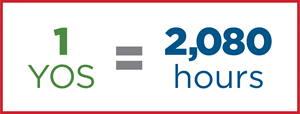
For retirement purposes, 2,080 hours equals 1 year. You are credited with a full year if you work 2,080 hours; however, you may earn no more than 1 year of service in any given year and no more than 80 hours in a pay period. Note: Banked leave time and mandatory furlough hours will not adversely affect your accumulation of service credit.
- Type of Employment: Full Time, Period of Time: 1 year - 2,080 hours, Service Credit Earned: 1 year.
- Type of Employment: Full Time, Period of Time: 1 Pay period - 80 hours, Service Credit Earned: 0.0385 of a year.
If you work less than full time.
Any work that is less than full time or intermittent (for example, a job-share position or seasonal work) is evaluated using the hours worked converted to a fraction of a year. The following table shows examples of how part-time employees earn service credit in proportion to the hours worked.
- Type of Employment: Part Time or Job Share, Period of Time: 1 year - half time, Service Credit Earned: 0.5000 of a year.
- Type of Employment: Part time or Job Share, Period of Time: 1 pay period - 40 hours, Service Credit Earned: 0.0192 of a year.
Getting credit for your other government work.
If you are a Defined Benefit Plan member and have worked for other Michigan governmental units (public school, or local governments, for example) you may be able to combine that service with your state service to qualify for a pension. The ability to combine service for eligibility purposes is permitted under Act 88 — Reciprocal Retirement Act of 1961.