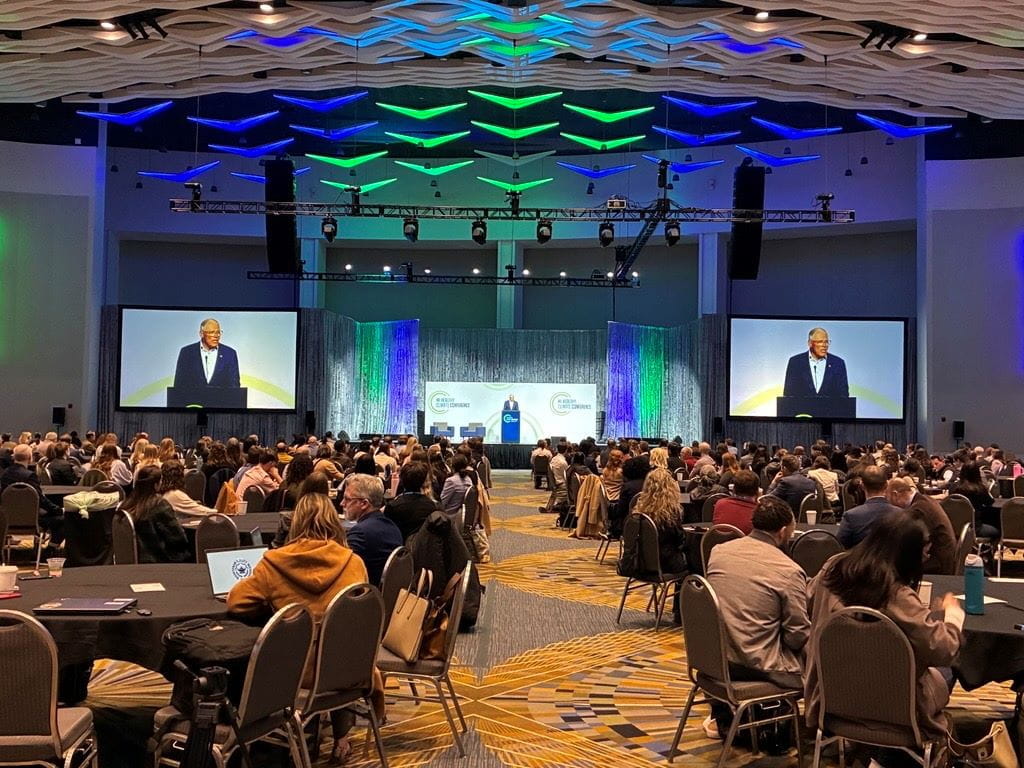
More than 700 Michiganders and others, from climate action leaders to local community members, gathered along the Detroit riverfront on April 21 with a shared purpose: turning climate commitments into positive outcomes for Michigan’s economy, health, and environment.
The Michigan Department of Environment, Great Lakes, and Energy (EGLE) and its Office of Climate and Energy (OCE) hosted the fourth annual MI Healthy Climate Conference at Huntington Place in the heart of the Motor City, centering a theme of “Advancing Climate Action Together.”
Attendees represented organizations spanning local, state, and tribal governments; academia and research; nonprofits; businesses; and community groups. Throughout the daylong event, conversations focused on turning goals and commitments into real change.
Jay Inslee, former governor of Washington state, opened the conference with a keynote address that underscored the accelerating pace of clean energy adoption nationwide. Despite political headwinds from D.C., he said, 92% of new energy capacity added in the U.S. in the past year came from renewable sources. Meanwhile, he noted, solar energy has come down in cost by more than 80% in a decade.
“This is a train to the future,” Inslee said. “It has arrived at the station, and everyone in this room has the capacity to continue that revolution.”
Inslee also emphasized the human stakes. Cutting reliance on fossil fuels can help drive down asthma rates and improve quality of life for children and families across Michigan, he said.
Dr. John Kotcher of George Mason University’s Center for Climate Change Communication delivered the afternoon keynote, on how to talk about climate in ways that motivate people to act.
EGLE Director Phil Roos celebrated how far Michigan has come in less than a decade, from setting climate goals to enacting them in law and beginning large-scale implementation.
“We moved from having no statewide climate commitment to adopting a clear, science-aligned goal: fully decarbonizing Michigan’s economy by 2050,” Roos said. “We backed that ambition with landmark legislation that provides the foundation and tools to implement the climate plan. Importantly, we are not turning back.”
He said a major 2026 focus is industrial decarbonization – a priority backed up by Governor Gretchen Whitmer in a video address to the conference.
The Governor announced the launch of the fourth MI Healthy Climate Challenge, part of a multiphase competitive grant program accelerating clean energy solutions. This new round will fund feasibility studies for manufacturers exploring both short- and long-term strategies to cut carbon emissions, further reinforcing Michigan’s commitment to building a strong, sustainable economy.
Michigan’s industrial sector remains central to its economy and identity, making it a key area for emissions reductions.
The conference also showcased climate action at the community level, with several members of the MI Healthy Climate Fellows program sharing their on-the-ground experiences and achievements throughout Michigan and illustrating how local engagement drives progress and improves outcomes – including bottom lines.
“They’ll listen a little bit more when you say you can save them some money,” said Jessica Austin, a fellow working as program coordinator at the MI Green Building Collaborative in Grand Rapids. She coordinates with the city and local businesses to help improve buildings’ energy efficiency. “Overall, the goal is you’re helping the earth.”
For Austin and her peers, the conference was an opportunity to learn from and network with like-minded people and groups.
Fellows serve a nearly year-long term at nonprofits and in state and local governments and community-based organizations across Michigan, where they provide critical support and capacity for tackling environmental and climate issues. Members benefit from training and career development support that also builds Michigan’s climate leadership pool.
Alessandra Carreon, chief climate officer in EGLE’s Office of Climate and Energy, emphasized the importance of bringing diverse voices together to drive progress.
“This conference shows what’s possible when we align around a shared vision,” she said. “From community organizations to industry leaders, people are stepping up with solutions that make a real difference in people’s lives. Our job is to support and scale that work so every Michigander can benefit.”
Sessions led by dozens of expert speakers and panelists covered a wide range of topics: clean industry, sustainable agriculture, building decarbonization, environmental justice, finance, recycling, renewable energy, and more. New to this year’s conference was a financial insecurity simulation exercise. Conference-goers met as a whole and in breakout sessions, with educational and networking opportunities designed to foster collaboration and spark new ideas.