
Our new AI chatbot is designed to help you find information more easily on our website. Look for it in the bottom right corner of your screen.
Workplace Rights
Workplace Rights
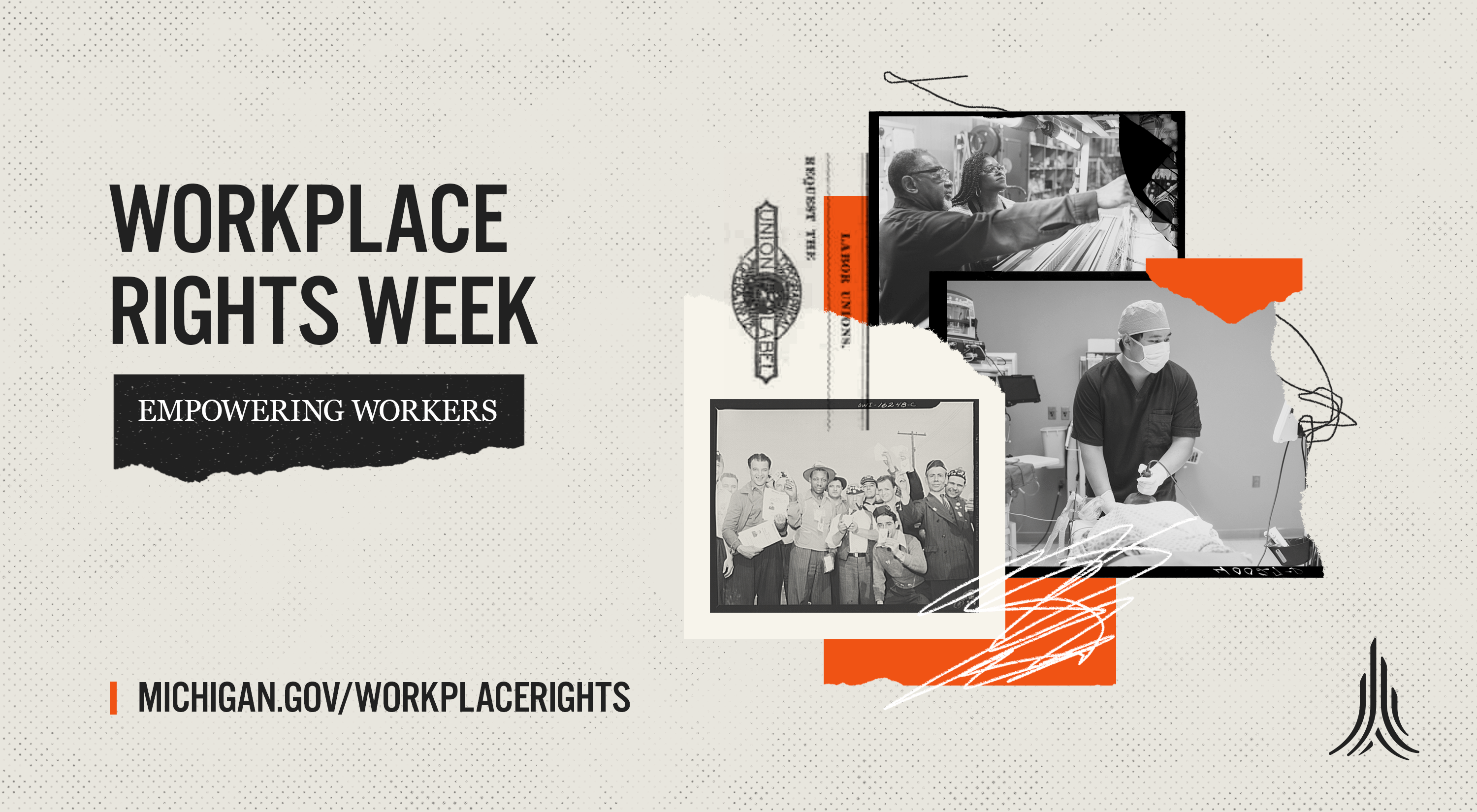
The historical role of May Day was to provide an eight-hour workday and extend Workplace Rights to hardworking men and women across the nation. Michigan's workforce benefits from the right to organize, bargain collectively and advocate for better protections, leveraging their knowledge to create equity amidst a growing Michigan economy.
Serving the residents of Michigan is of utmost importance and aligns with LEO's mission and purpose. The Workplace Rights resources showcases the state's commitment to the Labor movement and establishes Michigan as a place for economic growth and prosperity for all. These resources will help working people better understand their rights and feel empowered to fight for their protection.
Know Your Rights
-
Bureau of Employment Relations
Guide to Public Sector Labor Relations Law in Michigan
How to File an Unfair Labor Practice
Search Michigan Employment Relations Commission Decisions
Contact Bureau of Employment Relations Detroit Office at 313-456-3510 or Bureau of Employment Relations Lansing Office at 517-335-9142.
-
Wage and Hour
Contact the Wage and Hour Division at 517-284-7800 or whinfo@michigan.gov.
-
Michigan Occupational Safety and Health Administration
Contact Michigan Occupational Safety and Health Administration at 517-284-7777.
-
Workers' Disability Compensation Agency
Contact Workers' Disability Compensation Agency at 888-396-5041 or wcinfo@michigan.gov.
-
Michigan Department of Civil Rights
Sexual harassment is a form of discrimination – and it’s illegal.
What to do if you’ve experienced discrimination
Contact Michigan Department of Civil Rights at 800-482-3604 or MDCR-INFO@michigan.gov.
Share on your Channels
Video Highlights
-
Earned Sick Time
-
International Workers' Day
-
Wage Theft
-
Minimum Wage
-
Mental Health in the Workplace
Labor Movements that Shaped History
-
A drawing of the May Day event.
May Day - May 1, 1886
200,000 U.S. workmen engineered a nationwide strike for an 8-hour day. The historical role of May Day was to extend Workplace Rights to hardworking men and women across the nation. Michigan's workforce benefits from the right to organize, bargain collectively and advocate for better protections, leveraging their knowledge to create equity amidst a growing Michigan economy.
-
Photo of the strike - people gathered all around
Furniture Strike, Grand Rapids - 1911
When several thousands of workers in the city's furniture factories walked out to protest low wages and poor working conditions. The strikers demanding a nine-hour workday and a 10 percent raise, kept their walkout going for 17 weeks despite the company's refusal to bargain. While the strike ended without an immediate victory, the sacrifices of the workers, who were supported by the mayor and the local Catholic bishop, were a catalyst to eventually winning higher wages in both the furniture and other industries. -
Ford Hunger March
Ford Hunger March, Dearborn - 1932
Unemployed workers gathered at several locations in metro Detroit on March 7, 1932 and marched to the Ford River Rouge plant in Dearborn to seek jobs and relief. Ford security guards fired bullets into the crowd, killing four workers that day and wounding a fifth, who died later.;
-
Flint Sit Down Strike
Flint Sit Down Strike 1936-37
For 44 days, in 1936-37, auto workers occupied plants in General Motors' vast Flint network, while Women's Emergency Brigade members supplied them with food and built community support. Workers ended their occupation Feb. 11, 1937, once GM agreed to recognize the United Auto Workers. The victory inspired a wave of sit-downs throughout Michigan as thousands of workers joined unions, sparking the growth of the industrial union movement. An impressive monument honors the workers and tells their story at 1940 W. Atherton Rd. -
People striking at the Woolsworth's Five and Dime
Woolworth's Five and Dime, Detroit - February 1937
Over 100 women as young as 16 years old locked the doors of this popular downtown five-and-ten store on a busy Saturday shopping day in February 1937. They occupied the store for six days, winning raises and shorter hours.
-
Photo of the overpass where the Battle of the Overpass took place.
Battle of the Overpass, Dearborn - May 1937
When United Auto Workers organizers attempted to pass out union leaflets on a Miller Road overpass to ford workers on May 26, 1937, company security guards attacked them, sending several to the hospital. Photos of the bloody attack appeared in the media around the world, helping turn public opinion against Ford, who four years later signed a contract with the UAW. -
A photo of people at the Lansing Labor Holiday event.
Labor Holiday Monument, Lansing - June 1937
A historical marker at City Hall Plaza commemorates the Lansing Labor Holiday, a citywide general strike that shut down much of the city's factories and businesses on June 7, 1937. Workers took over downtown streets to protest strong-arm tactics by police against strikers at Capital City Wrecking Co., one of many shops newly organized by the United Automobile Workers. Capital City eventually negotiated a contract with its workers.
Women Who Made a Difference
-
Dorothy Haener
Dorothy Haener is a founding member of the National Organization for women, the Women's Equity Action League, the Michigan Democratic Caucus, and the Coalition of Labor Union Women. She was also a founder and co-chair of Michigan ERAmerica and co-chair of the Michigan Task Force on Sexual Harassment in the workplace. She is a nationally recognized expert on working women, having published numerous articles, given testimony at state and federal levels, served on Presidential Task Forces and Commissions, and spoken at national and international women's conferences in her continuing effort to achieve equality in the workplace.
-
Mildred M. Jeffrey
She was the first director of the Women's Department of the United Automobile Workers International Union and embodies the spirit and the energy of the labor movement, coupled with a strong tradition of community service. As a prominent spokesperson for women and workers, she has been honored with numerous awards and distinctions.
-
Rosie the Riveter
Commonly connected to Rose Will Monroe, an employee of the World War II Run Bomber Plant in Ypsilanti Township, Rosie the Riveter is an American icon created when the United States was desperate for women to join the war effort. She inspired a generation of women to enter the industrial workforce at a time when they were desperately needed. She succeeded, but more importantly, all women succeeded.