The Michigan Department of Environment, Great Lakes, and Energy (EGLE) today announced that the City of Flint's water continues to comply with state and federal standards for lead in drinking water as the city prepares to replace the remaining lead service lines recently identified as part of the ongoing inventory requirements of the state’s strict Lead and Copper Rule (LCR).
The latest six-month monitoring period from July 1, 2025, through Dec. 31, 2025, resulted in a 90th percentile calculation of 6 parts per billion (ppb) for lead. The 90th percentile calculation of 6 ppb means 90 percent of the test results used in the calculation came in at or below 6 ppb.
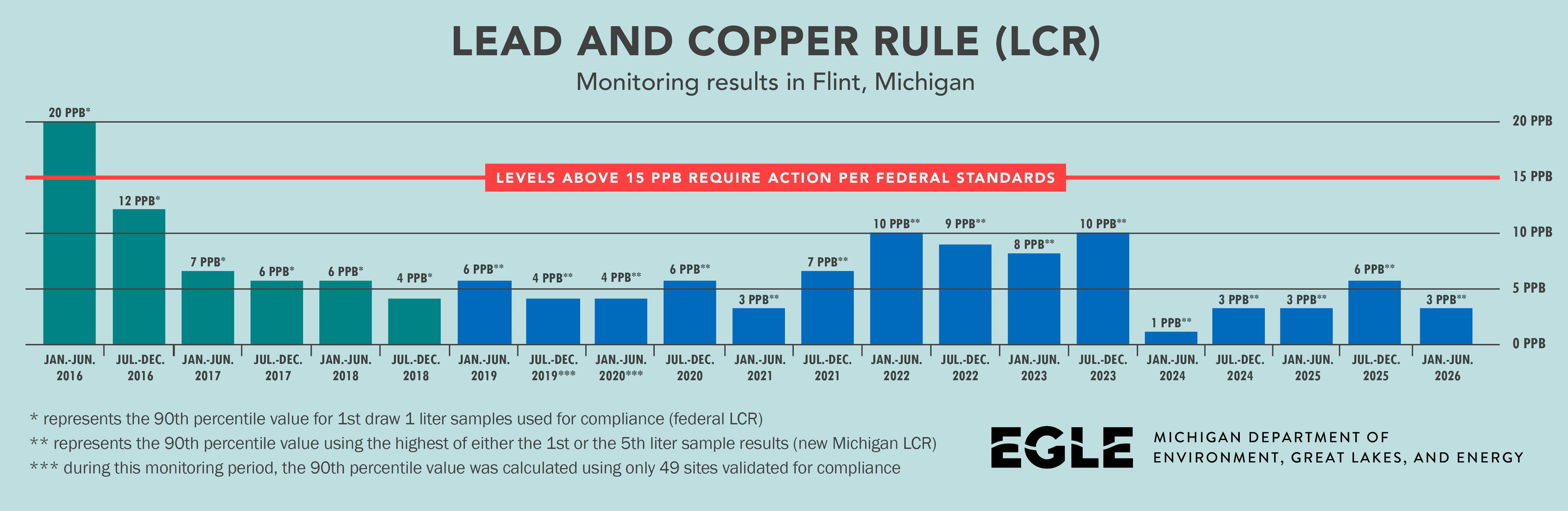
Since July 2016, the city of Flint's water system has tested below action levels of the federal LCR including Michigan’s tighter 12 ppb standard that went into effect in 2025. The federal standard remains at 15 ppb.
This most recent 6-month monitoring period included a larger number of business sites and contributed to an increase in the 90th percentile of 3 ppb from the first half of 2025. Business sites with low water usage and older plumbing can sometimes lead to higher lead results during a sampling period.
The latest test results were calculated from drinking water samples drawn from 61 homes and businesses known to have lead service lines. 45 of these sites were single-family homes and the other 16 were businesses or multi-family residences. As the vast majority of single-family residential (Tier 1) sites have had their lead service lines replaced and no longer meet the criteria for inclusion in the 90th percentile, more multi-family and non-residential (Tier 2) sites have been added to the city's sampling pool.
In July of 2025 the City of Flint and plaintiffs in the NRDC/Concerned Pastors Settlement Agreement confirmed that all lead service lines in the City of Flint covered by the agreement had been replaced.
According to the status report filed with the U.S. Eastern District Court, the final lead lines out of a total of nearly 11,000 lines identified in the agreement were replaced by July of 2025. More than 28,000 properties were excavated and checked for lead pipes during the replacement effort.
In addition to the completion of the replacement of the lead lines covered by the agreement, the state in May of 2024, filed a motion to assist the City of Flint in the final phase of restoration work at roughly 1,800 homes required under the settlement agreement. This allocated an additional $4,754,400 in yard and road restoration, and the final phase of non-residential service line replacement work in addition to the $97 million already spent on lead service line replacement and restorations in the city.
With roughly 98 percent of the residential lead service lines in the city replaced, EGLE continues to work with the City of Flint to replace the remaining Tier 1 and 2 service lines that had either opted out of the work performed under the previous settlement agreement or were discovered during the city’s inventory of service line materials that was completed in late 2024. Work to remove the remaining lines and complete property restoration work from the previous year will resume in the Spring of 2026. The city believes there are still roughly 500 lines requiring replacement.
Flint’s testing results can be found by visiting the State’s Flint Water website, Michigan.gov/FlintWater. Additional information about Michigan’s new testing requirements and results state-wide can be found at Michigan.gov/MiLeadSafe.