Seals of Biliteracy on Rise as Michigan Marks April is National Bilingual/Multilingual Advocacy Month
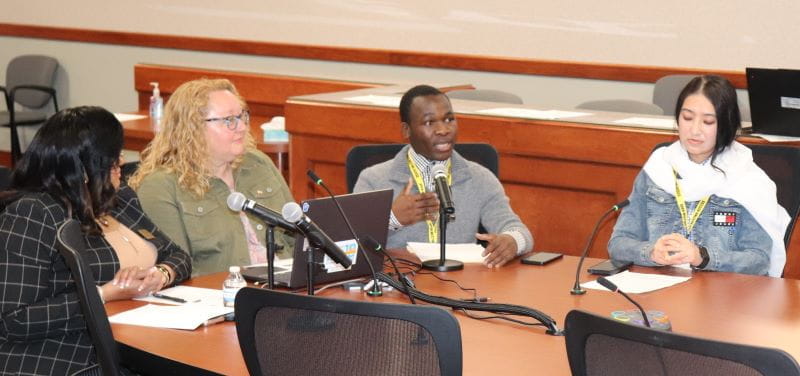 Peter Jepfte Ngboropeng Le, who earned a Seal of Biliteracy certification, speaks at today’s State Board of Education meeting as Suhaila Javed, another student who is a recipient of the seal, listens.
LANSING – A growing number of Michigan high school graduates are earning the Seal of Biliteracy certifying they are proficient in reading and writing in English and at least one other language.
In the 2024-25 school year, 2,797 graduates received the seal of biliteracy from the Michigan Department of Education (MDE), Kelly Alvarez, English learner consultant for the department, said during a presentation at today’s State Board of Education meeting. That was up from 2,253 the year before and 1,164 in 2018-19, the first full school year the seal was available.
Spanish was the most common language, with 1,817 students demonstrating proficiency in that language and English, followed by Arabic, with 266, and French, with 94.
April is National Bilingual/Multilingual Learner Advocacy Month.
“The Michigan Seal of Biliteracy provides future employers with a way of identifying people with biliteracy skills,” said State Superintendent Dr. Glenn Maleyko. “In today’s global society, many employers are looking for employees who have the ability to communicate in multiple languages, and colleges are looking for students with biliteracy skills.”
The biliteracy seal supports Goal 4 in Michigan’s Top 10 Strategic Education Plan, to expand secondary learning opportunities for all students.
Suhaila Javed, who is graduating from Lansing Everett High School this year, shared at the board meeting the importance of the Seal of Biliteracy.
“Speaking more than one language helps me think in different ways, communicate with more people and prepare for future careers,” she said. “Earning the Seal of Biliteracy shows that a student is ready to compete in global education and job markets. It also provides cultural knowledge, adaptability, and gives an advantage in college admissions.”
Javed, who was born in Afghanistan and whose first language is Dari, talked about learning English after coming to the U.S.
Peter Jepfte Ngboropeng Le, who came to the U.S. from Central Africa in 2024, speaks Pana, French, Fulani and English. He is graduating from Lansing Sexton High School this year with a biliteracy seal.
“The importance of biliteracy in 2026, from my experience being bilingual, strengthens the brain,” he told the board. “It improves problem-solving, multitasking, and even memory storage.”
He said his father’s ability to speak multiple languages helped the family survive when they crossed the river into Cameroon in 2014. “My father didn’t have a GPS or paper maps, but he had the sky and his voice,” he said. “Because he was multilingual, he could speak to every villager we met to ask for the safest paths and hidden water source. We drank from rivers and ate wild fruit to survive but it was the communication that led the 10-years-old me and my family to safety.”
Michigan is considered a top state for language diversity based on seals awarded for 44 languages in the 2022-23 school year. Students receive the seal if they pass approved biliteracy assessments and meet other high school graduation requirements. In some cases, seal recipients are English learners who came to the U.S. from another country. In other cases, they learned their family’s heritage language in addition to English or another language, sometimes by participating in Advanced Placement or International Baccalaureate programs.
In the 2024-25 school year, Michigan received successful biliteracy seal applications from 152 districts and entities, including traditional public schools, charter schools, private schools, cultural language schools and parents and students. The applications represented 60 languages.
Other languages for which at least 20 students received biliteracy seals in 2024-25 were: Bengali/Bangla, 55; Chinese/Mandarin, 55; Ukrainian, 55; German, 42; Sylheti, 39; Hindi, 24; Vietnamese, 23; and Portuguese, 21.
More information is available on the Michigan Seal of Biliteracy webpage or by emailing SealOfBiliteracy@Michigan.gov.
# # #