


Michigan DNR staff and partners continue to collect bat population data
Our beautiful state of Michigan is home to 9 bat species, 4 of which hibernate within abandoned mines across the Upper Peninsula between October and May. Bats play a vital role in ecosystems and human health by eating metric tons of insects, insects that damage agriculture crops, trees and can carry diseases that affect wildlife, pets and humans. During winter, Michigan DNR bat staff and their partners descend into hibernacula (places bats hibernate) to count bats and collect relevant data to help combat white-nose syndrome (WNS). WNS is a deadly fungal disease affecting hibernating bats throughout North America. WNS has caused significant declines in several bat species populations throughout their ranges including Michigan. Michigan DNR staff and their partners continue to collect data on bat populations and research strategies to mitigate the impacts of WNS and improve survival of our incredible, insect-loving bats!
Michigan’s annual winter-bat surveys are primarily conducted by two Michigan DNR Rare and Nongame Species Unit staff, made possible by State Wildlife Grant funds and White-nose Syndrome grants through the USFWS, with assistance from our amazing partners. Thank you to staff at the MDNR Parks and Recreation Division, local private mine owners, private landowners, tribal partners, citizen bat-roost monitors, partner universities and other agencies for another successful year of Michigan bat monitoring!
Michigan's bat season 2025–2026
Monitoring and surveys
Winter hibernacula surveys
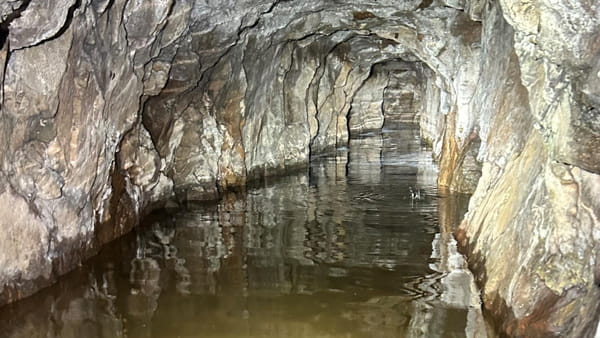
Michigan’s bat species use different strategies to survive the winter. While some migrate out of the state to warmer regions, others travel shorter distances to underground sites where temperatures stay cool but above freezing. These underground locations, known as hibernacula, allow bats to conserve energy throughout the winter months.
In Michigan, most hibernacula are historic, abandoned copper and iron mines located in the Upper Peninsula. Four of the state’s bat species rely on these mines for winter hibernation. This gives Michigan Department of Natural Resources (DNR) staff the opportunity to conduct annual surveys, monitor overwintering populations and track long-term trends.
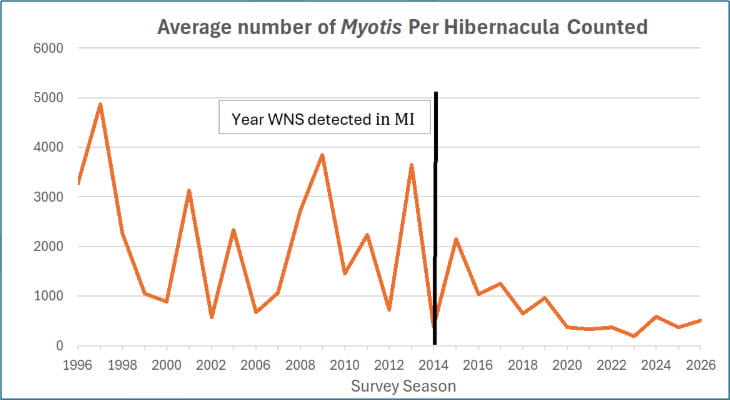
During the 2025–2026 season, DNR staff completed 36 surveys across Baraga, Dickinson, Keweenaw, Houghton and Ontonagon counties. Results show that little brown bat populations have stabilized in recent years and are beginning to slowly increase at several hibernacula. However, northern long-eared bats remain at very low numbers, emphasizing the importance of continued monitoring and conservation efforts to support this state and federally endangered species.
- We surveyed 24 unique sites, counting over 13,000 bats of all species
- Little brown bats were observed in 22 of our surveys, totaling over 12,000
- Big brown bats totaled 902 across 15 unique sites
- 12 tricolored bats were observed at 4 sites this survey season
- Northern long-eared bat populations continue to decline; we observed only 1 individual in 1 site this season
Michigan bat roost monitoring program
In 2025, the MDNR and Michigan Natural Features Inventory (MNFI) introduced the Michigan Bat Roost Monitoring Program to help bridge gaps in our understanding of Michigan’s bats by utilizing community scientists. Thank you to our volunteers for a successful first season and your help in guiding bat conservation across the state! If you are interesting in becoming a Bat Roost Monitor in Michigan, please visit the MBRMP program website for more information.
- 139 summer bat roosts reported (133 in the Lower Peninsula & 6 in the Upper Peninsula)
- 7 emergence surveys conducted (when bats leave their roost to feed at night or leave for the winter)
Summer mist netting
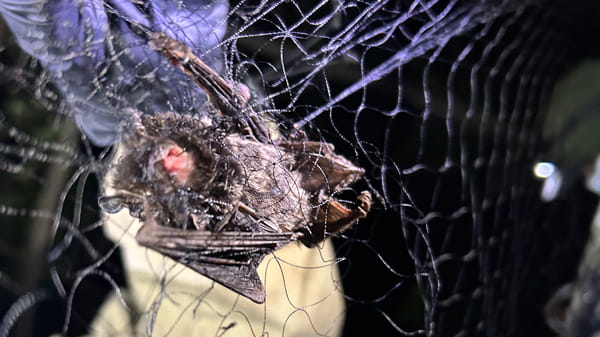
After hibernation, bats in the Midwest leave their winter sites to travel far-and-wide in search of summer roosting habitats (typically trees) and insects to eat. For the second year, the Michigan DNR participated in the “2025 Michigan Bat Blitz.” The event was hosted by the Keweenaw Bay Indian Community and included the Sault Tribe of Chippewa Indians, Little Traverse Bay Bands of Odawa Indians, Pokagon Band of Potawatomi, Bay Mills Indian Community and the U.S. Fish and Wildlife Service. The Bat Blitz took place in early August this year in the woods just outside Alberta in Baraga County.
- 3 nights of netting for a total of 15 mist net-nights (5 nets set each night for 3 nights)
- 6 bats caught and released
- 3 species: little brown bat (Myotis lucifugus), silver-haired bat (Lasionycteris noctivagans) and red bat (Lasiurus borealis)
Outreach and projects
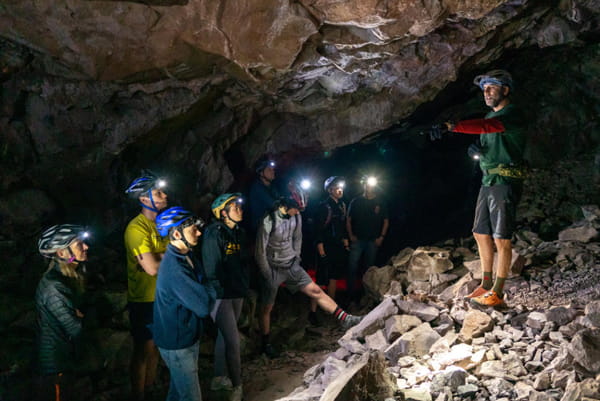
DNR bat staff maintains a year-round commitment to bridge the gap between scientific research and public awareness. By blending community engagement with conservation strategies, our team ensures that Michigan’s bat populations remain a priority – both in the classroom and the field. To elevate bat conservation awareness, we prioritize reaching a diverse audience through engagement with our local communities, schools, universities and continued participation in professional organizations.
- In honor of Earth Day 2026, our team shared their expertise and enthusiasm at both the Munising School Public Library and AuTrain-Onota Public Schools
- We represented the DNR at the Michigan Technological University annual career fair
- Staff participated in live question-and-answer panels following multiple screenings of a bat-themed documentary
- Continued participation in the Midwest Bat Working Group
- Chaired, planned and hosted the Michigan Bat Working Group (May 14, 2026)
Research associations
Rigorous fieldwork requires cross-departmental and multi-agency collaboration to develop conservation management strategies, providing recommendations to stakeholders and mitigate further loss. By contributing to these multi-agency groups and relevant research projects, we ensure that Michigan’s management practices are aligned with regional goals, allowing us to lead the way in bat conservation efforts across the Midwest and beyond.
- Virginia Tech = Disease transmission and microclimate of WNS-affected populations. We continued our long partnership with Virginia Tech University researchers with their long-term studies of bats and impacts from WNS.
- Western Michigan University, Rutgers University and Ball State University = UV treatment to reduce Pd loads and increase overwinter bat survival. We continue to provide logistical support for their sampling efforts.
- Michigan Technological University = Partnership and co-principal investigator on a research project cooling hibernacula to reduce the impacts from WNS on hibernating bats.
- University of Montana = Genetics and WNS. Program staff were involved in a national research effort led by the University of Montana to characterize genetic population structure and connectivity, identify genes that allow some bats to survive WNS and forecast population responses to WNS. In the spring of 2025, DNR staff and partners processed 90 bats for this project at 5 sites.
Recent Publications
- ICF. 2023. “Lake States Forest Management Bat Habitat Conservation Plan”. Fairfax, VA.
- Michigan Department of Natural Resources2024. “State Forest Management Plan”. Michigan Department of Natural Resources, Lansing, MI. 1766 pp.
- Barnes, T. M., Wolfe, J. D., Kurta, A., Smith, S. M., & Depue, J. E. (2026). “Relationship of temperature with declines and persistence of Myotis lucifugus after white‐nose syndrome”. Conservation Biology, e70236.
- John E. DePue, Jennifer A. Wong and Anthony K. Henehan. 2026. “Michigan’s Wildlife Action Plan: 2025-2035, Mines and Caves”. Michigan Department of Natural Resources, Lansing, MI.