Turkey management (pg. 4)
The Michigan Department of Natural Resources is committed to the
conservation, protection, management, use and enjoyment of the state’s
natural and cultural resources for current and future generations.
The Michigan Natural Resources Commission is a seven-member public
body whose members are appointed by the governor. The NRC has exclusive
authority to
regulate the taking of game and sportfish, and is authorized to
designate game species and authorize the establishment of the first
open season for animals through the issuance of orders. The NRC
conducts
monthly, public meetings in locations throughout Michigan. Citizens are
encouraged to become actively involved in these public forums. For more
information, visit Michigan.gov/NRC.
This program receives federal financial assistance from the U.S.
Fish and Wildlife Service. Under Title VI of the 1964 Civil Rights Act,
Section 504 of the Rehabilitation Act of 1973, Title II of the
Americans with Disabilities Act of 1990, the Age Discrimination Act of
1975 and Title IX of the Education Amendments of 1972, the U.S.
Department of the Interior prohibits discrimination on the basis of
race, color, national origin, age, sex or disability. If you believe
that you have been discriminated against in any program, activity or
facility, or if you need more information, please write to: Office of
Diversity, Inclusion and Civil Rights, Department of the Interior, 1849
C Street, NW, Washington, D.C. 20240.
NOTICE: This document is not a legal notice or a complete collection
of hunting regulations and laws. It is a summary of regulations issued
for hunters’ convenience. Copies of wildlife conservation orders, which
contain complete listings of regulations and legal descriptions, are
available at Michigan.gov/DNRLaws.
Return to table of contents
Managing turkeys (pg. 4)
Managing turkeys in Michigan involves the complex interactions of
turkey populations, their habitat and their relationship to people.
Hunting plays an important role in managing turkeys by regulating their
numbers. The goal of the spring turkey hunting season is to maximize
hunter opportunity while maintaining a satisfactory hunting experience.
License quotas are developed to harvest the desired number of turkeys
to meet management goals. For more information on turkey management in
Michigan, visit Michigan.gov/Turkey.
Return to table of contents
Season dates and hunting hours (pg. 4)
Spring
turkey hunting season dates and license quotas (pg. 4)
Why do
the spring turkey season dates change each year?
Spring turkey season dates are determined by a formula defined in
the Wildlife Conservation Order. Each year, the spring turkey season is
the second-to-last Saturday in April through a defined number of days
thereafter.
How many
spring turkey licenses are available in 2027?
Spring turkey licenses are valid for specific turkey management
units and hunting dates. In many TMUs, license availability is subject
to a license quota. The 2027 spring turkey hunting season dates and
license quotas are detailed in the following table:
| TMU |
Season dates |
License quota |
Hunt number |
| M |
April 17 – May 31 |
6,000 |
0110 |
| NN |
April 17 – April 30
|
18,000 |
0201 |
| Statewide |
May 1 – May 31 |
Unlimited |
0234 |
| ZZ* |
April 17 – May 31 |
Unlimited |
0301 |
| ZZ |
April 17 – April 30
|
8,000 |
0302 |
| ZZ |
May 1 – May 31 |
8,000 |
0303 |
*Private land only
Which
types of lands can I hunt with a general license?
A general license is valid on all public and private lands within
the TMU. All spring turkey hunt numbers, except Hunt 0234 and Hunt
0301, are for general licenses.
What is Hunt 0234?
Hunt 0234 is a statewide, guaranteed spring turkey license that does
not require an application in the drawing.
Where can I hunt
with a Hunt 0234 license?
With the Hunt 0234 license, you can hunt on:
- Public and private lands in the Upper Peninsula (TMU M).
- Public and private lands in the northern Lower Peninsula (TMU NN).
- Private lands only in the southern Lower Peninsula (TMU ZZ).
- Fort Custer military lands with permission.
What is Hunt 0301?
Hunt 0301 is a guaranteed spring turkey license, valid only for
private lands within TMU ZZ. You must have permission from the
landowner. Hunt 0301 is not valid on county, state or federal lands.
Exception: Licenses valid for Hunt 0301 can be used to hunt Fort Custer
military lands with permission. Hunt 0301 does not require an
application in the drawing.
When
can I purchase a Hunt 0234 license or a Hunt 0301 license?
You can purchase a Hunt 0234 license or a Hunt 0301 license
beginning March 15 at 10 a.m. Eastern Time. Hunt 0234 and Hunt 0301
have unlimited quotas and can be purchased throughout the entire spring
turkey hunting season.
Return to table of contents
Spring turkey management units (pg. 6)
Where
can I find descriptions of spring turkey management unit boundaries?
For detailed descriptions of spring turkey management unit
boundaries, visit Michigan.gov/DNRLaws
or contact a DNR customer service center, listed at Michigan.gov/ContactDNR.
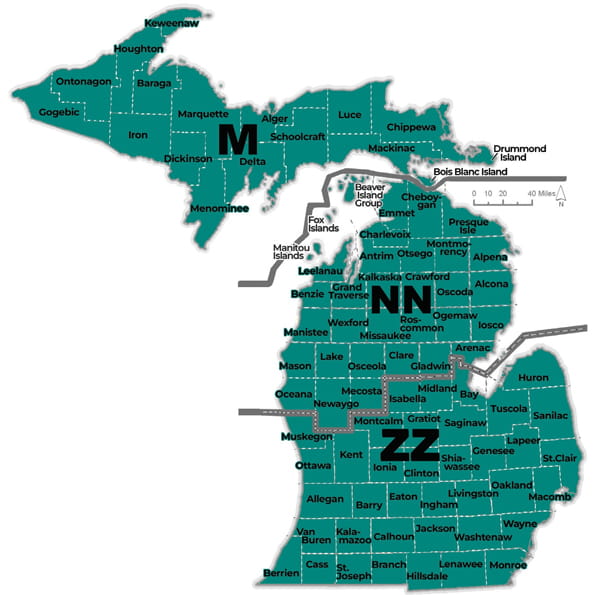
| Map symbol |
Description |
 |
Units open to spring turkey hunting |
 |
Unit boundaries |
 |
County boundaries |
Isle Royale (not pictured), part of
Keweenaw County, is closed to spring turkey hunting.
Return to table of contents
Bag limits (pg. 7)
How
many turkeys can I harvest with a spring turkey license?
You can harvest one bearded turkey per spring turkey license.
Can
I harvest a turkey without a beard during the spring turkey season?
No. You can only harvest a bearded turkey during the spring turkey
season.
Return to table of contents
Hunting hours (pg. 8)
When is it
legal for me to hunt spring turkeys?
Legal hunting hours for spring turkeys (one-half hour before sunrise
to one-half hour before sunset) for Zone A are published in the table. To
determine the opening (a.m.) or closing (p.m.) time in another zone,
add the minutes shown on the map for the zone to the time from the Zone
A hunting hours table.
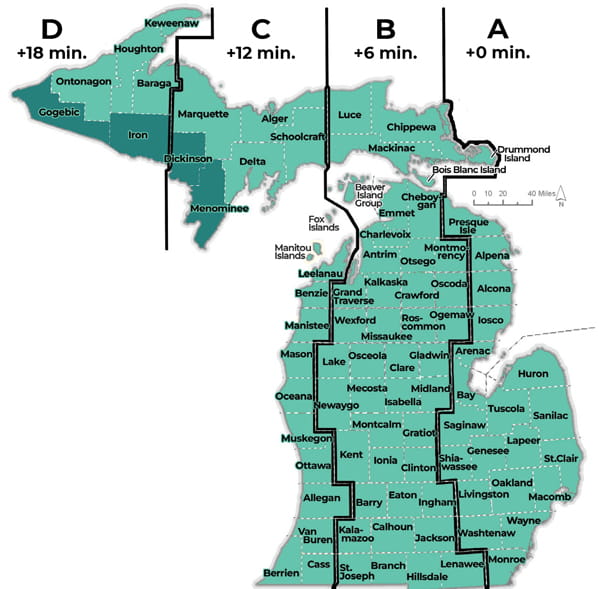
| Map symbol |
Description |
 |
Hunting time zone boundaries |
 |
Eastern time zone counties |
 |
Central time zone counties |
|
County boundaries |
Isle Royale (not pictured), part of
Keweenaw County, is closed to hunting and trapping.
Zone A hunting
hours table (April 2027 – May 2027)
Hunting hours listed are one half-hour before sunrise to one-half
hour before sunset. The hunting hours listed in the table reflect
Eastern Time, adjusted for daylight saving time where appropriate. If
you are hunting in Gogebic, Iron, Dickinson or Menominee counties
(Central Time), you must make an additional adjustment to the published
time by subtracting one hour.
| Date |
Time Zone A a.m. |
Time Zone A p.m. |
April 17
|
6:18
|
7:46
|
| April 18 |
6:17 |
7:47 |
| April 19 |
6:15 |
7:48 |
| April 20 |
6:14 |
7:49 |
| April 21 |
6:12 |
7:50 |
| April 22 |
6:11 |
7:52 |
| April 23 |
6:09 |
7:53 |
| April 24 |
6:08 |
7:54 |
| April 25 |
6:06 |
7:55 |
| April 26 |
6:05 |
7:56 |
| April 27 |
6:03 |
7:57 |
| April 28 |
6:02 |
7:58 |
| April 29 |
6:00 |
7:59
|
| April 30 |
5:59 |
8:01 |
| May 1 |
5:58 |
8:02 |
| May 2 |
5:56 |
8:03 |
| May 3 |
5:55 |
8:04 |
| May 4 |
5:54 |
8:05 |
| May 5 |
5:52 |
8:06 |
| May 6 |
5:51 |
8:07 |
| May 7 |
5:50 |
8:08 |
| May 8 |
5:49 |
8:09 |
| May 9 |
5:48 |
8:10 |
| May 10 |
5:46 |
8:11 |
| May 11 |
5:45 |
8:13 |
| May 12 |
5:44 |
8:14 |
| May 13 |
5:43 |
8:15 |
| May 14 |
5:42 |
8:16 |
| May 15 |
5:41 |
8:17 |
| May 16 |
5:40 |
8:18 |
| May 17 |
5:39 |
8:19 |
| May 18 |
5:38 |
8:20 |
| May 19 |
5:37 |
8:21 |
| May 20 |
5:36 |
8:22 |
| May 21 |
5:35 |
8:23 |
| May 22 |
5:35 |
8:24 |
| May 23 |
5:34 |
8:25 |
| May 24 |
5:33 |
8:26 |
| May 25 |
5:32 |
8:26 |
| May 26 |
5:32 |
8:27 |
| May 27 |
5:31 |
8:28 |
| May 28 |
5:30 |
8:29 |
| May 29 |
5:30 |
8:30 |
| May 30 |
5:29 |
8:31 |
| May 31 |
5:29 |
8:32 |
Return to table of contents
Spring turkey drawing system (pg. 10)
Drawing system overview (pg. 10)
How does the
spring turkey drawing system work?
Hunters are selected for a spring turkey license using a random
drawing system. In the annual drawing, Michigan residents and
nonresidents are equally eligible for selection and license purchase.
For more information on the spring turkey drawing, visit Michigan.gov/Turkey.
Return to table of contents
Eligible applicants (pg. 11)
Who is eligible to
apply for the drawing?
The following people are eligible to apply for a spring turkey
license (unless they have an active revocation or are otherwise
ineligible):
- A person who is or will be 17 years old or older during the hunt
period for which the person is applying for and has a hunter education
certificate.
- A person who is licensed as an apprentice hunter.
I am 10-16
years old. Can I apply for the drawing?
No. If you are 10-16 years old, you can purchase a spring turkey
youth license, so there is no need to apply. Go to the Spring turkey
license section for more information.
I
am not a resident of Michigan. Can I apply for the drawing?
Yes. You can apply for the Michigan spring turkey drawing as a
nonresident.
Return to table of contents
When
is the application period for the 2027 spring turkey drawing?
The application period is Jan. 1 – Feb. 1, 2027.
How much is an application?
An application is $5.
How many
spring turkey applications can I purchase?
You can only purchase one spring turkey application per year. You
can apply for a spring turkey license valid for a specific TMU during
specific season dates.
What
is the difference between "first hunt choice" and "second hunt choice"?
First hunt choices have priority for selection. When
applying, you must choose a first hunt choice and may also choose an
optional
second hunt choice. If you choose a second hunt choice, it will be
considered
only if licenses remain for that hunt number after all first hunt
choices have
been awarded for all applicants. There is no guarantee that licenses
will be
available for second hunt choices in any hunt number.
Which
identification do I need to purchase an application?
To purchase an application in Michigan, you must have one of the
following forms of identification:
- Valid Michigan driver’s license.
- Valid nonresident driver’s license.
- State of Michigan ID card (issued by the Secretary of State).
- Michigan DNR Sportcard.
Where can I purchase an
application?
You can purchase an application from any license agent, online at Michigan.gov/DNRLicenses or
through the Michigan DNR Hunt Fish app. The app is available for
download at the Google Play Store or the Apple App Store. Find a
license agent at
Michigan.gov/DNRLicenseAgents.
How do I apply for the drawing?
- Review the spring TMU map in the Spring turkey management units section
and choose the TMU(s) you want to hunt.
- Review the spring turkey hunt table in the Spring turkey hunting season dates and
license quotas
section to find your desired season dates for the TMU(s) you chose.
Make note of the corresponding hunt number(s) and be sure to select
this number when purchasing your application.
- Purchase an application for the hunt number(s) you chose (you can
select two hunt numbers — first and second choice).
- Check your receipt for accuracy and retain it as proof of your
application.
Can I apply to hunt
with other hunters?
Yes. You can apply in a party with one other person. If you apply
with more than one person, you will be ineligible for the drawing.
Everyone in the party will receive a license if the party is selected,
except for those who submit an invalid application.
How do I apply
with someone else as a party?
The first person to apply (either you or the other member of the
party) selects the hunt number(s) and receives a “party ID” number,
which is printed on the application receipt. A new party ID number is
issued each year. Then, the other person uses the party ID number when
applying to complete the party. Make sure to verify the party ID number
is identical on both receipts.
The
receipt I received is not printed clearly or has an error. What do I do?
You are responsible for obtaining a DNR application receipt that
correctly states your customer ID and hunt choice. Do not accept a
receipt that is not legible. Check your receipt for accuracy and retain
as proof that you applied. Ensure any application errors are corrected
prior to the application deadline. If you submit an invalid
application, you will be ineligible for the drawing.
I am having trouble
applying. What do I do?
You can call 517-284-9453 for assistance.
Return to table of contents
Drawing results (pg. 12)
When will drawing
results be available?
Drawing results will be available on March 1, 2027.
How do I check my drawing
results?
You can check your drawing results online at Michigan.gov/DNRLicenses,
through the Michigan DNR Hunt Fish app or by calling 517-284-9453. You
are responsible for obtaining your drawing results.
What
happens if I am successful in the drawing?
You can purchase the license for which you were selected. Go to the Licensing section for
more information.
Can I sell my drawing success?
No. You cannot sell your spring turkey drawing success to another
person.
Can I transfer my drawing
success?
No. You cannot transfer your spring turkey drawing success to
another person.
What
happens if I am not successful in the drawing?
If you applied in the drawing and were unsuccessful, you can
purchase a leftover license for another hunt number with a quota
remaining beginning March 8 at 10 a.m. ET. Depending on how many
hunters apply, leftover licenses may or may not be available for some
spring turkey management units and/or hunt period dates. Go to the Leftover licenses section for more
information.
What happens if
I didn’t apply for the drawing?
If you didn’t apply for the drawing, you have three options. You can
purchase one of the following, beginning March 15 at 10 a.m. ET:
- A leftover license, if available.
- A Hunt 0234 license.
- A Hunt 0301 license.
Go to the Spring turkey hunting
season dates and license quotas and Leftover licenses sections for more
information.
Return to table of contents
Leftover licenses (pg. 13)
Are there always
leftover licenses available?
No. There is no guarantee that leftover licenses will be available for
any hunt number, except Hunt 0234 and Hunt 0301, which have unlimited
quotas. Current leftover license and permit availability may be viewed
at Michigan.gov/DNRLicenses.
When
can I purchase a leftover license if I was not successful in the drawing?
If any licenses remain after the drawing and you have a current base
license, you can purchase a leftover spring turkey license on a
first-come, first-served basis beginning March 8 at 10 a.m. ET.
When
can I purchase a leftover license if I didn’t apply for the drawing?
If any licenses remain as of March 15 at 10 a.m. ET and you have a
current base license, you can purchase a leftover spring turkey license
on a first-come, first-served basis, or a Hunt 0234 or Hunt
0301 license.
I
am not a resident of Michigan. Can I purchase a leftover license?
Yes. You can purchase a leftover spring turkey license as a
nonresident, if available.
How
many leftover spring turkey licenses can I purchase?
You can only purchase one spring turkey license (awarded in the
drawing or leftover) per year.
Return to table of contents
Licensing (pg. 14)
Identification requirements (pg. 14)
Which
identification do I need to purchase a license?
To purchase a hunting license in Michigan, you must have one of the
following forms of identification:
- Valid Michigan driver’s license.
- Valid nonresident driver’s license.
- State of Michigan ID card (issued by the Secretary of State).
- Michigan DNR Sportcard.
What is a DNR Sportcard?
A DNR Sportcard serves as a valid form of identification for people
without a driver’s license. There are no age restrictions or residency
requirements for purchase. A DNR Sportcard is not required if you have
a valid state-issued driver’s license or ID card. A DNR Sportcard with
accurate information can be used from year to year.
Do I qualify as a Michigan
resident?
To qualify for as a Michigan resident, you must meet one of the
following criteria:
- Reside in a settled or permanent home or domicile within the
boundaries of this state with the intention of remaining in this state.
Resident status can only be claimed in one state.
- Be a full-time student at a Michigan college or university and
reside in the state during the school year.
- Serve full-time in the U.S. military and be officially stationed
in Michigan.
- Serve full-time in the U.S. military and maintain residency in
Michigan.
I
own land in Michigan but live in a different state. Can I purchase a
resident hunting license?
No. The ownership of land in Michigan by itself is not a
qualification for a resident license. You would be considered a
nonresident.
Do I have
to carry my hunting license(s) when hunting?
Yes. When hunting, you must carry your applicable hunting license(s)
and the identification used to purchase the license(s) and present them
upon demand of a Michigan conservation officer, a tribal conservation
officer or any law enforcement officer. If you are using an electronic
kill tag, you must be able to present the electronic kill tag on your
mobile device.
Return to table of contents
Hunter education (pg. 15)
Is
hunter education required for purchasing a license?
Yes. If you were born on or after Jan. 1, 1960, you must present
your hunter education certificate or previous hunting license to
purchase your license. An apprentice license, mentored hunting license
or equivalent does not satisfy the requirement of previous hunting
experience. Individuals
who are qualified to hunt under the Mentored Hunting Program are exempt
from the hunter education requirements (go to the Mentored hunting
section for more information). A valid hunter education certificate
from
another state meets this requirement. Michigan’s hunter education
courses are offered throughout the year around the state. The online
course can be found at Michigan.gov/HunterEducation.
For a replacement Michigan hunter education certificate, visit Michigan.gov/RecreationalSafety.
What
are the rules for a youth hunter 10-16 years old who has a hunter
education certificate?
A youth hunter 10-16 years old who has a hunter education
certificate must be accompanied by an adult 18 years old or older while
hunting, unless the youth is hunting on land where a parent or guardian
regularly lives.
I
am new to turkey hunting. Is there a program to help new hunters like
me?
Yes. The DNR, Michigan Wild Turkey Hunters
Association, National Wild Turkey Federation and other groups may offer
wild
turkey hunter orientation courses. A fee may be charged, and space may
be
limited. For details about events, visit Michigan.gov/Turkey.
Return to table of contents
License types and fees by age (pg. 15)
Where can I
purchase a Michigan hunting license?
You can purchase a Michigan hunting license from any license agent,
online at Michigan.gov/DNRLicenses
or through the Michigan DNR Hunt Fish app. The app is available for
download at the Google Play Store or the Apple App Store. Find a
license agent at Michigan.gov/DNRLicenseAgents.
| License type |
Youth age 9 and under |
Youth age 10–16 |
Resident age 17–64 |
Resident senior age 65+ |
Nonresident age 17+1 |
| Base license* — valid through March 31, 2028 |
N/A |
$6 |
$11 |
$5 |
$151 |
| DNR Sportcard2 |
$1 |
$1 |
$1 |
$1 |
$1
|
| Hunt/fish combo license* |
N/A |
N/A |
$76 |
$43 |
$266 |
| Inclusive mentored license3 |
$0 |
$0 |
$0 |
$0 |
$0 |
| Mentored youth license |
$7.50 |
N/A |
N/A |
N/A |
N/A |
| Pure Michigan Hunt application |
N/A |
$5 |
$5 |
$5 |
$5 |
| Spring turkey application |
N/A |
N/A |
$5 |
$5 |
$5 |
| Spring turkey license |
N/A |
N/A |
$15 |
$6 |
$15 |
| Spring turkey youth license |
N/A |
$15 |
N/A |
N/A |
N/A |
*One dollar from each of these licenses will be used to educate the
public on the benefits of hunting, fishing and trapping in Michigan and
the impact of these activities on the conservation, preservation and
management of the state’s natural resources.
1Nonresidents under 17 years old may purchase a resident base
license.
2A DNR Sportcard is not required if you have a valid state-issued
driver’s license or ID card.
3The inclusive mentored license package is only available for
qualified individuals at DNR offices, online at Michigan.gov/DNRLicenses
or through the Michigan DNR Hunt Fish app.
Resident active-duty U.S. military personnel and Michigan veterans
with a 100% disability rating can obtain a leftover spring turkey
license free of charge beginning March 15. Licenses are full price for
those who apply for a license and are selected in the drawing.
Return to table of contents
Mentored hunting (pg. 16)
What is the Mentored
Hunting Program?
The Mentored Hunting Program is a set of rules that establishes the
mentored youth license package and the inclusive mentored license
package.
What
are the rules for a mentor participating in the Mentored Hunting
Program?
A mentor is responsible for the mentored hunter’s actions in the
field. The mentored hunter must always be within arm's length of the
mentor. A mentor must ensure the hunting device (bow, crossbow or
firearm) used by the mentored hunter is properly fitted and
appropriately
suited for the mentored hunter. A mentor can only carry two hunting
devices in the field while mentoring. To participate as a mentor in the
Mentored
Hunting Program, you must meet all of the following qualifications:
- Be at least 21 years old.
- Have previous hunting experience.
- Possess a current-year Michigan base license that is not an
apprentice license.
What is the mentored youth
license?
The mentored youth license is a license package that allows resident
and nonresident youth hunters 9 years old and younger to hunt small
game, waterfowl, turkey (spring and fall) and deer, trap furbearers and
fish for all species with a qualified mentor. It also allows the
mentored youth hunter to apply for or purchase additional licenses
including antlerless deer, bear and elk. Elk applications and licenses
are only available to residents. The mentored youth license and
kill tags will remain valid for the duration of the license year, even
if the mentored youth hunter turns 10 years old during the year. The
spring turkey license issued with the mentored youth license is valid
for one bearded turkey in any open spring turkey management unit on
public or private lands.
What is the inclusive
mentored license?
The inclusive mentored license is a license package that allows
individuals with developmental disabilities to hunt small game,
waterfowl, turkey (spring and fall) and deer, trap furbearers and fish
for all species with a qualified mentor. It also allows the mentored
hunter to apply for or purchase additional licenses including
antlerless deer, bear and elk. Elk applications and licenses are only available to residents. The spring turkey license issued with
the inclusive mentored license is valid for one bearded turkey in any
open spring turkey hunt unit on public or private lands.
Who qualifies
for the inclusive mentored license?
To qualify for the inclusive mentored license, one of the following
must apply:
- The mentored individual is a minor child with a developmental
disability and is unable to complete hunter education.
- The mentored individual is an adult with a developmental
disability, has a guardian appointed under chapter 6 of the mental
health code (1974 PA 258, MCL 330.1600 to 330.1644) and is unable to
complete hunter education.
Where
can I purchase the inclusive mentored license package?
You can purchase an inclusive mentored license package from any DNR
office, online at Michigan.gov/DNRLicenses
or through the Michigan DNR Hunt Fish app.
Return to table of contents
Apprentice hunting (pg. 17)
What is the Apprentice
Hunting Program?
The Apprentice Hunting Program allows a person, resident or
nonresident, who does not have a hunter education certificate and is 10
years old or older to hunt during the current hunting seasons with a
qualified mentor. An apprentice hunter will need to purchase a base
apprentice license to participate. Additional licenses are required to
harvest bears, deer, elk, furbearers turkeys and waterfowl.
How
many times can I purchase a base apprentice license?
You can purchase a base apprentice license for up to two license
years before you must successfully complete a hunter education course
and purchase a regular base license.
I
am an apprentice hunter. Can I purchase a spring turkey license?
Yes. If you are licensed under the Apprentice Hunting Program, you
can purchase a spring turkey license awarded in the drawing or a
leftover spring turkey license, if available.
I am an
apprentice hunter. Can I hunt by myself?
No. If you are licensed under the Apprentice Hunting Program, you
must be accompanied by someone 21 years old or older who has a regular
base license and a current-year hunting license for the same game you
are hunting. If you are an apprentice hunter who is 10-16 years old,
your accompanying mentor must be your parent, guardian or someone
designated by your parent or guardian who is at least 21 years old. A
mentor can accompany no more than two apprentice hunters while hunting.
Does
my accompanying mentor need to have a spring turkey license for the
same TMU or season dates as me?
For hunting spring turkey, your accompanying mentor needs a
current-year spring turkey license, but it does not have to be for the
same TMU or season dates as your spring turkey license.
How
close do I need to be to my accompanying mentor during the hunt?
Your accompanying mentor must be able to come to your immediate aid
and stay within a distance that permits uninterrupted, unaided visual
and auditory contact.
Return to table of contents
U.S. military
personnel and Michigan veterans (pg. 18)
I
am a resident of Michigan and in the military. Do I get a discount?
Yes. If you are a full-time, active-duty member of the federal U.S.
military and have maintained Michigan resident status, your hunting
license fees are waived, except for hunting licenses obtained through a
drawing. You must present military ID, leave papers, duty papers,
military orders or other evidence verifying that you are an active-duty
member of the military, along with a valid Michigan driver’s license or
voter registration card.
I
am not a resident of Michigan and in the military. Do I get a discount?
No. Hunting license fees are not waived for nonresidents, even if
you are a full-time, active-duty member of the federal U.S. military.
I
am a Michigan veteran with a disability. Do I get a discount?
Yes. Michigan resident veterans with a service-connected disability
are eligible to obtain any hunting license that does not require a
separate application free of charge, if one of the following conditions
is met:
- You have been determined by the United States Department of
Veterans Affairs to be permanently and totally disabled as a result of
military service and entitled to veterans’ benefits at the 100% rate,
for disabilities other than blindness.
- You have been rated by United States Department of Veterans
Affairs as individually unemployable.
Documentation of eligibility from the Veterans Administration
stating either of the above conditions should be in the possession of a
veteran when obtaining free licenses and while afield. For more information on hunters with disabilities, visit Michigan.gov/DNRAccessability.
Return to table of contents
Treaty-authorized hunters (pg. 19)
Can I hunt with a tribal
member?
Yes. You can hunt with a tribal member who is present and actively
hunting if you possess a state-issued hunting license for the
applicable species and season for which you are hunting. You must
follow all applicable state spring turkey hunting regulations.
Return to table of contents
Base license (pg. 19)
What is a base license?
A base license is required for everyone who hunts in Michigan. A
base license provides funding for habitat and conservation work on both
public and private land and supports the work of conservation officers
and field staff to ensure safe, legal hunting and trapping practices
are followed. A base license is not a kill tag and is valid for hunting
small game. Additional licenses are required to hunt and trap other
species. Hunters are always encouraged to carry their base license
when hunting.
Armadillos, porcupines and Russian boars may be taken year-round,
statewide with a valid base license.
When can I purchase the
2027 base license?
The 2027 base license will be available for purchase from any license
agent, online at Michigan.gov/DNRLicenses
or through the Michigan DNR Hunt Fish app beginning March 1, 2027.
Return to table of contents
Hunt/fish combo license (pg. 19)
What is the hunt/fish
combo license?
The hunt/fish combo license is a license package that includes an
annual fishing license good for all species on any Michigan body of
water, a base license that allows small game hunting and a deer combo
license (regular and restricted kill tags) valid in both archery and
firearm seasons.
Return to table of contents
Spring turkey license (pg. 19)
What is a spring turkey
youth license?
A spring turkey youth license is a kill tag that allows an
individual 10-16 years old to harvest a turkey on all public and
private lands within any open spring TMU and season dates. Spring
turkey youth licenses will be available for purchase beginning March 1,
2027. You must have permission from the landowner to hunt on private
property.
What is a spring turkey
license?
A spring turkey license is a kill tag that allows an individual 17
years old or older to harvest a turkey within a designated TMU and hunt
period during the spring turkey season.
I
was successful in the drawing, but cannot purchase my spring turkey
license. Why not?
While an application can be purchased prior to obtaining a base
license, you must purchase a 2027 base license before you can purchase
a spring turkey license.
What
kill tag options do I have when I purchase a spring turkey license?
When you purchase a spring turkey license, you will have the option
to receive an electronic kill tag (eHarvest tag) or a traditional paper
kill tag, depending on where you purchase your spring turkey license.
I
purchased my spring turkey license online at Michigan.gov/DNRLicenses.
When will I get my paper kill tag?
If you purchased your spring turkey license online at Michigan.gov/DNRLicenses,
your paper kill
tag will be mailed to you 10 to 15 business days after your purchase.
You cannot go hunting without the paper kill tag in your possession.
I
purchased my spring turkey license through the Michigan DNR Hunt Fish
app. When will I get my eHarvest tag?
If you purchased your spring turkey license through the Michigan DNR
Hunt Fish app, your eHarvest tag will be available on your mobile
device immediately after purchase. You must be able to present the
eHarvest tag on a
mobile device while in the field. You will not receive a paper kill tag.
Which
types of lands can I hunt with a spring turkey license?
A spring turkey license is valid on all public and private lands
within the designated TMU, except spring turkey licenses for Hunt 0234
(go to the Spring turkey hunting
season dates and license quotas section
for location restrictions) and Hunt 0301 (private lands only). You must
have permission from the landowner to hunt on private property.
Can I
purchase more than one spring turkey license?
No. You cannot purchase more than one spring turkey license per year.
Can
I purchase a Hunt 0234 license or a Hunt 0301 license in addition to a
general license?
No. You can only purchase one spring turkey license per license year.
I
am licensed under the Mentored Hunting Program. Can I purchase a spring
turkey license?
No. If you are licensed under the Mentored Hunting Program, you
automatically receive a spring turkey license. Go to the Mentored hunting section for more
information.
Can
I allow someone else to hunt using my spring turkey license?
No. You cannot use another person’s kill tag or allow another person
to use your kill tag. It is illegal for a hunter to harvest or attempt
to harvest a turkey unless the hunter has an unused spring turkey
license issued in their name for the TMU and season dates in which they
are hunting.
Can I use
the same kill tag on more than one turkey?
No. You cannot use a kill tag more than once.
Can I
use my kill tag on a turkey someone else harvested?
No. You cannot use your kill tag on a turkey you did not harvest.
Return to table of contents
What if I lost my non-kill tag(s)?
Non-kill tags are licenses without kill tags, including the base license. If you lost your non-kill tag(s), you can:
- Visit a license agent and have your non-kill tag(s) replaced for $3
each by providing the identification number used for the original
purchase.
- Login online at Michigan.gov/DNRLicenses to access your purchase history and reprint your non-kill tag(s) at no cost.
- If you originally purchased your non-kill tag(s) online at Michigan.gov/DNRLicenses, you received an email containing a PDF file of non-kill tags. The PDF file can be saved and reprinted if misplaced.
- Open
the Michigan DNR Hunt Fish app to access your non-kill
tag(s) digitally at no cost. Your active licenses are stored within the
app and viewable at any time. You do not need to reprint non-kill tags
if you can present them through the app on your mobile device.
- Call 517-284-6057 for licensing assistance.
What if I lost my paper kill tag(s)?
If you lost your paper kill tag(s), you can:
- Visit a license agent and have your paper kill tag(s) replaced for
full price by providing the identification number used for the original
purchase.
- Login online at Michigan.gov/DNRLicenses
to access your purchase history and purchase replacement paper kill
tags for full price. Paper kill tags that are replaced online at Michigan.gov/DNRLicenses
will be mailed to you 10 to 15 business days after your replacement
purchase. You cannot go hunting without the paper kill tag(s) in your
possession.
- Open
the Michigan DNR Hunt Fish app to access your purchase history and
purchase replacement paper kill tags for full price. Paper kill tags
that are replaced through the Michigan DNR Hunt Fish app are not
eHarvest tags. Replacement
paper kill tags will be mailed to you 10 to 15 business days after your
replacement purchase. You cannot go hunting without the paper kill
tag(s) in your possession.
- Call 517-284-6057 for licensing assistance.
What if I lost my eHarvest tag(s)?
If you originally purchased your eHarvest tag(s) through the
Michigan DNR Hunt Fish app, your eHarvest tag(s) cannot be lost or
damaged. You can open the mobile app to access your purchase history
and eHarvest tag(s) at any time.
Return to table of contents
Pure Michigan Hunt (pg. 22)
What is the Pure Michigan Hunt?
The Pure Michigan Hunt is a chance at the hunt of a lifetime for
three lucky hunters. Winners will receive one elk (resident only),
bear, antlerless deer, spring turkey, fall turkey and base hunting
license at no cost. They may also participate in one reserved waterfowl
hunt at a managed waterfowl area or have first selection of another
hunt choice at any managed waterfowl area if approved by the local area
manager. Also, winners will receive a prize package worth thousands of dollars and
can choose to transfer their Pure Michigan Hunt opportunities to other
individuals. Each PMH license will be valid for the applicable 2028
species hunting season and in any open hunt area for that species,
except bear hunting on Drummond Island. Licenses will be subject to all
2028 hunting regulations.
How does
the Pure Michigan Hunt drawing system work?
Hunters are selected for a Pure Michigan Hunt license package using
a random drawing system. In the license drawing, Michigan residents and
nonresidents are equally eligible for selection and license purchase.
When
is the application period for the 2028 Pure Michigan Hunt drawing?
The application period is Jan. 1 – Dec. 31, 2027.
How
many Pure Michigan Hunt applications can I purchase?
You can purchase as many Pure Michigan Hunt applications as you wish
until Dec. 31, 2027.
I am an
apprentice hunter. Can I apply in the drawing?
No. You must be eligible to purchase a regular, nonapprentice base
license to apply in the Pure Michigan Hunt drawing.
I
am not a resident of Michigan. Can I apply in the drawing?
Yes. You can apply in the Pure Michigan Hunt drawing as a
nonresident. However, if you are selected, you will not be eligible to
receive the PMH elk license.
When
will the 2028 Pure Michigan Hunt winners be announced?
Three lucky hunters will be drawn in January 2028, and the winners
will be announced via Facebook video broadcast, with final confirmation
by phone. Drawing results will be posted online the week following the
video announcement.
For more information on the Pure Michigan Hunt drawing, visit Michigan.gov/PMH.
Return to table of contents
Where to hunt (pg. 23)
Hunting and trapping zones (pg. 23)
What are the
hunting and trapping zone boundaries?
Michigan is divided into three hunting and trapping zones: Zone 1,
Zone 2 and Zone 3. Zone 1 includes all of the Upper Peninsula. The
dividing line between Zone 2 and Zone 3 is from the Lake Michigan
shoreline north of Muskegon Lake easterly on Memorial Drive to Ruddiman
Drive to Lake Avenue, easterly on Lake Avenue to M-120 in North
Muskegon, northeasterly on M-120 to M-20, easterly on M-20 to U.S. 10,
easterly on U.S. 10 to Garfield Road in Bay County, northerly on
Garfield Road to Pinconning Road, easterly on Pinconning Road to Seven
Mile Road, northerly on Seven Mile Road to Lincoln School Road (County
Road 25) in Arenac County, northerly on Lincoln School Road to M-61,
easterly on M-61 to U.S. 23, easterly on U.S. 23 to the center line of
the Au Gres River, southerly along the center line of the Au Gres River
to Saginaw Bay, easterly 90 degrees east for 7 miles into Saginaw Bay,
then northerly 78 degrees east to the International Boundary. For a map
of hunting and trapping zone boundaries, visit Michigan.gov/DNRLaws.
Return to table of contents
Safety zones (pg. 23)
What
are the safety zones around buildings when hunting with a firearm?
Safety zones are all areas within 150 yards (450 feet) of an
occupied building, dwelling, house, residence, cabin or any barn or
other building used in a farm operation. No person may hunt in, shoot
through or shoot at any wild animal or wild bird with a firearm within
a safety zone without the written permission of the owner or occupant
of the property. The safety zone applies to hunting only. It does not
apply to indoor or outdoor shooting ranges, target shooting, law
enforcement activities or the lawful discharge of firearms for any
nonhunting purpose. Special safety zones are established at Sleeping
Bear Dunes National Lakeshore. Visit NPS.gov/SLBE
for more information.
Return to table of contents
Special hunting opportunities (pg. 23)
Are
there special spring turkey hunting opportunities at Fort Custer Training Center?
Yes. The Fort Custer Training Center near Battle Creek offers turkey
hunting opportunities for military personnel and occasionally for youth and hunters with disabilities. For current hunting
opportunities and more information, visit FortCusterHunt.org and click on
the “Turkey Hunts” tab or call 269-282-7878.
Return to table of contents
National forest lands (pg. 24)
Can I hunt on national
forest lands?
Yes. Opportunities to hunt on national forest lands may be available
for the Hiawatha, Huron-Manistee and Ottawa national forests. All state
laws apply to national forest lands. Additional federal regulations
also apply. For a complete listing of regulations, see 36 CFR 261 (Code
of Federal Regulations) at FS.USDA.gov.
Return to table of contents
National wildlife refuges (pg. 24)
Can I hunt on national
wildlife refuges?
National wildlife refuges are closed to hunting unless expressly
permitted. All state laws apply to national wildlife refuge lands.
Additional federal regulations also apply and can be found in 50 CFR
(Code of Federal Regulations) at FWS.gov.
Please consult the appropriate national wildlife refuge office for
refuge-specific regulations.
- Harbor Island National Wildlife Refuge: Managed by Seney National
Wildlife Refuge, 906-586-9851. Limited turkey hunting is allowed. Visit
FWS.gov/Refuge/Harbor_Island
for more information.
- Huron National Wildlife Refuge: Managed by Seney National
Wildlife Refuge, 906-586-9851. Closed to hunting. Visit FWS.gov/Refuge/Huron for more
information.
- Kirtland’s Warbler Wildlife Management Area: Managed by Seney
National Wildlife Refuge, 906-586-9851. Limited turkey hunting is
allowed. Parcels of property occupied by Kirtland’s warblers are closed
to all entry during the bird’s breeding season (May 1 – Aug. 15).
Closed parcels will be posted. Visit FWS.gov/Refuge/Kirtlands_Warbler
for more information.
- Michigan Islands National Wildlife Refuge: Managed by Seney and
Shiawassee national wildlife refuges. Closed to public access. Visit FWS.gov/Refuge/Michigan_Islands
for more information.
- Michigan Wetland Management District: Managed by Shiawassee
National Wildlife Refuge, 989-777-5930. Limited turkey hunting is
allowed. Visit FWS.gov/Refuge/Michigan_WMD
for more information.
- Seney National Wildlife Refuge: Managed locally, 906-586-9851.
Closed to spring turkey hunting. Visit FWS.gov/Refuge/Seney/Visit-us/Activities/Hunting
for more information.
- Shiawassee National Wildlife Refuge: Managed locally,
989-777-5930. Limited spring turkey hunting is allowed. Visit FWS.gov/Refuge/Shiawassee/Visit-us/Activities/Hunting
for more information.
Return to table of contents
DNR-managed public lands (pg. 24)
Over 4.5 million acres of public lands are managed by the DNR and
open to hunting!
Where can I find
public hunting lands near me?
You can find places to hunt by visiting Michigan.gov/MiHunt.
The interactive DNR map application Mi-HUNT can help you plan your
hunting and other outdoor recreation adventures. It is the
responsibility of the users of these maps to be aware of all
regulations relevant to their hunting activities and locations. These
maps show approximate boundaries of the lands open to public hunting.
What are Turkey Tracts?
Turkey Tracts are a series of actively managed, walk-in turkey
hunting areas across southern Michigan. With accessible walking trails
and a kiosk with maps and area information, they are great places for
new hunters to explore. With the help of hunters and partners such as
the National Wild Turkey Federation, the DNR developed this program to
highlight local wildlife management on public hunting areas and connect
hunters with local business partners. Current sites are located in
Allegan, Barry, Montcalm, Oakland, Tuscola and Washtenaw counties. The
program will be expanded to more locations in the future. Visit Michigan.gov/Turkey for more
information.
Where
can I find the rules for DNR-managed public lands?
You can find the DNR-managed public land use rules at Michigan.gov/DNRLaws. Please
keep in mind that you cannot:
- Cut branches, limbs, trees or other vegetation for shooting lanes
on public lands.
- Block any gate, road or trail on public lands.
- Camp on public lands without a permit. Free permits and
applicable rules are available online at Michigan.gov/Camping
or at most DNR offices. Permits must be posted at your campsite.
Dispersed camping is not allowed in state parks, state recreation
areas, state forest campgrounds and some state game areas. A fee is
charged for camping at designated campsites in state parks, state
recreation areas, state forest campgrounds and some state game areas.
Return to table of contents
State parks and recreation
areas (pg. 25)
Can I hunt in
state parks and recreation areas?
Yes. Some state parks and recreation areas are open to hunting.
State parks are closed to hunting unless opened by law (visit Michigan.gov/DNRLaws
for more information). State recreation areas are open to hunting
unless closed by law. Approximately 92% of state park and state
recreation area lands are open to hunting.
Are
there restrictions on hunting in state parks and recreation areas?
Yes. Contact individual parks or recreation areas for current
hunting regulations and any restrictions for those areas prior to
hunting. You cannot target shoot in a state park or recreation area,
except at designated shooting ranges located in Algonac State Park and
Bald Mountain, Island Lake, Ortonville and Pontiac Lake recreation
areas.
Can
I camp at a state park or recreation area while hunting?
Yes. Camping is allowed only on designated campsites. Some state
parks and recreation areas have seasonal closures. To make camping
reservations, go to MiDNRReservations.com.
Do
I need a Recreation Passport to use state parks and recreation areas?
Yes. If you are accessing a state park, recreation area or boating
access site by motor vehicle, you must have a Recreation Passport. The
Recreation Passport gives you access to all 103 state parks and
recreation areas as well as all state forest campgrounds and
DNR-administered boating access sites in Michigan. Camping fees remain
in effect. State forests and state game
areas do not require a Recreation Passport. For more information, visit Michigan.gov/RecreationPassport
or call 517-284-7275.
Return to table of contents
Local municipalities (pg. 26)
Are
there any local municipalities with hunting or trapping restrictions?
Yes. Some local municipalities may be closed to hunting, trapping or
the discharge of firearms. Please contact the local municipality office
or local law enforcement agency to find out about restrictions.
Are there
townships with hunting restrictions?
Yes. Townships or parts of townships in these counties are closed to
hunting or restricted to types of firearms or the discharge of firearms
as posted: Alcona, Arenac, Barry, Berrien, Crawford, Dickinson, Eaton,
Emmet, Genesee, Iosco, Jackson, Kalamazoo, Livingston, Mackinac,
Macomb, Manistee, Oakland, Otsego, Ottawa, Presque Isle, Saginaw, St.
Clair, Washtenaw and Wayne. These areas are posted with the
restrictions. For descriptions, contact the appropriate township clerk
or township police department. Find county-specific rules at Michigan.gov/DNRLaws.
Return to table of contents
Commercial Forest lands (pg. 26)
What are Commercial Forest
lands?
Commercial Forest lands are privately owned forests enrolled in the
Commercial Forest Program. CF landowners are not required to identify
the property as CF, and CF land may be fenced and/or gated. The
presence of a fence or gate does not prohibit public access to CF lands
for fishing, hunting or trapping. The landowner may restrict public
access during periods of active commercial logging to ensure public
safety. Descriptions of land in the CF Program and a GIS map are
available on the DNR website at Michigan.gov/CommercialForest.
CF parcels can also be found using Mi-HUNT at Michigan.gov/MiHunt. Contact
the DNR Forest Resources Division at 517-284-5900 or visit the Commercial
Forest webpage for more information about CF lands.
Can I hunt on Commercial
Forest lands?
Yes. Over 2.2 million acres of privately owned forests enrolled in
the Commercial Forest Program are accessible by foot to the public for
fishing, hunting and trapping. To hunt all species, you must possess
licenses that are valid for private-land hunting. Use of motorized
vehicles for fishing, hunting or trapping access is at the landowner’s
discretion. Any activities other than the acts of fishing, hunting and
trapping require landowner permission. Leaving anything unattended,
other than traps, also requires landowner permission. In addition,
hunters may not build structures or construct blinds other than with
natural materials found on-site. The use of nails, bolts or tree steps
is not allowed. The cutting of shooting lanes or destruction of brush,
trees or other vegetation is prohibited. Commercial activity on CF
lands is not allowed for any purpose other than forestry or oil and gas
extraction.
Return to table of contents
Hunting Access Program (pg. 27)
What is the Hunting Access
Program?
The Hunting Access Program provides public hunting opportunities on
private hunting lands. The DNR leases lands from private landowners to
allow public hunting. This program is now one of the oldest dedicated
private-lands, public-access programs in the nation. Private landowners
determine whether all hunters, or youth and apprentice hunters only,
may hunt on their property. They also determine whether hunters may
harvest deer only, turkey only, small game only, sharp-tailed grouse
only, all legal species or a combination of any of these options.
Property owners specify the maximum number of hunters allowed on the
land at any one time. Members of the public can use HAP lands only for
hunting purposes; no other activities or recreation are permissible.
How do I hunt on HAP lands?
If you utilize a HAP property, you are a guest of the landowner.
Respect for the landowner and landowner’s privacy is vital. You should
use the types of registration service provided. Appropriate conduct is
expected and helps ensure a good experience for both you and the
landowner. All rules and regulations enforced by the DNR apply while
hunting on HAP lands. Lands enrolled in HAP are available each day on a
first-come, first-served basis. Hunters must register at each property
headquarters to hunt for that day. To help hunters locate and scout HAP
lands, aerial photographs of HAP properties are available at Michigan.gov/MiHunt.
For more information on HAP, including a current listing of enrolled
lands, property details, registration details, HAP rules and enrollment
applications, visit Michigan.gov/HAP.
Return to table of contents
Waterways (pg. 27)
Can I float hunt along
waterways?
Hunting and trapping are exclusive rights of landowner(s) bordering
the waterway and their invited guests. You must secure permission from
the landowner(s) before float hunting along those waterways that are
protected by the recreational trespass law. You can float hunt on and
along waterways that are surrounded by public lands and open to hunting.
Return to table of contents
Rights of way (pg. 28)
Can I hunt within a road
right of way?
You can hunt within a road right of way where the adjoining property
is publicly owned. If the adjacent property is privately owned, you
must have permission from the landowner.
Can I hunt within a
railroad right of way?
No. You must have written permission from the
railroad company to be exempt from trespass. Railroad rights of way are private property. Trespassing on
railroad
property is a misdemeanor.
Can
I hunt within a utility right of way on private property?
No. You must have written permission from the landowner to be exempt
from trespass. Utility rights of way, such as underground gas lines and
overhead power lines, on private property are closed to public access.
Return to table of contents
Trespassing (pg. 28)
Do I
need permission to hunt on someone’s private land?
Yes. Trespassing is unlawful and erodes support for recreational
hunting. Written or verbal permission is required from the landowner or
leaseholder before you hunt on any farmlands, connected woodlots,
private land or property that is fenced or enclosed. Hunters are
required to produce their hunting licenses for landowners upon request.
Unless previously prohibited by the landowner, a person not possessing
a firearm may enter on foot upon the property of another person for the
sole purpose of retrieving a hunting dog. The person cannot remain on
the property beyond the reasonable time necessary to retrieve the dog.
What
if the game animal I wounded goes onto private land?
If you wound a game animal and it goes onto private property, you
have no
legal right to pursue it without permission from the landowner and
would be subject to prosecution for trespassing.
Return to table of contents
Equipment regulations (pg. 28)
Unlawful equipment (pg. 28)
Are
there any types of equipment I cannot use to hunt a turkey?
Yes. You cannot use any of the following types of equipment to hunt
a turkey in Michigan:
- Snares, traps, cages, nets, pitfalls or deadfalls.
- Spears, slingshots, fully automatic firearms, airbows or
mechanical devices other than bows, crossbows and firearms.
- Cartridges containing tracer or explosive bullets.
- Drugs, poisons, anticoagulants, stupefying substances, smoke, gas
or explosives.
Go to the Bows, crossbows and
firearms section for more information on equipment restrictions.
Return to table of contents
Hunter orange (pg. 29)
Do I need
to wear hunter orange while turkey hunting?
No. If you are hunting turkeys, you are exempt from the hunter
orange requirement.
Return to table of contents
No. You cannot use an elevated platform to hunt turkeys on public
lands during the spring turkey season. Elevated platforms are
prohibited on public lands during the spring turkey hunting season.
Elevated platforms are only permitted on public lands from Sept. 1
through March 1.
Yes. You can use an elevated platform to hunt turkeys on private
lands during the spring turkey season with the permission of the
landowner. A fall arrest system is recommended. Permanent elevated
platforms are not allowed on Commercial Forest lands. The use of tree
steps, nails, screws, bolts, etc. is also not allowed on Commercial
Forest lands.
Can
I use a ground blind on public lands during the spring turkey hunting
season?
Yes. You can use a ground blind on public lands to hunt turkeys
during the spring turkey season. However, only the following three
types of ground blinds are legal on public lands:
- Type 1 (portable ground blind): This blind must be clearly
portable
and removed at the end of each day’s hunt (if you wish to leave your
blind out overnight, see Type 3 below). Fasteners, if used to attach or
anchor the blind, cannot penetrate the cambium of a tree and must be
removed daily. No identification is required. These blinds may be used
for legal hunting on public lands, including all state game areas,
state parks and state recreation areas in Zone 3.
- Type 2 (dead natural materials ground blind): This blind must be
constructed exclusively of dead and natural materials found on the
ground in the area of the blind, except that a hunter can add netting,
cloth, plastic or other materials for concealment or protection from
the weather if these materials are not permanently fastened to the
blind and are removed at the end of each day’s hunt. These items can be
tied to the blind but cannot be stapled, nailed, glued or fastened in
any permanent manner. No identification is required. Fasteners (nails,
screws, etc.) cannot be used in construction. These blinds may be used
for legal hunting on public lands, including all state game areas,
state parks and state recreation areas in Zone 3.
- Type 3 (constructed ground blind): This includes all other blinds
not meeting the requirements of either Type 1 or Type 2, including
portable ground blinds if not removed daily. Identification is
required. Fasteners, if used to anchor or attach the blind, cannot
penetrate the cambium of a tree and must be removed with the blind.
These blinds are not legal on state game areas, state parks and state
recreation areas in Zone 3. Note: If a person’s Type 3 ground blind has
been permitted to be placed on land administered by a local public
agency (city, township, county), the local agency will establish the
length of time that a blind may be placed on its property.
Can
I use a ground blind on private lands during the spring turkey season?
Yes. You can use a ground blind to hunt turkeys on private lands during
the spring turkey season with the permission of the landowner.
Permanent ground blinds are not allowed on Commercial Forest lands.
In legible English, you must permanently affix your name and address
or Michigan driver’s license number or DNR Sportcard number to the Type
3 ground blind if it is placed on public lands.
Return to table of contents
Bows, crossbows and firearms (pg. 30)
Which equipment can
I use to hunt a turkey?
You can use a bow, a crossbow or a firearm per the regulations
explained in this section.
Which equipment can
a mentored hunter use?
A licensed mentored hunter can
use a bow, a crossbow or a firearm. Any hunting device possessed by a
mentored hunter must be sized appropriately to fit the physical
abilities of the mentored hunter.
Which equipment
can an apprentice hunter use?
An apprentice hunter can use a bow, a crossbow or a firearm.
I
hunt with a crossbow. Are there any restrictions on which arrows, bolts
or quarrels I can use?
Yes. If you are hunting with a crossbow, you can only use arrows,
bolts and quarrels at least 14 inches in length, tipped with a
broadhead point at least 7/8 inch wide.
What
are the firearm restrictions I must follow when hunting a turkey during
the spring turkey season?
If you are turkey hunting during the spring turkey season, you must
abide by the following firearm restrictions or use a bow or crossbow.
Legal firearms are as follows:
- A firearm designed to fire a fixed shotgun shell.
- A muzzleloading shotgun loaded with black powder or a
commercially manufactured black powder substitute.
Can I use a
pneumatic gun to hunt a turkey?
Yes. You can use a pneumatic gun to hunt a turkey if it is a
muzzleloading shotgun or is designed to fire a fixed shotgun shell.
Are
there ammunition size restrictions for hunting a turkey with a shotgun?
Yes. When hunting a turkey with a shotgun, you can only use or carry
afield No. 4 shot or smaller.
Are
there shell capacity restrictions for hunting a turkey with a shotgun?
No. When hunting a turkey with a shotgun, there are no shell
capacity restrictions.
Do
I have to use lead-free ammunition when hunting a turkey?
While not required by law, it is recommended that you use lead-free
ammunition when hunting a turkey. Some national wildlife refuges
require the use of lead-free ammunition. Please consult the appropriate
national wildlife refuge office for refuge-specific regulations.
I
have a concealed pistol license. Can I carry my pistol while hunting?
Yes. The prohibition on carrying any other type of firearm does not
apply to pistols carried under authority of a concealed pistol license,
or under a specific exception from the CPL requirement.
I
am not a resident of Michigan. What documentation do I need to carry a
handgun in Michigan?
You must own and have in your possession either a concealed pistol
license or a license to purchase, carry or transport issued by your
home state to legally carry or transport a handgun in Michigan. For
more information about statewide handgun regulations, obtaining a CPL,
or concealed weapons and firearms laws, contact your local police
department.
Return to table of contents
Transporting bows,
crossbows and firearms (pg. 31)
How
should I transport my bow, crossbow or firearm when afield outside the
legal hunting hours?
Firearms must be unloaded in the barrel and all arrows must be in a
quiver when you are afield outside the legal hunting hours.
How
should I transport my bow, crossbow or firearm while in or on a motor
vehicle?
These rules apply whether your vehicle is parked, stopped or moving.
At all times when carried in or on a motor vehicle:
- Shotguns, muzzleloaders and all other firearms must be unloaded
in
both barrel and magazine and enclosed in a case or carried in the trunk
of a vehicle on private or public property.
- Bows and crossbows must be unloaded and uncocked or enclosed in a
case or carried in the trunk of a vehicle while that vehicle is
operated on public land or on a highway, road or street.
- A person holding a valid permit to hunt from a standing vehicle
may
transport or possess an uncased firearm with a loaded magazine on a
personal assistive mobility device if the action is open.
How
should I transport my bow, crossbow or firearm while in or on an
off-road vehicle?
These rules apply whether your off-road vehicle is parked, stopped
or moving. At all times, when carried in or on an off-road vehicle:
- Shotguns, muzzleloaders and all other firearms must be unloaded
in
both barrel and magazine and enclosed in a case or equipped with and
made inoperative by a manufactured, key-locked, trigger-housing
mechanism.
- Bows and crossbows must be unloaded and uncocked or enclosed in a
case or carried in the trunk of a vehicle while that vehicle is
operated on public land or on a highway, road or street.
- A person holding a valid permit to hunt from a standing vehicle
may
transport or possess an uncased firearm with a loaded magazine on a
personal assistive mobility device if the action is open.
How
should I transport my firearm while in or on a boat?
These rules apply when the vessel is under power and until forward
motion has ceased. Once the vessel is no longer under power and forward
motion has ceased, firearms can be loaded. When carried in or on a
motor-propelled boat or sailboat, while the vessel is under power or
forward motion is occurring, shotguns, muzzleloaders and all other
firearms must be unloaded in both barrel and magazine.
Return to table of contents
Hunting methods (pg. 32)
General hunting
methods and restrictions (32)
Can I
hire a hunting guide for spring turkey hunting?
Yes. You can hire a commercial hunting guide for spring turkey
hunting in Michigan. A list of licensed commercial hunting guides is
available at Michigan.gov/WildlifePermits.
Can I harvest a
turkey while it is in a tree?
No. You cannot harvest a turkey while it is in a tree.
Can I set fires to drive
out turkeys?
No. You cannot set fires to drive out game animals, including
turkeys.
Can
I hunt turkeys while under the influence of alcohol or controlled
substances?
No. You cannot hunt turkeys while under the influence of alcohol or
controlled substances.
Return to table of contents
Decoys and calls (pg. 32)
Can
I use mechanical, electronic or live decoys to hunt a turkey during the
spring turkey season?
No. You cannot use mechanical, electronic or live decoys to hunt a
turkey during the spring turkey season.
Is a decoy
moved by the wind considered mechanical?
No. A windsock or similar decoy body anchored at a fixed point into
the ground, and whose only motion is derived exclusively by power of
the natural wind, is not considered a mechanical decoy.
Can
I stalk a turkey using handheld decoys or silhouettes during the spring
turkey season?
No. You cannot stalk a turkey with a handheld decoy or silhouette
during the spring turkey season.
Can
I use electronic turkey calls to hunt a turkey during the spring turkey
season?
No. You cannot use or possess electronic devices that imitate turkey
calls while hunting a turkey during the spring turkey season.
Return to table of contents
Baiting (pg. 33)
Can
I use bait while hunting a turkey during the spring turkey season?
No. You cannot use bait to aid in the taking of a turkey during the
spring turkey season. This does not apply to standing farm crops
(normal agricultural practices) or other naturally growing grains,
fruits or vegetables.
Return to table of contents
Hunting with dogs (pg. 33)
Can
I use a dog to hunt a turkey during the spring turkey season?
No. You cannot hunt a turkey with a dog during the spring turkey
season.
Return to table of contents
Wildlife diseases (pg. 33)
Wildlife disease reporting (pg. 33)
What
if I see a sick-looking animal while scouting or hunting?
The DNR encourages you to report any sightings of sick or dead
wildlife at Michigan.gov/EyesInTheField.
You should provide information about the location, number and condition
of the animals you observed. Contact the DNR Wildlife Health Section at
517-336-5030 if you have any questions.
Avian influenza (pg. 33)
What is avian influenza?
Avian influenza, or “bird flu,” is caused by viruses that infect
both wild and domestic birds and mammals. These viruses impact poultry
and wild birds in different ways. In poultry, avian influenza is
typically extremely contagious, resulting in high death loss and
associated economic losses to poultry producers. Wild birds can carry
the viruses but don’t always get sick or die. Visit Michigan.gov/WildlifeDisease
or Michigan.gov/BirdFlu for
more information.
Am I at
risk of avian influenza when hunting turkeys?
Although human risk is considered to be low, precautions should be
taken when handling wild birds (go to the Handling and processing game meat
section for more information). Wild birds can carry bird flu without
appearing sick. As a
general precaution, people should not harvest or handle wild birds that
are obviously sick or found dead. Hunters who handle wild birds should
dress game birds in the field when possible and practice good
biosecurity to prevent any potential disease spread.
Return to table of contents
Invasive species (pg. 34)
Stop the spread of invasive
species (pg. 34)
How can I
help stop the spread of invasive species?
Prevention is the best way to manage invasive species! Invasive
species are often spread unintentionally. Seeds and plant parts readily
attach to equipment, and they are unknowingly
transported from one area to another. Plants may also spread
in
dirt, mud and debris on people, pets and equipment. Forest pests can
travel in firewood when moved to new locations.
To help prevent the spread of invasive species and protect habitat,
hunters should take the following precautions:
- Always practice PlayCleanGo:
Arrive clean and leave clean.
- Inspect all gear and equipment before and after use, including
decoys, elevated platforms, ground blinds and clothing. Remove any
plant debris, animals, dirt and mud.
- Clean shoes, apparel and equipment (blinds, vehicles and more)
of mud and debris before moving to a new site.
- Burn firewood where you buy or collect it.
- Use firewood from nearby. Do not bring firewood from home.
What
if I see an invasive species while scouting or hunting?
Invasive species can cause significant harm to wildlife habitat,
reduce hunting opportunities and damage equipment. The DNR encourages
you to learn how to identify and report invasive species at MISIN.MSU.edu. For more information
on invasive species management or your local cooperative invasive
species management area, visit Michigan.gov/Invasives.
Harvest and
possession of invasive species (pg. 34)
Can I harvest Russian boar?
Yes. Russian boar can be hunted and trapped, year-round, statewide
with a valid base license. Any swine (including Russian boar) can be taken on public land by
anyone possessing a valid hunting license or a concealed pistol
license, or on private land with the landowner’s permission. You are
encouraged to report all Russian boar seen or taken at Michigan.gov/RussianBoar, at squealonpigs.com
or by calling 517-336-1928.
Can I possess
invasive plants in Michigan?
No. You cannot move or possess invasive plants, including for use on
blinds. For a complete list
of prohibited and restricted species, visit Michigan.gov/Invasives.
Return to table of contents
After the harvest (pg. 35)
Return to table of contents
Validating harvest (pg. 35)
I
have a paper kill tag. Can I tag my turkey after I take photos?
No. Immediately after harvesting and before moving a turkey, you
must validate your paper kill tag and securely attach the paper kill
tag to the leg of the turkey. You cannot transport or possess a turkey
unless the validated paper kill tag is attached to
the leg of the turkey.
How do I validate my paper
kill tag?
To validate your paper kill tag, you must notch out the appropriate
information as instructed on the paper kill tag.
How
must I tag my harvested turkey if I have a paper kill tag?
You must securely and permanently attach the entire paper kill tag
to the leg of the turkey. The best way to attach a paper kill tag that
was purchased at a
license agent is to lay a strong piece of wire or cord across the back
of the paper kill tag so the tag can be folded in half and to tape it
in place as needed. Do not stick or wrap the paper kill tag directly
onto the leg of the turkey. The best way to attach a paper kill tag
that was purchased at Michigan.gov/DNRLicenses
is to put a wire or cord through the prepunched holes on the paper
kill tag. Tie the wire or cord to the turkey’s leg in such a manner
that the paper kill tag remains securely attached. Make sure the paper
kill tag is completely legible and visible for inspection. The paper
kill tag must remain attached until you process or butcher the turkey
or until the turkey is accepted for processing and recorded by a
commercial processor or taxidermist.
I
have an eHarvest tag. Can I validate my turkey harvest after I take
photos?
No. Immediately after harvesting and before moving a turkey, you
must validate your eHarvest tag. You cannot transport or possess a
turkey unless the eHarvest tag validation has been
completed.
How do I validate my
eHarvest tag?
To validate your eHarvest tag, you must use your mobile device to
access the Michigan DNR Hunt Fish app and complete the following steps:
- Select your eHarvest tag within the app.
- Select the validate button.
- Enter the harvest date.
- Select the confirm button once you have ensured the entered date
is correct.
Do I need
to tag my turkey if I have an eHarvest tag?
If you have an eHarvest tag, you do not need to attach a tag to the
harvested turkey if the turkey remains in your possession or is
physically stored at your primary residence. However, a durable tag
with your spring turkey license number must be attached to the turkey if you are no
longer present with the turkey to display your eHarvest kill tag data
on your phone.
I
have an eHarvest tag for a turkey. When do I need to tag my turkey with
a durable material?
You must attach a tag made of durable material to your
turkey when you are no longer personally present with the turkey and
unavailable
to display your eHarvest tag data on your phone. A durable tag must
include
your spring turkey license number legibly written in permanent ink and be attached to
your
turkey in a secure and permanent manner. A durable tag must remain
attached to
the turkey until the turkey has been processed.
Can I
use spur length to determine the age of my turkey?
Yes. Spur length can be used to estimate the age of a male turkey.
Use the following chart to determine the approximate age of your turkey:
| Spur length (inches) |
Curvature |
Sharpness |
Age of turkey |
| Less than 0.5” |
None |
Rounded |
Younger than 1 year |
| 0.5” to 1” |
Straight |
Blunt |
1 to 2 years |
| 1” to 1.25” |
Slightly curved |
Pointed |
2 to 3 years |
| Over 1.25” |
Curved |
Sharp |
Older than 3 years |
Return to table of contents
Transporting game animals (pg. 36)
What are the
rules for transporting game animals?
You can transport your own and another person’s lawfully taken game animal.
You cannot transport or possess a turkey unless a validated kill tag is
attached to the leg of the turkey or you have validated your eHarvest
tag. If you are transporting another person's turkey that was harvested
with an eHarvest tag and the other person is not present, a durable tag
with the other person's spring turkey license number must be attached
to the turkey. You cannot destroy the identity or
evidence of the sex of a turkey while in the field or when transported
in a motor vehicle.
Return to table of contents
Mandatory turkey harvest
reporting
A turkey must be reported within 72 hours of harvest or before you
transfer possession, whichever comes first.
What is mandatory
turkey harvest reporting?
All successful
turkey hunters with a state-issued turkey license are required to
report their turkey harvest through the DNR’s website
or mobile app. The system will allow a near real-time estimate of
turkey harvest as it occurs.
How do I report my harvest?
Each paper kill tag and eHarvest tag has a unique, underlined
license number that must be used for the harvest report. You must use
the correct license number from the paper kill tag or eHarvest tag you
used to harvest the turkey with. You can report your harvest through
eLicense (Michigan.gov/DNRLicenses)
or the Michigan DNR Hunt Fish app. Once your harvest report
is completed, you will be given a confirmation number and the option to
receive a copy by email.
To report your harvest through eLicense:
- Visit Michigan.gov/DNRHarvestReport
on a computer or mobile device to go directly to the reporting page.
- Enter your license number for the kill tag or eHarvest tag you
used and date of birth to
begin the harvest report.
- If you don’t have your spring turkey license number, you can
log in to eLicense (using your driver’s license and
birthdate, or user ID and password), then click on the Harvest Report
tab to review the tags available for harvest reporting.
- If you don’t already have an
eLicense account, you will have the chance to create one to enter your
harvest report.
- Enter the harvest report information.
To report your harvest through the Michigan DNR Hunt Fish app:
- Download or open the app on a mobile device. You must sign in or
create
an account to use the Michigan DNR Hunt Fish app. The
app is available for download at the Google Play Store or the Apple App
Store.
- If you complete your eHarvest tag validation within the app,
you will be provided with an option on the tag validation screen to
complete your harvest report for the eHarvest tag. You will select the Go to Harvest Report button on the
bottom of your validation screen to continue with the harvest report.
- If
you previously completed your tag validation and need to return to
complete
your harvest report, you will select the kill tag or eHarvest tag you
used and
then select Harvest Report Available.
- Enter the harvest report information.
Do I still need to tag my
turkey?
If you have a paper kill tag, you must continue to attach a paper
kill tag to a harvested turkey. The paper kill tag must remain
attached to the turkey until it is processed. If you have an eHarvest
tag, you must ensure your eHarvest tag validation has been completed.
Anyone in possession of a turkey after
the harvest reporting timeframe expires must retain and be able to
present the
confirmation number. If you have an eHarvest tag and you are no longer
personally present with your turkey, you must attach a tag made of
durable material to your turkey. The durable tag must include your
spring turkey license number.
Return to table of contents
Handling and processing game
meat (pg. 37)
Should I be concerned about
dioxin?
Health assessors from the Michigan Department of Health and Human
Services and Michigan DNR determined that samples of wild game from the
floodplains of the Tittabawassee River and Saginaw River downstream of
Midland contained high levels of dioxin and dioxin-like compounds. Wild
game tested include deer, turkey, cottontail rabbit, squirrel, wood
duck and Canada goose. As a result, the MDHHS advises hunters and their
families to follow these recommendations related to turkey:
- Do not eat turkey harvested in or near the floodplain of the
Tittabawassee River downstream of Midland. If you choose to eat turkey
taken from this area, at a minimum the skin, liver and gizzard should
be removed and discarded.
- Other wild game species that have not been tested in this area
may
also contain dioxins at levels that are a concern. To reduce general
dioxin exposure from other wild game, trim any visible fat from the
meat before cooking. Do not consume organ meats such as the liver or
brains, and do not eat the skin.
For additional information regarding dioxin, dioxin-like compounds
and wild game advisories for the Tittabawassee River and Saginaw River
floodplains, including a map of the area covered by these advisories,
go to the MDHHS website at Michigan.gov/Dioxin.
Should I be
concerned about lead in game meat?
Traditional ammunition containing lead may fragment, leaving
small lead particles remaining in game meat. Some of these
lead particles may be too small to be seen or felt when field-dressing
and processing
game. Being exposed to any lead can be a serious issue for developing
bodies and nervous systems, so those most at risk of health effects
from eating wild game meat that contains lead are young children and
women who are pregnant or planning to become pregnant. Wildlife
consuming
discarded meat and internal organs from animals harvested with lead
ammunition
may be affected as well.
How
can I help mitigate concerns about lead while hunting a turkey?
Select lead-free ammunition such as steel, bismuth or tungsten. When
hunting a turkey with a shotgun, you can only use or carry afield No. 4
shot or smaller. It is important to pattern your shotgun with the
ammunition you will hunt with.
If you are using lead ammunition:
- Select the appropriate ammunition and pattern your shotgun with
the same ammunition you will hunt with.
- Inspect the meat around wound channels to remove lead shot or
pellets that may have entered the meat.
- Make every effort to recover the turkey.
- Remove the entire turkey from the field.
- Avoid cooking the meat with acidic ingredients, such as vinegar
or
wine. Cooking meat harvested with lead ammunition in acidic ingredients
can increase bioavailability, making lead more easily absorbed.
How should I handle
and process game meat?
Keep yourself and others healthy by taking care of your harvested
meat. The Michigan Department of Health and Human Services recommends
proper food safety practices when handling and processing game meat, as
well as any
other meat or poultry.
Return to table of contents
Buying and selling game animals (pg. 39)
Can I buy or sell game animals?
No. You cannot buy or sell game animals, dead or alive, except as
provided by Wildlife Conservation Order 4.3, available at Michigan.gov/DNRLaws.
Return to table of contents
Wild turkey cooperator patch (pg. 40)
Who
coordinates the Wild Turkey Cooperator Patch Program?
Michigan’s Wild Turkey Cooperator Patch Program is coordinated by
the Michigan chapter of the National Wild Turkey Federation, in
partnership with the DNR.
What is the
National Wild Turkey Federation?
The National Wild Turkey Federation is a not-for-profit organization
dedicated to the conservation of the American wild turkey and the
preservation of the hunting tradition. Proceeds from patch sales are
used to fund wild turkey-related projects and management in Michigan.
Each year the National Wild Turkey Federation, working cooperatively
with the DNR, contributes more than $300,000 to wild turkey and
hunter-heritage programs in Michigan.
Do
I need to harvest a turkey to purchase a wild turkey patch?
No. You do not have to harvest a turkey to purchase a patch.
How much
does a wild turkey patch cost for adults?
Adult hunters, collectors and other interested individuals can
purchase a wild turkey patch for $8, including postage and handling.
How
much does a wild turkey patch cost for young turkey hunters?
Young hunters, 17 years old and younger, who have a valid turkey
hunting license can get a free wild turkey patch by sending their name
and complete address, along with a legible copy of their valid turkey
hunting license, to National Wild Turkey Federation, Wild Turkey Patch
Program, P.O. Box 471, Schoolcraft, MI 49087. If you have questions,
email miturkeypatch@gmail.com.
Can I
order wild turkey patches from previous years?
No. You can only purchase the current-year wild turkey patch.
How do I order a wild
turkey patch?
Wild turkey patches must be ordered online at MINWTF.org. Mail-in patch orders will no
longer be accepted, except for the free wild turkey patch for young
hunters.
When will I receive
my wild turkey patch?
You should receive your wild turkey patch six to eight weeks after
purchase.
Return to table of contents
Wild turkey brood survey (pg. 40)
Can I help the DNR monitor turkey populations?
Yes. You can help the DNR monitor turkey populations by
participating in the annual wild turkey brood survey, available July 1 through Aug. 31 each year. Report any
sightings of wild turkey young and adults at Michigan.gov/Turkey or by contacting a DNR office.
Return to table of contents
Report all poaching (pg. 40)
Reporting violations (pg. 40)
Can I possess a live wild
animal?
No. It is unlawful to possess live game or protected animals taken
from the wild except under a permit issued by the DNR. Visit Michigan.gov/WildlifePermits
for more information.
What is the
Interstate Wildlife Violator Compact?
Michigan is a member of the Interstate Wildlife Violator Compact, an
agreement where participating states share information about fish and
game violators and honor each other’s decision to deny licenses and
permits. If your hunting, fishing or trapping license is revoked in
Michigan, you may lose your privileges in the other 45 participating
states as well. And, if your license is revoked in any of those states,
it also may be revoked in Michigan.
What are
the penalties for turkey hunting violations?
Violations of turkey hunting regulations, including application
violations, are misdemeanors, and the following penalties may apply.
- Up to 90 days of imprisonment.
- Up to $1,000 in fines.
- License revocation for up to five years.
Reimbursement to the state for unlawful taking of wild turkey is
$1,000 per animal plus an additional $1,000 for a turkey with a beard.
How do I report suspected
poaching?
If you witness a natural resource violation or have information on
the illegal killing of game animals in Michigan, report it immediately.
You
can do this by texting or calling 800-292-7800. Phone lines are open
24/7. You may remain anonymous.
Return to table of contents
Glossary
- Accompany
- to go along with another individual under circumstances that
allow
one to come to the immediate aid of the other individual while staying
within a distance from the other individual that permits uninterrupted,
unaided visual and auditory communication.
- Apprentice hunter
- a person 10 years old or older without a hunter education
certificate who is licensed under the Apprentice Hunting Program.
- Bag limit
- the number of animals that may be taken and possessed as
determined by the DNR.
- Bait
- a substance composed of grains, fruits, vegetables or other food
placed to lure or entice wild turkeys. This does not apply to standing
farm crops (normal agricultural practices) or other naturally growing
grains, fruits or vegetables.
- Bow
- a device for propelling an arrow from a string drawn, held and
released by hand if the force used to hold the string in the drawn
position is provided by the archer’s muscles.
- Buy/sell
- an exchange or attempt or offer to exchange for money, barter or
anything of value.
- Chase
- to follow animals with dogs or other wild or domestic animals
trained for that purpose.
- Crossbow
- a device consisting of a bow, with a draw weight of 100 pounds or
more, mounted transversely on a stock or frame and designed to fire an
arrow, bolt or quarrel by the release of a bow string controlled by a
mechanical or electric trigger with a working safety.
- Developmental disability
- a severe, chronic condition as defined in section 100a of the
mental health code, 16 1974 PA 258, MCL 330.1100a.
- eHarvest tag
- an electronic license, also known as an electronic kill tag, that
is displayed as an electronic copy and validated through the Michigan
DNR Hunt Fish app.
- Elevated platform
- any horizontal surface, constructed or manufactured by a person,
that increases the field of vision of a person using it beyond the
field of vision that normally would be attained by that person standing
on the ground. Elevated platforms include scaffolds, raised platforms,
ladders, steps and any other device that is used to assist in climbing
a tree.
- Firearm
- any device that will, is designed to or may readily be converted
to expel a projectile by action of an explosive.
- Fixed shotgun shell
- a self-contained shotgun shell consisting of the case, primer,
propellant charge, and projective or projectiles.
- Game animal
- any species of wildlife designated by the Legislature or the
Natural Resources Commission as game under Section 40110 of the
Michigan Natural Resources and Environmental Protection Act and any of
the following animals: badger, bear, beaver, bobcat, brant, coot,
coyote, crow, deer, duck, elk, fisher, Florida gallinule, fox, goose,
hare, Hungarian partridge, marten, mink, muskrat, opossum, otter,
pheasant, quail, rabbit, raccoon, ruffed grouse, sharp-tailed grouse,
skunk, snipe, sora rail, squirrel, Virginia rail, weasel, wild turkey,
woodchuck and woodcock.
- Ground blind
- a structure, enclosure or any material, natural or manufactured,
placed on the ground to assist in concealing or disguising a person for
the purpose of harvesting an animal.
- Hunt or hunting
- to pursue, capture, shoot, kill, chase, follow, harass, harm, rob
or trap a wild animal, or to attempt to engage in such an activity.
- Hunter education/safety
- a certification course used to train hunters on understanding
wildlife management, wildlife identification, ethics, laws and
regulations, and firearms safety and handling.
- Hunter orange
- the highly visible color commonly referred to as hunter orange
that
includes blaze orange, flame orange and fluorescent blaze orange.
- Identification
- a driver license issued by Michigan, another state or a Canadian
province as accepted by the DNR, a State of Michigan identification
card issued by the Secretary of State, or a Sportcard issued by the DNR.
- Invasive species
- a species that is not native and whose introduction causes
harm or is likely to cause harm to Michigan’s economy, environment or
human health.
- Kill tag
- a license that is affixed to a harvested bear, bobcat, deer, elk,
fisher, marten, otter or turkey.
- License
- a document or a tag, stamp, plastic card or other device that may
include a stamp or a tag that authorizes the licensee to hunt, fish,
trap or possess wild animals or aquatic species and other
identification required by the DNR.
- Mechanical decoy
- any device that, by design or construction, uses motion as a
visual stimulus to attract an animal.
- Mentor
- a person at least 21 years old who has a valid license to hunt
and
previous hunting experience and is participating in the Mentored
Hunting Program.
- Nonresident
- a person who is not a resident of Michigan.
- Pneumatic gun
- any implement, designed as a gun, that will expel a BB or pellet
by spring, gas or air.
- Poaching
- the illegal shooting, trapping or taking of game, fish or other
natural resources from private or public property.
- Protected wildlife
- bear cubs, bear sows accompanied by cubs, cougars, eagles, flying
squirrels, hawks, lynx, moose, nongame birds (except starlings, house
sparrows and feral pigeons), owls, spruce grouse and wolverines.
Protected wildlife cannot be taken at any time.
- Residence
- a permanent building serving as a temporary or permanent home.
Residence may include a cottage, cabin or mobile home, but does not
include a structure designed primarily for taking game, a tree blind, a
tent, a recreational or other vehicle, or a camper.
- Resident
- a person who resides in a settled or permanent home or domicile
within the boundaries of this state with the intention of remaining in
this state; a student who is enrolled in a full-time course at a
college or university within this state and who resides in the state
during the school year; a person regularly enlisted or commissioned as
an officer in the armed forces of the United States and officially
stationed in this state; or a person regularly enlisted or commissioned
as an officer in the armed forces of the United States who, at the time
of enlistment, was a resident of this state and has maintained his or
her residence in this state for purposes of obtaining a driver license
or voter registration, or both.
- Safety zone
- all areas within 150 yards (450 feet) of an occupied building,
dwelling, house, residence, cabin or any barn or other building used in
a farm operation.
- Season dates
- the legal dates that a species may be hunted or trapped.
- Shotgun
- a firearm designed to be fired from the shoulder that uses the
energy of the explosive in a fixed shotgun shell to fire through a
smooth bore either a number of ball shot or a single projectile for
each single function of the trigger.
- Take
- to hunt with any weapon, dog, raptor or other wild or domestic
animal trained for that purpose; kill; chase; follow; harass; harm;
pursue; shoot; rob; trap; capture or collect animals, or to attempt to
engage in such an activity.
- Transport
- to carry or ship animals within this state or to points outside
this state.
- Turkey management unit or TMU
- a geographical area, as defined in the Michigan Wildlife
Conservation Order, used to set turkey hunting regulations.
- Uncocked bow
- a bow that is not in the drawn position.
- Uncocked crossbow
- a crossbow that is not in the cocked position.
- Unloaded bow
- a bow that does not have an arrow nocked.
- Unloaded crossbow
- a crossbow that does not have a bolt in the flight groove.
- Unloaded firearm
- a firearm that does not have ammunition in the barrel, chamber,
cylinder, clip or magazine when the barrel, chamber, cylinder, clip or
magazine is part of or attached to the firearm. Muzzleloading firearms
are considered unloaded when the cap is removed or priming powder is
removed from the pan, or when the battery is removed on electronic
systems. The ball and powder can remain in the barrel.
- Wild animal
- a mammal, bird, fish, reptile, amphibian or crustacean of a wild
nature indigenous to this state or introduced to this state by the DNR
or a species determined by the DNR to be of public benefit.
Return to table of contents


