Fast facts:
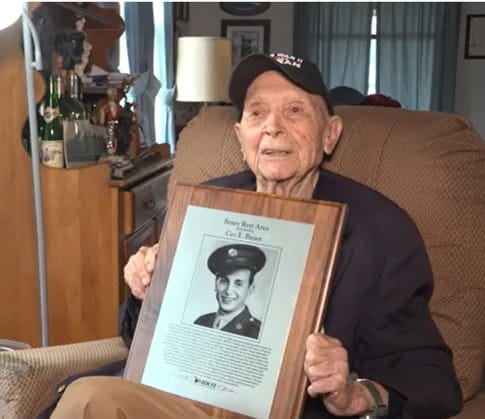
- The Upper Peninsula’s Seney Stretch Rest Area has been named in honor of retired MDOT engineer and Ithaca resident Ceo Bauer since 1980.
- At 103, this decorated World War II veteran may be the oldest living MDOT retiree.
- A video interview recounting Bauer’s career is online.
SENEY, Mich. - Driving along what’s considered one of the most boring roads in Michigan, you might speed right past a roadside landmark dedicated to a very interesting man.
Near the east end of the 25-mile arrow-straight section of M-28 in the middle of Michigan’s Upper Peninsula known as the Seney Stretch is a small rest area. It’s borne the name of honoree Ceo Bauer since 1980. At the time, Bauer was a recently retired Michigan Department of Transportation (MDOT) employee with 31 years of service.
Today, at 103, this decorated World War II veteran may well be the oldest living MDOT retiree. Bauer recently sat down for a video interview recounting his career.
Born in Carson City in Montcalm County, Bauer attended a one-room school and graduated from Carson City High in 1940. He found his calling as an engineer in the U.S. Army.
“I was drafted in 1943,” Bauer recalled. “And I went into the Infantry, the 35th Infantry Division. Took my basic (training). But then one day, down in Alabama, an officer came out and said, 'You’ve been selected to go to engineering school.'”
Bauer studied at the Carnegie Institute of Technology (now known as Carnegie Mellon University) until the program he was in shut down in advance of the looming invasion of Europe. He was then assigned as a rifleman to the 95th Infantry Division. The 95th landed on Normandy’s Omaha Beach in September 1944, a few months after D-Day.
In early November 1944, Bauer and his fellow soldiers received orders to cross the Moselle River into the outskirts of Metz, France. They moved toward their objective, facing heavy resistance. During the fighting, Bauer was hit by shrapnel across his torso, face and limbs. Severely wounded, he spent 17 months recovering. He received a Purple Heart for his service and was later awarded the French Legion of Honor.
While Bauer’s injuries prevented him from returning to battle, the soldiers of the 95th Infantry Division eventually liberated Metz and advanced further into the Lorraine region. Their heroic efforts earned the division the nickname “The Iron Men of Metz.”
Since the late 1980s, the city of Metz has invited soldiers back to commemorate major anniversaries of the city’s liberation. Bauer, who now lives in Ithaca, last visited France in 2024.
After the war, Bauer went back to college at Michigan State University (MSU) on the G.I. Bill. Engineers were in short supply, he noted, as the booming postwar nation built out cities, suburbs and roadways. Immediately after earning his Bachelor of Science in civil engineering in 1949, he joined MDOT’s precursor, the Michigan Highway Department, as an engineer trainee.
During the first decade of his career, he was with the department’s Testing and Research Division in both the Upper and Lower peninsulas, mostly as district soiis engineer in Newberry and Saginaw.
In Newberry, Bauer said, “there was construction going on in all directions from Newberry and Seney… that’s where I got to do a lot of great things… busy as the devil, working everywhere.”
Throughout the 1950s, he played a major role in transportation development across the U.P., contributing to numerous significant road projects and earning widespread respect for his expertise and dedication.
In 1959, Bauer was transferred to the Federal-Aid Section of the Highway Department’s Local Government Division at Lansing, where he retired in 1980 as engineer of the Federal-Aid Local Agency Program. His entire professional career was spent at MDOT. Local governments frequently recognized his contributions to the federal-aid program, reflecting the lasting impact of his work.
Beyond his professional accomplishments, Bauer has led a full and active life centered around hunting, fishing, global travel and meaningful philanthropy to MSU and other organizations.
Bauer said he’s proud of the rest area named after him, if a little surprised that he’s been the honoree for so long. “I’ll put in a recommendation here…” he chuckled. “I recommend they leave it there and not rename it until after I pass away.”