The web Browser you are currently using is unsupported, and some features of this site may not work as intended. Please update to a modern browser such as Chrome, Firefox or Edge to experience all features Michigan.gov has to offer.
Test
Home | Learn | Contamination | Treatment | Education & Outreach | Projects | Resources
Most contaminants in water have no taste, color or smell. The only way you might know if you have a problem is to test your drinking water.
The water coming to your home may already be regularly tested for certain contaminants depending on your water supply. If you have a private residential well, testing is your responsibility.
If you have concerns about your drinking water quality and would like to test your drinking water, follow the steps below to learn more about what to test for and how to test your water.
-
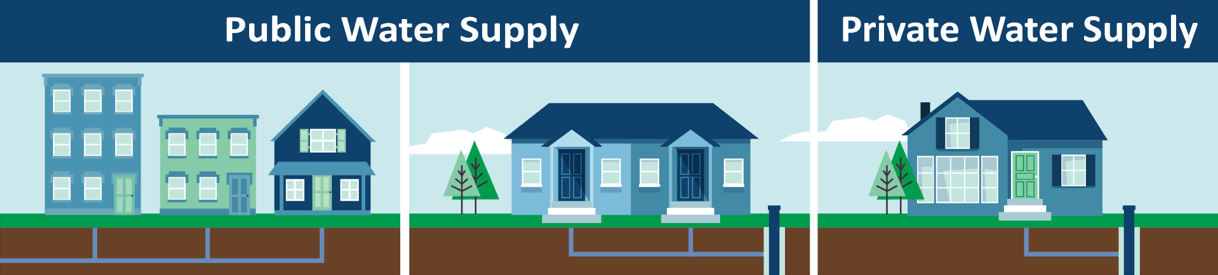
Public Water Supply Customers
- Public water supplies are required to test their water on a routine schedule for certain contaminants.
- Water is tested at the water supply facility, but the water quality in your home may be different. After leaving the water supply facility, water flows through service lines and your home's plumbing where contaminants can enter the water.
- If a contaminant is found in the water at the water supply facility, those water test results will be reported in the Consumer Confidence Report (CCR).
- Check with your supplier or your CCR to learn about contaminant testing and results.
- If you still have concerns about your water quality or want to know more about your drinking water, have your drinking water tested by a certified drinking water laboratory (see Step 2 for certified lab options).
- If you are not sure what to test for, you can find your concern (taste, smell, odor, color etc.) using the EGLE Common Drinking Water Quality Concerns page to find which test(s) may be recommended based on what you are concerned about.
Private Residential Well Owners
You own your water system! This comes with the responsibility of protecting your drinking water quality and the groundwater source. Private well owners are required to test the water when the well is constructed.
MDHHS recommends drinking water testing on the following schedule:
Every Year Every 3 to 5 Years At Least Once Coliform Bacteria and E. coli
Nitrate
Nitrite
Arsenic
Lead
PFAS Other times to consider testing your water:
- A household member is pregnant.
- An infant or young child is living in the home.
- Flooding has happened near the well.
- Repairs were made to the well.
- The water’s taste, color or smell changes.
Check with your local health department for guidance on what to test for in your local area and visit our Private Well Testing Fact Sheet for more information on testing your private residential well water.
You can also find your concern (taste, smell, odor, color, etc.) using the EGLE Common Drinking Water Quality Concerns page to find which test(s) may be recommended based on what you are concerned about.
* MDHHS recommends you test your drinking water for PFAS at least once even if you do not live near a potential source of PFAS contamination or if you are unsure about nearby sources. If you know you live near a potential source of PFAS but have not had your drinking water tested for PFAS, call MDHHS at 800-648-6942 to see if your home is in an area that is under investigation for PFAS. MDHHS may be able to test your water for free.
** MDHHS recommends private residential well owners test for lead in drinking water every 3-5 years because groundwater can change over time. If the groundwater is corrosive, it could cause lead to leach from pipes, plumbing fixtures and solder into the drinking water. Private residential well water does not have added corrosion control like public water supplies to prevent leaching when pipes corrode and this can impact the level of lead in your drinking water. You can learn more about lead in plumbing and how to check your plumbing for lead in the Lead in Drinking Water fact sheet and How to Find Out if Lead May Be in Your Drinking Water fact sheet. If you have questions about testing your water for lead, call MDHHS at 800-648-6942.

-
If you have concerns about the quality of your drinking water and want to know more, consider having your water tested by a certified laboratory.
Certified labs must meet standards for proper methods and quality control.
A few questions to ask when deciding which lab to use:
- Does the lab analyze water samples from private, individual residences?
- Does the lab analyze drinking water samples for the contaminant(s) you want to have tested?
- Does the lab accept water samples statewide?
- What is the cost?
Certified Lab Options
- Michigan Department of Environment, Great Lakes, and Energy (EGLE) Drinking Water Laboratory.
Call 517-335-8184 to order a test kit or visit the Drinking Water Laboratory website to learn more.
- Your local health department.
Contact your local health department to learn if they offer drinking water testing.
- Certified drinking water analysis labs.
Contact a Michigan certified private drinking water analysis laboratory.
Follow all sampling, packing and shipping instructions.
This is very important for accurate results. Water samples can be easily contaminated if instructions are not followed. Water samples may require ice packs and/or overnight shipping to the lab.
You can talk with your local health department or call MDHHS at 800-648-6942 if you have questions about testing.
-
To understand the quality of your water, compare your water test results with established federal or state drinking water standards for contaminants in drinking water. Drinking water standards for public water supplies are created by agencies such as the United States Environmental Protection Agency (EPA) or Michigan Department of Environment, Great Lakes, and Energy (EGLE). The Michigan Safe Drinking Water Act provides EGLE the authority to oversee these drinking water standards.
When you compare your results with drinking water standards and health-based values, be sure you understand what these mean and what they were created for. Some standards and values are:
- Based on people’s health.
- Established not because of health concerns, but to help manage taste, smell and color of water.
- Based on technology available to treat water for contaminants.
Not all lab report test results use the same measurements as the established drinking water values. When you compare your results, it is important to know that these are all equal:
0.1 milligrams per liter (mg/L)
0.1 parts per million (ppm)
100 micrograms per liter (µg/L)
100 parts per billion (ppb)
100,000 nanograms per liter (ng/L)
100,000 parts per trillion (ppt)Resources available to help you:
MDHHS has a series of contaminant fact sheets that can help you understand what results mean for that contaminant and what health risks are associated with each.
You can also call MDHHS at 800-648-6942, Monday through Friday between 8 a.m. and 5 p.m. with questions and concerns.
View a fact sheet with this information: How to Read Your Drinking Water Lab Results Table.
Updated 9/3/26