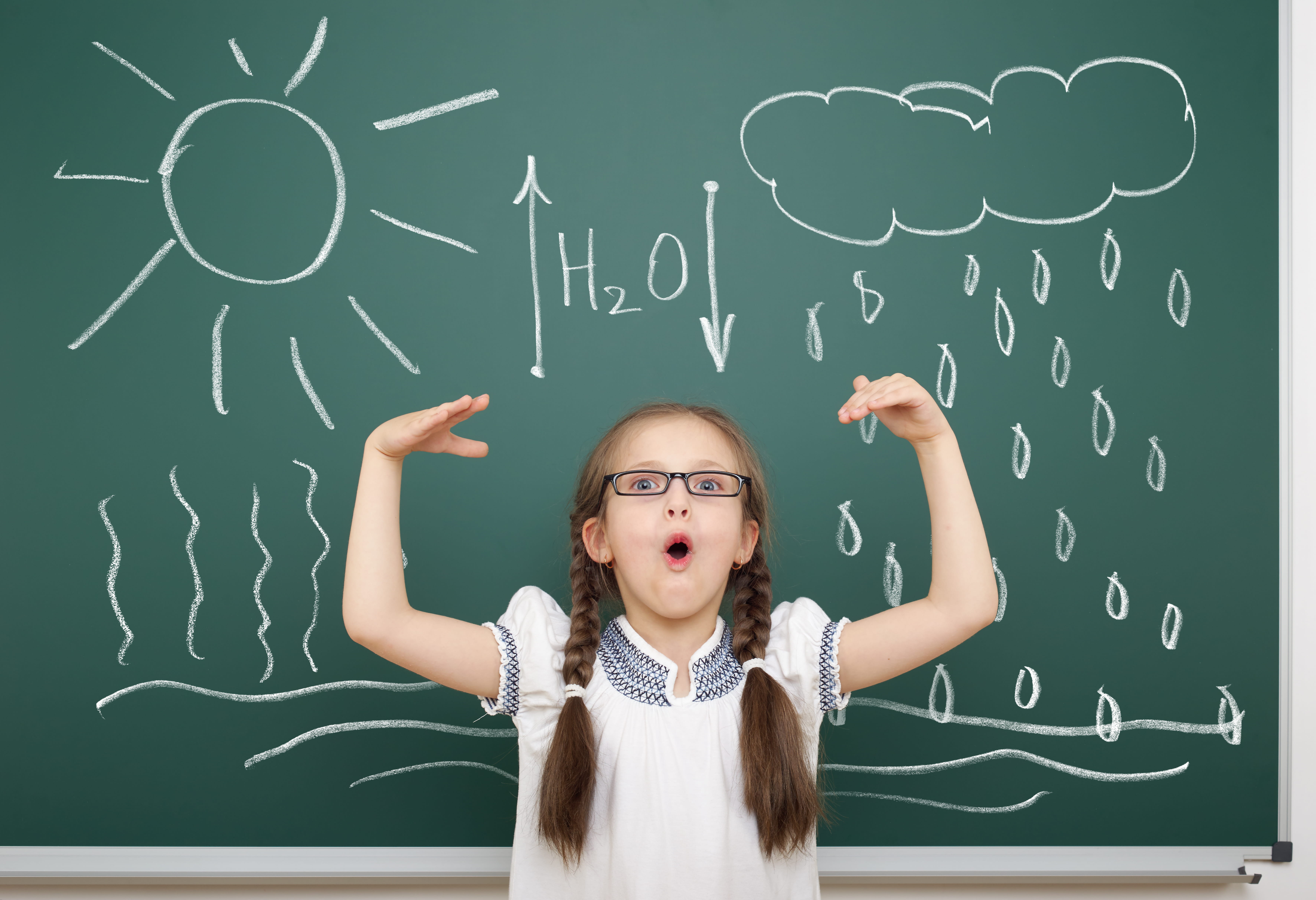
It's never too early to start learning! Let's teach our children the importance of taking care of our water sources. It is critical for the health of generations to come.

Learn about Federal changes to Medicaid and Food Assistance Programs..
Michigan's Women, Infants & Children program, providing supplemental nutrition, breastfeeding information, and other resources for healthy mothers & babies.
Information on the Family Independence Program, State Disability Assistance, SSI, Refugee, and other cash assistance.
If you cannot afford child care, payment assistance is available.
Children's Special Health Care Services information and FAQ's.
Information on assistance with home repairs, heat and utility bills, relocation, home ownership, burials, home energy, and eligibility requirements.
Information on the Food Assistance Program, eligibility requirements, and other food resources.
Information about the health care programs available through Medicaid and how to qualify.
Our migrant program works with a number of organizations to provide services for Michigan’s migrant and seasonal farmworkers.
A federal program which helps persons admitted into the U.S. as refugees to become self-sufficient after their arrival.
Universal caseload, or task-based processing, is a different way of handling public assistance cases.
Information on the Children's Protective Services Program, child abuse reporting procedures, and help for parents in caring for their children.
Information on adoption programs, adoption resources, locating birth parents and obtaining information from adoption records.
Information on Adult Protective Services, Independent Living Services, Adult Community Placement Services, and HIV/AIDS Support Services.
Information on child support services for participants and partners.
Programs for healthy children & families, including immunization, lead poisoning prevention, prenatal smoking cessation, and many others.
Information on the Children's Foster Care program and becoming a Foster Parent.
Information about the Michigan law that requires certain information be made available to a woman who is seeking an abortion at least 24 hours prior to the abortion procedure.
Information on treatment and services for juvenile offenders, success stories, and more.
Child Welfare Medical and Behavioral Health Resources
MDHHS and partners support a continuum of prevention services. The continuum is inclusive of primary, secondary, and tertiary prevention activities. Visit this page to learn more.
Information about injury and violence prevention programs in Michigan
Information on Safe Sleep for your baby, how to protect your baby's life.
The Michigan Department of Health and Human Services' (MDHHS) Environmental Health Bureau (EHB) uses the best available science to reduce, eliminate, or prevent harm from environmental, chemical, and physical hazards.
Information, sources of data and resources to support Firearm Injury Prevention efforts across the state of Michigan.
Medical Resources for Child Protection
Serves as liaison and provides funding to Michigan’s 45 local health departments.
Adult Behavioral Health & Developmental Disability Services
Information and resources for development of Plans of Safe Care.
Multicultural Health
Prevention of diseases & conditions such as heart disease, cancer, diabetes and many others.
Home to an array of public health programs, initiatives and interventions aimed at improving the health and well-being of women, infants, families and communities.
Birth, Death, Marriage and Divorce Records
Boards and Commissions
Bridge Card Participation Information on Electronic Benefits for clients and businesses, lists of participating retailers and ATMs, and QUEST.
Provider Payments Information on the direct deposit of State of Michigan payments into a provider's bank account.
Information on How to Bid, Requests for Proposals, forms and publications, contractor rates, and manuals.
Information & resources for Community and Faith-Based partners
Farmworker Services
Information on DHS Applications and Forms grouped by category.
State Health Improvement Plan (SHIP)
Health Care Providers
Licensing information for Adult Foster Care and Homes for the Aged, Child Day Care Facilities, Child Caring Institutions, Children's Foster Care Homes, Child Placing Agencies, Juvenile Court Operated Facilities and Children's or Adult Foster Care Camps.
Michigan Statewide Systems of Care
Information on the grant awarded for the State Innovation Model Proposal
Protect MiFamily -Title IV-E Waiver
Offers resources for agencies who operate the Weatherization Assistance Program in the state of Michigan
Information on resources in your community and volunteer recruitment and training, and services provided at local DHS offices.
Information is collected to monitor the general health and well-being of Michigan citizens.
Equal Opportunity, Legal Base, Laws and Reporting Welfare Fraud information.
A variety of reports & statistics for programs and services.

Search is currently unavailable. Please try again later.
The web Browser you are currently using is unsupported, and some features of this site may not work as intended. Please update to a modern browser such as Chrome, Firefox or Edge to experience all features Michigan.gov has to offer.
It's never too early to start learning! Let's teach our children the importance of taking care of our water sources. It is critical for the health of generations to come.
 In this video for kids, Dewy the Water Drop explains how water from the environment makes its way into our homes to become our drinking water. You will learn about the water cycle, watersheds, groundwater, surface water and the ways that drinking water can be supplied to our homes, including private residential wells and public water supplies. By the end of the video, we hope you have a better understanding of where drinking water comes from!
These activity books include coloring pages, word searches, mazes, puzzles, activities and more to help you understand where drinking water comes from. To view the activity books, click the images below.
Grades kindergarten-2

Grades 3-5

MDHHS has developed worksheets to raise awareness about drinking water for older students. These well water mazes and word searches are recommended for grades 3-5 and 6-8. You can order copies of the worksheets on the MDHHS Clearinghouse website or click the images below to print them.
Grades 3-5

Grades 6-8

This bracelet-making activity is a fun way to learn about protecting the environment! As you string different colored beads, the worksheet will explain how everyday actions can affect the water we drink. Once the bracelet is tied, it reminds you that everyone has a role in keeping water clean. The activity is paired with a short video that shows why water quality is important and gives simple tips on how we can all help protect it. View the Step Up for Water Quality Bracelet Activity worksheet by clicking below.
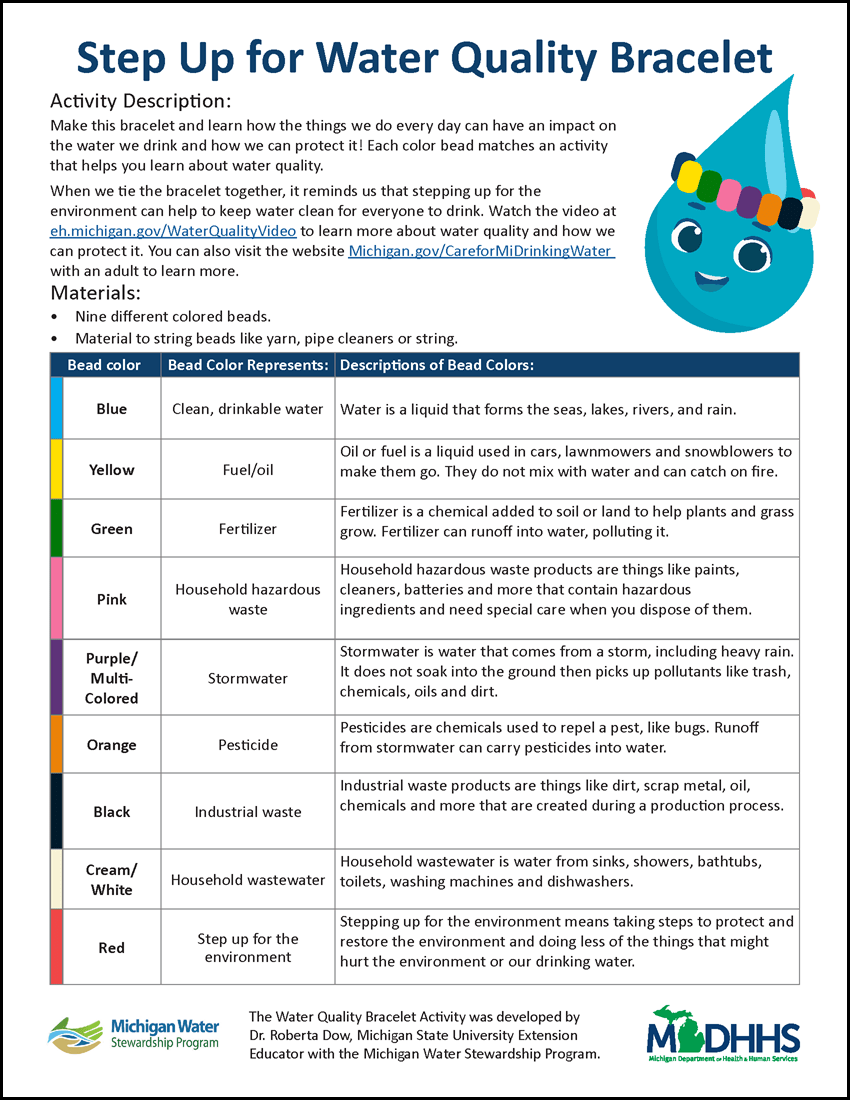
Watch the video that goes along with the activity by visiting the Step Up for Water Quality YouTube video.
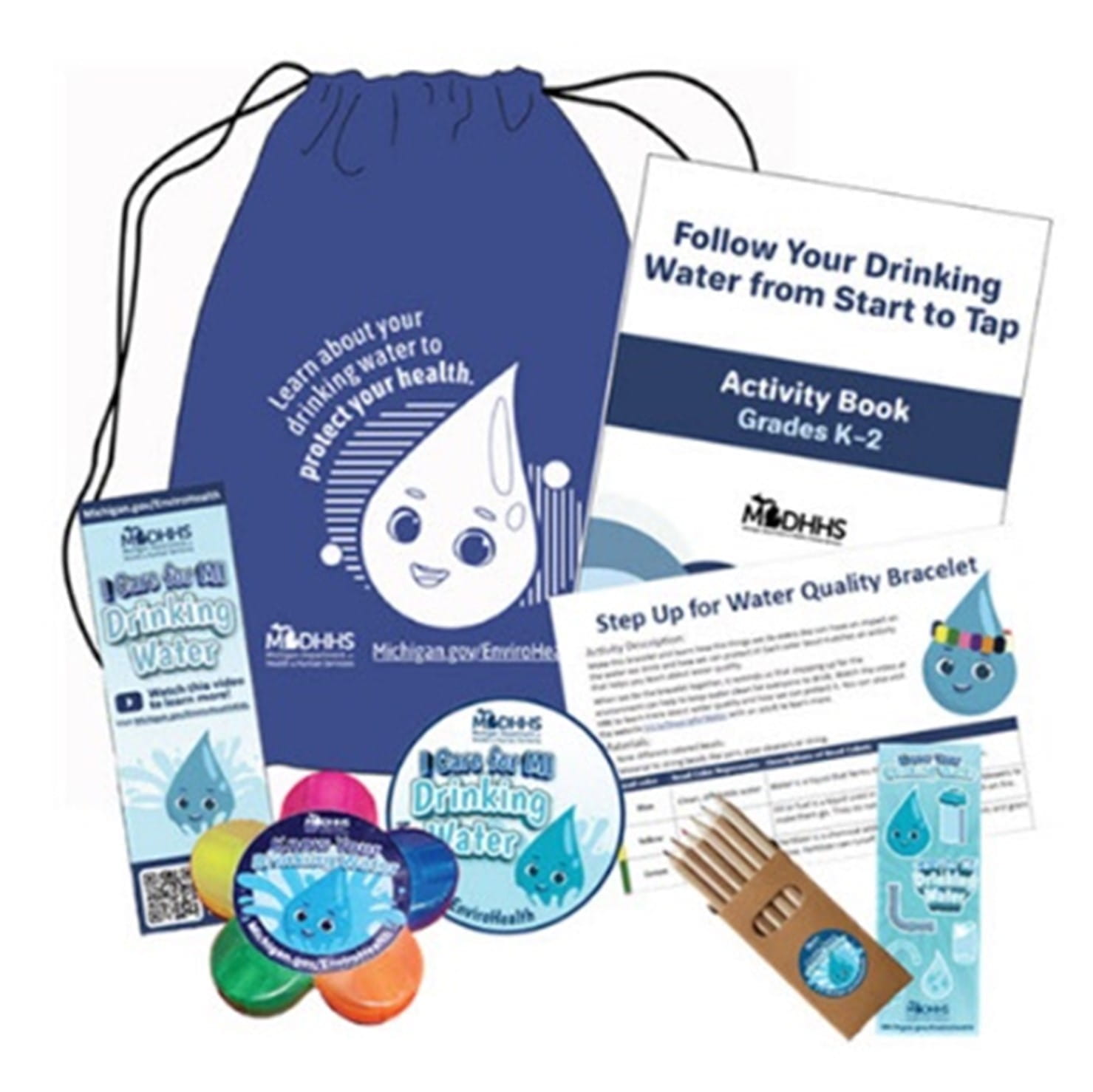 These fun kits include our Youth Activity Books, Step Up for Water Quality Bracelet activity, Dewy stickers and bookmarks, markers and colored pencils all put together in one fun drinking water themed drawstring bag.
You can order these bags on the MDHHS Clearinghouse website. There are bags available for grades kindergarten-5.
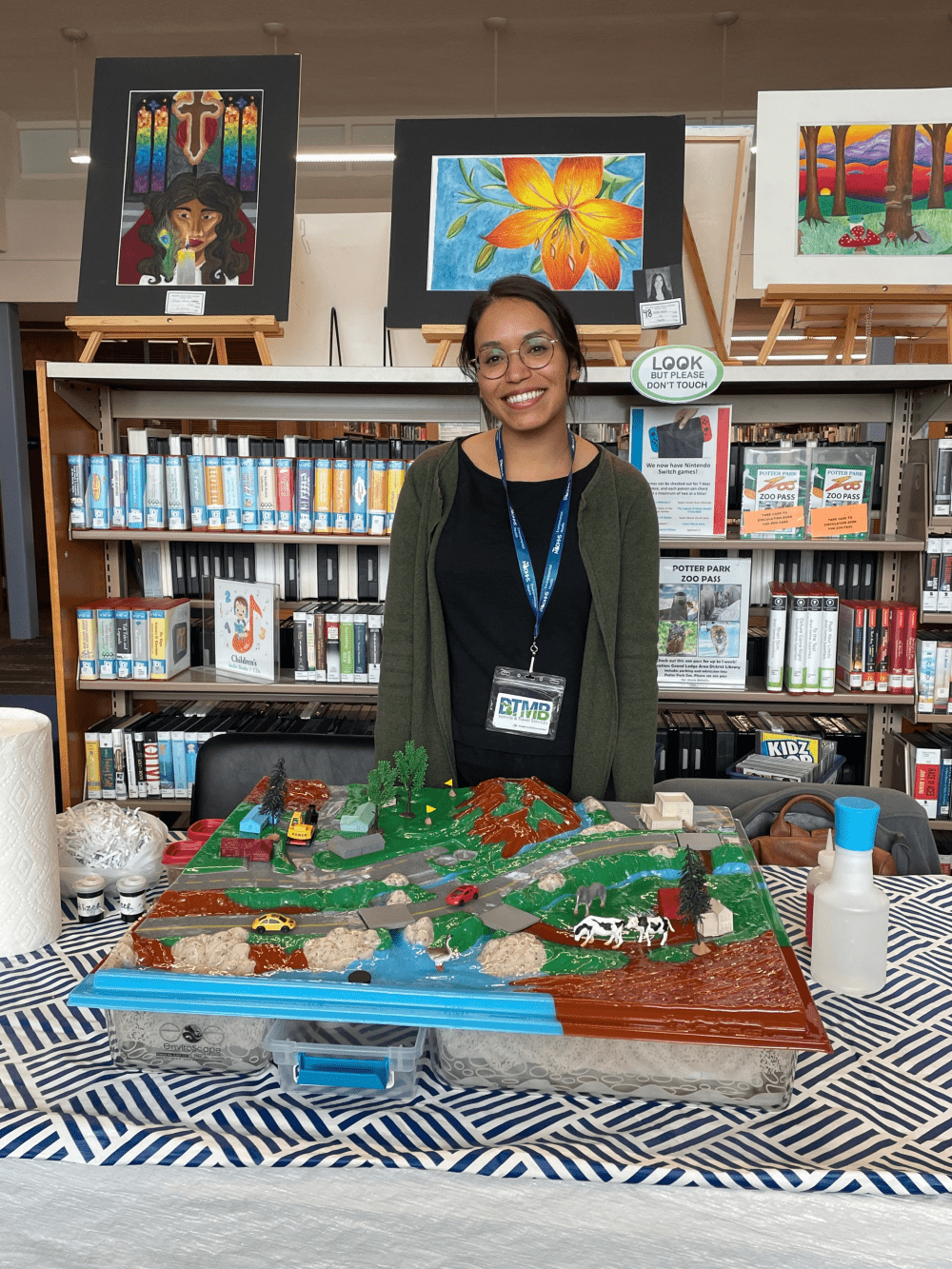 MDHHS has developed learning lessons to educate residents on how they can protect their health from environmental hazards. These learning lessons share best practices and offer educational activities to learn about reducing exposure to environmental hazards.
Lessons can range from 5 minutes to 20 minutes in length and are appropriate for both kids and adults.
You can find out more about Learning Lessons and how to request a demonstration by visiting the Community Guide on our website.
This toolkit contains prepared, science-based social media messages, graphics, videos and printable materials. These materials are designed to make sharing drinking water information easy! See the toolkit here.
Things we do every day affect the health of our environment and the quality of lakes, rivers and groundwater that become our drinking water.
Our environment is made up of the air, water, minerals, plants and animals that surround us. Everything in our environment is interconnected and you contribute to the health of the environment by being a part of it! Our drinking water, too, starts off as part of our natural environment. It begins as water in lakes, rivers or groundwater.
Our everyday actions impact the environment and our drinking water. Pollution and overuse of fertilizers release harmful contaminants into our waterways. These contaminants may end up in our drinking water.
How to be a Clean Water Champion
There are easy ways that you can become a Clean Water Champion at home and within your community:
Did you know...
A person who steps up for the environment by protecting it and using natural resources responsibly is sometimes referred to as an environmental steward.
Being a Clean Water Champion means that you are doing environmental stewardship.
Protect Michigan’s Groundwater
As a state, community and individuals, we can all help protect Michigan’s groundwater. Let’s work together to ensure we have safe groundwater to use for drinking!
There are some projects in place to improve water quality around our great state! These are just a few:
Updated 9/3/26