Find the Eat Safe Fish Guide for Your Area
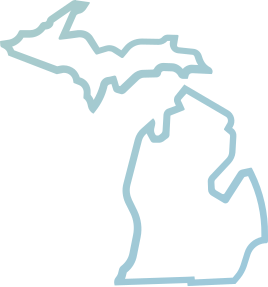
Learn more about the Eat Safe Fish Guides by clicking on the map or the links below.
Learn about Federal changes to Medicaid and Food Assistance Programs..
Michigan's Women, Infants & Children program, providing supplemental nutrition, breastfeeding information, and other resources for healthy mothers & babies.
Information on the Family Independence Program, State Disability Assistance, SSI, Refugee, and other cash assistance.
If you cannot afford child care, payment assistance is available.
Children's Special Health Care Services information and FAQ's.
Information on assistance with home repairs, heat and utility bills, relocation, home ownership, burials, home energy, and eligibility requirements.
Information on the Food Assistance Program, eligibility requirements, and other food resources.
Information about the health care programs available through Medicaid and how to qualify.
Our migrant program works with a number of organizations to provide services for Michigan’s migrant and seasonal farmworkers.
A federal program which helps persons admitted into the U.S. as refugees to become self-sufficient after their arrival.
Universal caseload, or task-based processing, is a different way of handling public assistance cases.
Information on the Children's Protective Services Program, child abuse reporting procedures, and help for parents in caring for their children.
Information on adoption programs, adoption resources, locating birth parents and obtaining information from adoption records.
Information on Adult Protective Services, Independent Living Services, Adult Community Placement Services, and HIV/AIDS Support Services.
Information on child support services for participants and partners.
Programs for healthy children & families, including immunization, lead poisoning prevention, prenatal smoking cessation, and many others.
Information on the Children's Foster Care program and becoming a Foster Parent.
Information about the Michigan law that requires certain information be made available to a woman who is seeking an abortion at least 24 hours prior to the abortion procedure.
Information on treatment and services for juvenile offenders, success stories, and more.
Child Welfare Medical and Behavioral Health Resources
MDHHS and partners support a continuum of prevention services. The continuum is inclusive of primary, secondary, and tertiary prevention activities. Visit this page to learn more.
Information about injury and violence prevention programs in Michigan
Information on Safe Sleep for your baby, how to protect your baby's life.
The Michigan Department of Health and Human Services' (MDHHS) Environmental Health Bureau (EHB) uses the best available science to reduce, eliminate, or prevent harm from environmental, chemical, and physical hazards.
Information, sources of data and resources to support Firearm Injury Prevention efforts across the state of Michigan.
Medical Resources for Child Protection
Serves as liaison and provides funding to Michigan’s 45 local health departments.
Adult Behavioral Health & Developmental Disability Services
Information and resources for development of Plans of Safe Care.
Multicultural Health
Prevention of diseases & conditions such as heart disease, cancer, diabetes and many others.
Home to an array of public health programs, initiatives and interventions aimed at improving the health and well-being of women, infants, families and communities.
Birth, Death, Marriage and Divorce Records
Boards and Commissions
Bridge Card Participation Information on Electronic Benefits for clients and businesses, lists of participating retailers and ATMs, and QUEST.
Provider Payments Information on the direct deposit of State of Michigan payments into a provider's bank account.
Information on How to Bid, Requests for Proposals, forms and publications, contractor rates, and manuals.
Information & resources for Community and Faith-Based partners
Farmworker Services
Information on DHS Applications and Forms grouped by category.
State Health Improvement Plan (SHIP)
Health Care Providers
Licensing information for Adult Foster Care and Homes for the Aged, Child Day Care Facilities, Child Caring Institutions, Children's Foster Care Homes, Child Placing Agencies, Juvenile Court Operated Facilities and Children's or Adult Foster Care Camps.
Michigan Statewide Systems of Care
Information on the grant awarded for the State Innovation Model Proposal
Protect MiFamily -Title IV-E Waiver
Offers resources for agencies who operate the Weatherization Assistance Program in the state of Michigan
Information on resources in your community and volunteer recruitment and training, and services provided at local DHS offices.
Information is collected to monitor the general health and well-being of Michigan citizens.
Equal Opportunity, Legal Base, Laws and Reporting Welfare Fraud information.
A variety of reports & statistics for programs and services.
Search is currently unavailable. Please try again later.
The web Browser you are currently using is unsupported, and some features of this site may not work as intended. Please update to a modern browser such as Chrome, Firefox or Edge to experience all features Michigan.gov has to offer.
Learn more about the Eat Safe Fish Guides by clicking on the map or the links below.

The U.S. Environmental Protection Agency (EPA) started the GLRI program in 2010 to identify AOCs around the Great Lakes Basin. An AOC is an area that has been contaminated with high levels of chemicals and needs to be cleaned up. Currently, Michigan has 11 active AOCs. With funding provided by the GLRI project, the Michigan Department of Environment, Great Lakes, and Energy (EGLE) is able to assist in efforts to clean up AOCs while the Michigan Department of Health and Human Services (MDHHS) educates the public on these areas.
Below is a list of current GLRI AOCs in Michigan. Click each area for more information on that AOC, including fish consumption guidelines for the area.
Kalamazoo River Area and the Enbridge Oil Spill
Fish consumption guidelines for other areas of Michigan not listed as an AOC can be found in the Eat Safe Fish Guides.
Learn more about how places become AOCs at the Michigan's Areas of Concern factsheet.
Learn more about the Great Lakes Restoration Initiative by visiting GLRI.US.
EPA has announced that the following areas were “delisted” or removed from the international list of Great Lakes Areas of Concern following successful restoration efforts.
Learn more about AOC delisting on the EPA Restoring the Great Lakes Areas of Concern page.
MDHHS has issued specific guidelines for some areas with unique issues. Sites become "Superfund" sites through an evaluation process called "Superfund Site Assessment." Superfund Site Assessment work consists of discovery, evaluation and nomination of contamination sites to the Superfund National Priorities List (NPL).
Kalamazoo River Area and the Enbridge Oil Spill
Some AOCs can also be designated as superfund sites or have superfund sites overlapping a part of the AOC. Learn more about Superfund sites by visiting the EPA's Superfund page or the Michigan Department of Environment, Great Lakes, and Energy's (EGLE) Superfund Program page.
Michigan Areas of Concern Frequently Asked Questions (factsheet)
National List of Fish Advisories
2015 Final Report - Measuring Perfluorinated Compounds in Michigan Surface Waters and Fish
2016 Final Report - Assessing Michigan's Beneficial Use of Sport-Caught Fish in Areas of Concern
Family Friendly Fishing Waters
Michigan PFAS Response Fish and Wildlife