Infectious Disease Outbreaks

This page provides information on current and recent infectious disease outbreaks in Michigan, including case counts, outbreak updates, and resources for the public and health care providers.

Cyclosporiasis Outbreak 

MDHHS is investigating an outbreak of cyclosporiasis in Michigan. While the investigation is ongoing, available information indicates that lettuce or salad greens may be a potential source of this outbreak. However, other food items cannot be completely ruled out. No specific type of produce, grower, or supplier has been identified as the source. 
 
MDHHS continues to work with local health departments and partners to investigate cases and provide updates as more information becomes available.

Michigan Case Counts

Total Cases: 10,773
As of July 30, 2026, 193 reported cases indicated they had been hospitalized.

Last updated: July 31, 2026

Data notes

  • Case counts reflect all cases of cyclosporiasis reported during the outbreak investigation period and may change as additional information becomes available.
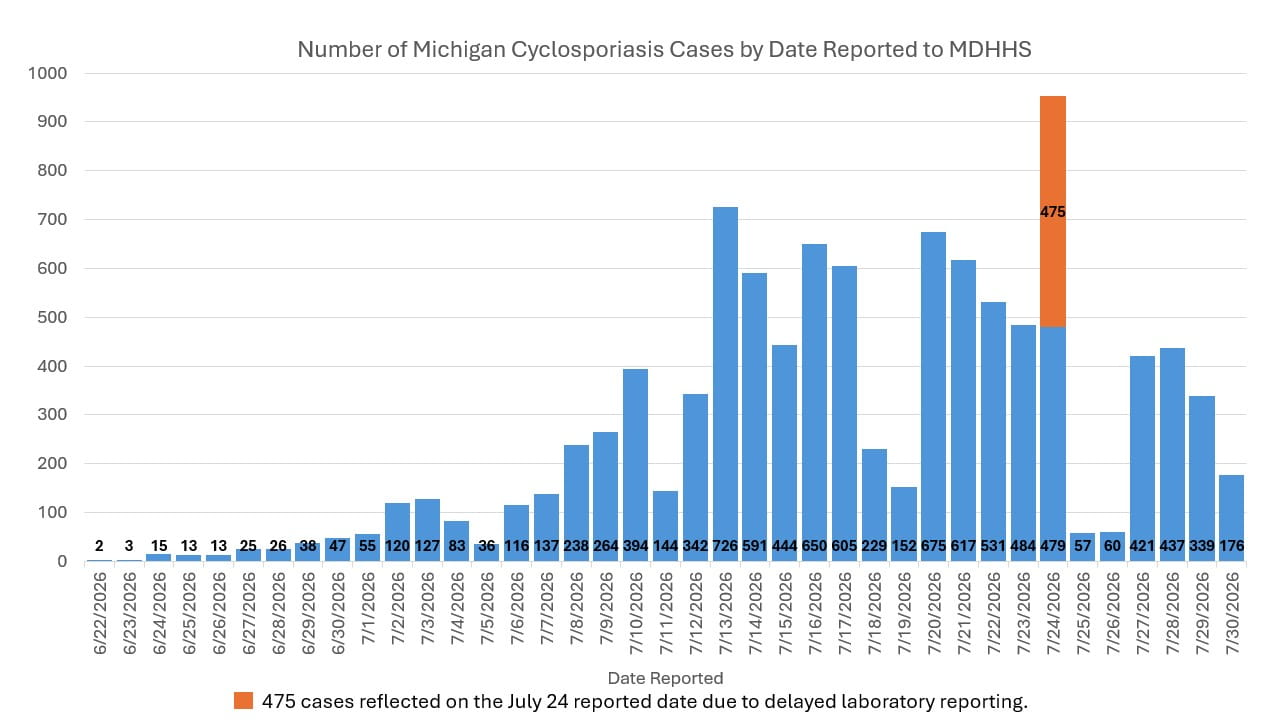
  • The July 27, 2026 total cases include approximately 475 cases that were not previously reported to MDHHS due to delayed laboratory reporting. These cases do not reflect a sudden increase in illnesses.
  • Case counts reflect data reported through 9:30 a.m. Eastern Time.
  • Total case counts are updated daily, Monday through Friday, by 11:00 a.m. Eastern Time.
  • Hospitalization status and detailed outbreak data are updated weekly on Thursdays.


National cyclosporiasis case count information is available from CDC: Cyclosporiasis Surveillance.

News and Updates

Resources

Detailed Outbreak Data

  •  

    County/Jurisdiction

    Number Cyclosporiasis Cases Reported

    Alcona 13
    Allegan 85
    Alpena 98
    Antrim 3
    Arenac 5
    Barry 23
    Bay 10
    Benzie 3
    Berrien 22
    Branch 15
    Calhoun 297
    Cass 12
    Charlevoix 5
    Cheboygan 3
    Clare 36
    Clinton 226
    Crawford 49
    Delta 1
    Detroit City 246
    Eaton 381
    Emmet 2
    Genesee 502
    Gladwin 4
    Grand Traverse 12
    Gratiot 217
    Hillsdale 57
    Houghton 3
    Huron 48
    Ingham 810
    Ionia 176
    Iosco 26
    Isabella 102
    Jackson 293
    Kalamazoo 256
    Kalkaska 5
    Kent 159
    Lake 6
    Lapeer 25
    Leelanau 2
    Lenawee 368
    Livingston 356
    Macomb 282
    Manistee 4
    Marquette 5
    Mason 6
    Mecosta 20
    Midland 29
    Missaukee 1
    Monroe 368
    Montcalm 55
    Montmorency 3
    Muskegon 348
    Newaygo 33
    Oakland 1043
    Oceana 25
    Ogemaw 6
    Osceola 25
    Oscoda 2
    Otsego 3
    Ottawa 124
    Presque Isle 9
    Roscommon 12
    Saginaw 86
    Sanilac 43
    Shiawassee 445
    St. Clair 26
    St Joseph 34
    Tuscola 22
    Van Buren 100
    Washtenaw 875
    Wayne 1379
    Wexford 2

    Last Update: July 30, 2026

    Data notes

    • Case counts reflect all cases of cyclosporiasis reported during the outbreak investigation period and may change as additional information becomes available.
    • Nine (9) reported cases have an unknown county of residence. As a result, the total shown in the county distribution may not equal the overall case count.
    • Case counts reflect data reported through 9:30 a.m. Eastern Time.
    • Cases by county are updated weekly on Thursdays.


  •  

    Age Group

    Number of Cases

    0-9 years 64
    10-19 years 639
    20-29 years 1909
    30-39 years 2216
    40-49 years 1892
    50-59 years 1503
    60-69 years 1222
    70-79 years 713
    80-89 years 209
    90 years and above 15

    Last update: July 30, 2026

    Data notes

    • Case counts reflect all cases of cyclosporiasis reported during the outbreak investigation period and may change as additional information becomes available.
    • Four (4) cases have an unknown age. As a result, the total shown in the age distribution may not equal the overall case count.
    • Case counts reflect data reported through 9:30 a.m. Eastern Time.
    • Cases by age group are updated weekly on Thursdays.

  • This graph shows the cyclosporiasis cases reported to MDHHS from June 22, 2026, through 9:30 a.m. July 30, 2026.

    This graph shows the cyclosporiasis cases reported to MDHHS from June 22, 2026, through 9:30 a.m. July 30, 2026. Noting July 24 inflated cases.

    Last update: July 30, 2026

    Data notes

    • Case counts reflect all cases of cyclosporiasis reported during the outbreak investigation period and may change as additional information becomes available.
    • The July 24, 2026 reported date includes approximately 475 cases that were not previously reported to MDHHS due to delayed laboratory reporting. These cases do not reflect a sudden increase in illnesses.
    • Cases by date reported are updated weekly on Thursdays.

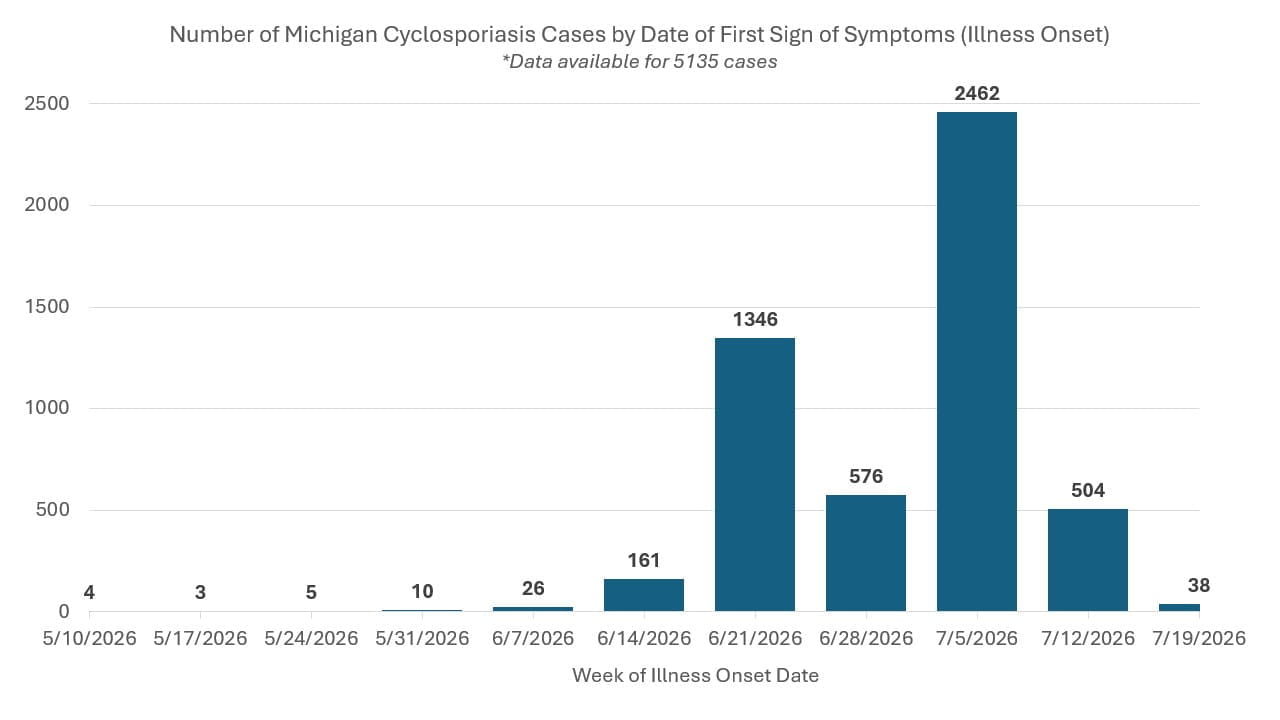
  • This graph shows the week of illness onset for cyclosporiasis cases reported to MDHHS from May 10, 2026, through July 25, 2026.

    This graph shows the week of illness onset for cyclosporiasis cases reported to MDHHS from May 10, 2026, through July 25, 2026.

    Last update: July 30, 2026

    Data notes

    • Case counts reflect all cases of cyclosporiasis reported during the outbreak investigation period and may change as additional information becomes available.
    • Cases by illness onset are updated weekly on Thursdays.

This is an active and evolving situation, these recommendations may change as more information becomes available.

Recommended actions for individuals who think they may have cyclosporiasis:

People experiencing gastrointestinal illness, such as sudden and ongoing diarrhea, are encouraged to contact their health care provider for testing and treatment. For general questions about the cyclosporiasis outbreak, contact your local health department. Cyclosporiasis is treated with antibiotics along with rest and drinking plenty of fluids to maintain hydration.

Recommended practices for all individuals serving, preparing or consuming lettuce and salad greens in impacted counties:

Given early information from the investigation, MDHHS recommends the following lettuce and salad green safety measures:

  • Purchase whole heads: Buy whole heads of lettuce rather than pre-washed, bagged lettuce or pre-mixed salad kits.
  • Discard outer layers: Before preparation, remove and discard the outer two to three layers of leaves.
  • Wash inner leaves: Thoroughly wash the remaining inner leaves under clean running water.
  • Prioritize cooking: For greens that can be cooked, cooking to an internal temperature of at least 158°F (70°C) is the safest option. The parasite is resistant to routine chemical disinfection, and washing alone cannot guarantee removal.

General practices to reduce your risk of cyclosporiasis and other foodborne illnesses:

  • Cook when you can. Heating food to 158°F (70°C) or higher kills Cyclospora.
  • Peel produce. Peeling is highly effective for food items with removable skin as the parasite sits on the outer surface.
  • Wash all fresh produce under clean running water, even if you plan to peel it.
    • “Pre-washed” does not guarantee safety and rewashing bagged lettuce is unlikely to remove cyclospora. While washing alone may not fully eliminate cyclospora, it enhances protection when combined with cooking or peeling. 

Additional food safety reminders:

  • Wash hands with soap and water before and after handling or preparing food.
  • Scrub firm fruits and vegetables, such as melons and cucumbers, with a clean produce brush.
  • Cut away any damaged or bruised areas on fruits and vegetables before preparing and eating.
  • Wash and sanitize utensils and surfaces before and after handling food. Wash and sanitize display cases and refrigerators where fresh produce is stored.
  • Wash and sanitize cutting boards, surfaces and utensils used to prepare, serve or store fresh produce.
  • Refrigerate cut, peeled or cooked fruits and vegetables as soon as possible.