
The web Browser you are currently using is unsupported, and some features of this site may not work as intended. Please update to a modern browser such as Chrome, Firefox or Edge to experience all features Michigan.gov has to offer.
Hepatitis C Disease Intervention Specialist (DIS)
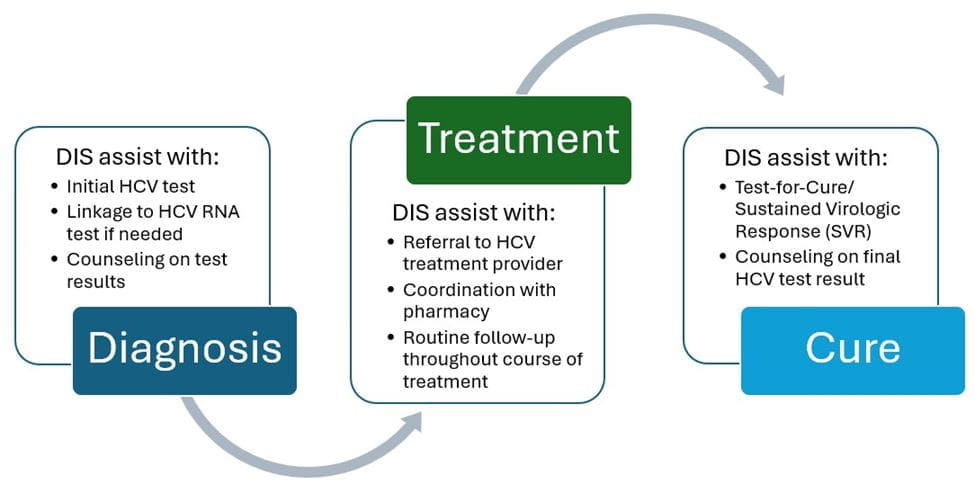
The MDHHS Disease Intervention Specialist (DIS) Unit was established in August 2021 as part of Michigan's commitment to eliminating Hepatitis C (HCV). The team works with Michigan residents at risk for or living with HCV to ensure timely access to medical care and curative treatment. Achieving successful HCV treatment outcomes requires both comprehensive support for clients as well as skilled training for DIS. DIS take on many roles to support Michigan residents, including:
- Schedule medical appointments.
- Assist with insurance navigation.
- Coordinate transportation.
- Connect clients to patient assistance programs.
- Offer appointment reminders.
- Aid in HCV testing order.
- Refer to local community resources.
- Connect to virtual HCV treatment provider(s).


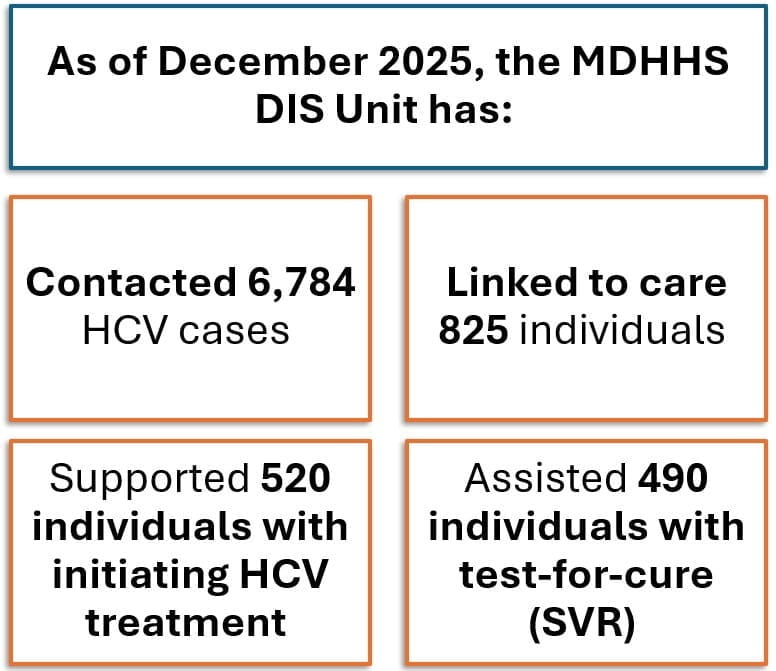
Data source: Michigan Disease Surveillance System & DIS ACCESS Database
Dates: October 1, 2021 - September 19, 2025
For questions or support, please contact us at MDHHS-DIS@Michigan.gov.
-
General Information on Hepatitis C
-
Hepatitis C Treatment
Today, hepatitis C is treated with direct-acting antiviral medications (DAAs). These oral medications are highly effective, well tolerated, and typically taken for 8-12 weeks. Below are fact sheets and prescribing information for the DAAs most commonly used to treat hepatitis C.
- Mavyret Patient Brochure
- How to take Mavyret
- Epclusa Patient Brochure
- How to take Epclusa
- Harvoni Patient Brochure
- How to take Harvoni
- Zepatier Patient Brochure
- Vosevi Patient Brochure
In the past, hepatitis C treatment often required injectable interferon and ribavirin, which could be lengthy and have side effects. Those older treatments are no longer the standard of care. Today’s DAA medications are simple, taken by mouth, have minimal side effects, and cure more than 95% of people. Hepatitis C treatment today is easier and more effective than ever before.
MDHHS Telehealth Hepatitis C Treatment Program - MDHHS now offers a Telehealth Hepatitis C Treatment Program, our Nurse Practitioner (NP) and Disease Intervention Specialist (DIS) staff ensure that evaluation and treatment are easily accessible. Download the referral form and securely fax it to 517-763-0490 or reach out to MDHHS-NPViralHep@Michigan.gov for more information.
-
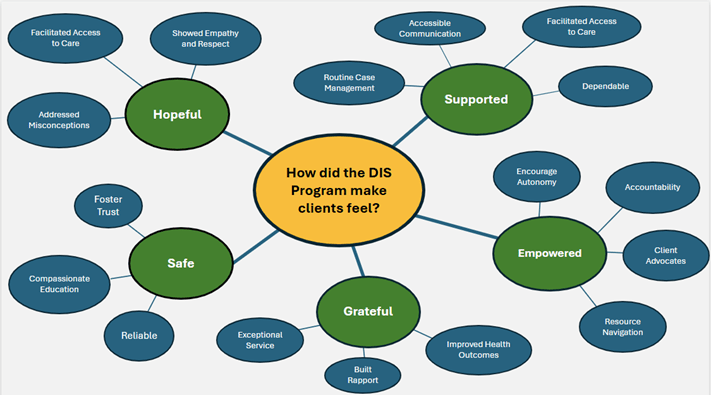
Feedback from Clients Working with DIS
- “Thank you so much for all your help. You are changing my life in ways that I haven't been able to do on my own. I can't describe how much it means to me to have you advocating for me and my health. I appreciate you so much!”
- “Thanks to you I have an appointment with the doctor next week! I really can’t thank you enough for all you do. I’d be lost without you. You are the best! Thank you!”
- “I am very grateful for you and all of your help getting me on treatment”

-
We Treat Hep C
Data estimates that over 69,000 Michiganders are currently living with hepatitis C, and that almost half of this population is unaware of their infection. Hepatitis C can be cured in as little as 8 to 12 weeks with safe, effective, oral (pill) medications.
Through the We Treat Hep C Initiative, which started in April 2021, hepatitis C treatment medication MAVYRET® no longer requires prior authorization and hepatitis C treatment with MAVYRET® is available to all Medicaid ($1 copay) and Healthy Michigan Plan (no copay) beneficiaries at little to no cost. Other direct-acting antiviral medications ($3 copay) require prior authorization and are approved when MAVYRET® is not clinically appropriate.
-
Pregnancy
The Centers for Disease Control and Prevention recommend HCV testing at least once during all pregnancies. Although there is currently no treatment approved for use during pregnancy, identifying pregnant individuals living with HCV allows for linkage to HCV treatment after delivery and monitoring of liver function and symptoms during pregnancy.
-
Perinatal
Perinatal hepatitis C is estimated to occur in 5% to 15% of babies born to HCV-infected persons. There are no known methods to prevent HCV transmission from mother to baby while in utero or during delivery. There is no HCV vaccine or prophylaxis, and the method of delivery, such as cesarean section, has not been shown to decrease transmission.
It is ok to breastfeed while living with HCV. It is important to monitor for cracked or bleeding nipples and to temporarily stop breastfeeding until nipples are healed. Infants exposed to HCV should be tested for HCV to identify if they have a current HCV infection. HCV Perinatal testing protocol is:
- At 2-6 months with an HCV RNA test
- If previously not been tested, at 7-17 months with an HCV RNA test
- If previously not been tested, at 18 months or older with an anti-HCV with reflex to HCV RNA test
HCV treatment is currently approved for children beginning at age 3. Younger children diagnosed with HCV should be monitored until they become eligible (or developmentally ready to take medications daily for 8-12 weeks).
-
Coinfection
Approximately 21% of people living with HIV in the United States are coinfected with HCV. Many of these individuals are already engaged in other programs such as the Ryan White program, highlighting the importance of addressing HCV within this priority population.
-
Justice-Involved Populations
Individuals who are currently incarcerated or recently released face disproportionately high rates of hepatitis C. Limited access to testing and treatment during incarceration, in combination with barriers to care post-release, can delay diagnosis and treatment.
The DIS Unit prioritizes outreach and linkage to care for justice-involved populations by:
- Partner with correctional facilities to support HCV education, testing, and treatment
- Link individuals to medical care and HCV treatment Reduce barriers such as lack of health insurance, transportation, or knowledge of local resources available
- Collaborate with community organizations that work with returning citizens to ensure continuity of care
In addition to the services offered by the DIS Unit, the following resources can support returning citizens in accessing care and other essential services:
- Pure Michigan Talent for returning Citizens
- Returning hope to returning citizens
- Michigan Vital Records Office
- Michigan 211
- FindHelp.org
- Michigan Medicaid
- Michigan Department of Labor and Economic Opportunity
- Detroit Rescue Mission Ministries
- Goodwill Industries
- Probation Information Network Reentry Resources: Michigan
- For Washtenaw County: a Brighter Way
-
Harm Reduction and Syringe Service Programs
Harm Reduction is a set of public health strategies that empowers people who use drugs with the choice to live a healthy, self-directed life. Harm reduction focuses on reducing the harm associated with drug use while recognizing that all people deserve safety and dignity.
Harm Reduction Agencies (HRA) are also known as Syringe Service Programs (SSP) and can also be known as Syringe Exchange Programs (SEP), Syringe Access Programs (SAP), and Needle Exchange Programs (NEP). SSPs reconnect marginalized community members to their community and empower people to make positive changes in their lives.
-
Local Health Departments
Michigan’s Local Health Departments (LHDs) play a critical role in the state’s hepatitis C response. They identify individuals who have recently tested positive for HCV and provide essential services including hepatitis C navigation, education, testing, and linkage to treatment. Many LHD’s also assist with connecting clients to community specialists when needed. MDHHS’s role is to support and enhance these local efforts by providing data, technical assistance, and resources to help LHDs continue their vital work.
-
Testing
If you are at risk of Hepatitis C or have been exposed to the virus, getting tested is a critical step. Early detection and treatment are key to preventing severe liver damage and improving overall health outcomes. Routine screening is recommended for anyone over age 18 and more frequently for individuals at higher risk, such as those with a history of intravenous drug use (IVDU), certain healthcare workers, or anyone who received blood transfusions before 1992.
HCV testing is a two-step process. An HCV Antibody (AB) test is used to detect past exposure to HCV. A positive HCV AB test is followed by an HCV RNA test to confirm current HCV infection. It is important to note that once a person tests positive for HCV antibodies, the result will remain positive for life, even after the virus is cleared or cured.
-
Financial Assistance
Patient assistance programs help people uninsured or underinsured afford medications. The initiative is typically led by pharmaceutical companies, nonprofits, and government agencies to improve access, usage, and adherence to prescription drugs for little or no cost.
If you do not have insurance, or are underinsured and cannot afford medication, these programs often offer free or low-cost options. Each program has different eligibility requirements as well as vary in benefits offered.
-
Additional Resources for Individuals Living with HCV
- HCV Support groups: Help-4-Hep
- Community resources
- Community transportation database
- Use MI Bridges to apply for assistance, check your eligibility status and manage your account online.
- For Veterans: Michigan Veterans Affairs Agency
- State Health Insurance Program for Medicaid Support
- Findhelp.org
- Health Care Coverage Eligibility
- US Department of Housing and Urban Development
-
FAQ
How can I prevent getting HCV?
- There are ways to reduce your risk of getting hepatitis C. Some of these include:
- Avoiding sharing needles or syringes.
- Avoiding sharing personal items that may come in contact with blood (e.g. toothbrushes, razors, nail clippers, unregulated tattoo/piercing equipment, etc.).
- Avoiding unsafe sexual activity and use condoms or other protective equipment during sex with anyone, including someone who has HCV.
How do I screen for HCV?
- There are options available to get tested for hepatitis C. Ask your health care provider, or if you do not have one, you can find one using the Find a Healthcare Professional Tool.
- Your local health department may also offer hepatitis C testing. Find your local health department by visiting the Michigan Association for Local Public Health (MALPH) Directory.
- To find a testing location near you, visit GetTested.CDC.gov.
What medicines cure HCV?
- HCV is curable with an oral direct-acting antiviral (DAA) medication which can be completed in as little as 8-12 weeks. Today’s treatments are more than 95% effective in curing hepatitis C and usually have little to no side effects.
- A list of FDA-approved HCV Medications can be found here.
Can I get reinfected after HCV cure?
- Yes, it is possible to become reinfected with HCV after being cured, especially for individuals with certain ongoing risk factors such as intravenous drug use (IVDU). Preventative measures are the only way to protect against becoming reinfected with HCV. A previous HCV infection does not make you immune to a future HCV infection, and there is no vaccine available for HCV.
Do I need to be sober for HCV treatment?
- You can be treated for Hepatitis C without the requirement of six months of sobriety. In Michigan, treatment is available even if you are still using drugs, helping to prevent the spread of the virus.
- There are ways to reduce your risk of getting hepatitis C. Some of these include: