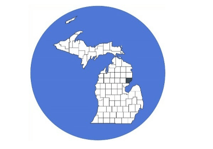

Former Wurtsmith Air Force Base and the Oscoda Area

The former Wurtsmith Air Force Base (WAFB) in Oscoda (Iosco County), Michigan is approximately 170 miles north of Detroit. It primarily operated as a training base for 70 years from 1923-1993.

A variety of hazardous substances, such as fuels, firefighting foam, solvents and pesticides, have been handled, stored and disposed at the former WAFB. Some of these materials were released into the environment, resulting in soil, groundwater, sediment and surface water contamination at several locations. Contaminants from some of these areas have migrated beyond the base’s boundaries.

As part of Base Realignment and Closure, the Air Force is responsible for addressing environmental contamination from prior WAFB operations since its closure.

The beginning of the WAFB public health investigation

Contaminants were first discovered at WAFB in October 1977, when an on-base resident complained that the base's drinking water supply tasted and smelled odd. The discovery prompted several environmental investigations.

Investigators found that on-base water supply wells, surface water, sediment and soil had been impacted by volatile organic compounds (VOCs). VOCs are chemicals that easily evaporate into the air.

Some WAFB areas had VOC contamination significant enough to warrant immediate cleanup activities.

The WAFB site was proposed for the U.S. Environmental Protection Agency's (EPA's) National Priorities List in January 1994. For more information visit:

Responding to volatile organic compounds (VOCs) at the WAFB

Drinking water supply changes

After contamination was found in 1977, the main water supply wells were disconnected. Fifty-eight areas with potential VOC* contamination were further evaluated under the U.S. Department of Defense’s Installation Restoration Program.

Today, several on-base and off-base facilities, residences and camps receive their drinking water from the Huron Shores Regional Utility Authority. This drinking water source is Lake Huron, and it meets all federal and state drinking water quality standards.

*VOCs are chemicals that easily evaporate into the air. To learn more about VOCs in drinking water, visit:


Vapor intrusion concerns

In addition to concerns about drinking water contamination, there are also concerns that people could be exposed to VOCs in indoor air through vapor intrusion.

Vapor intrusion is a process that can occur when underground chemical vapors from contaminated soil or groundwater enter your home or business.

Vapor intrusion continues to be investigated on the base. For updates and more information, visit:

Discovering per- and polyfluoroalkyl substances (PFAS) in the Oscoda area

In 2010, the Michigan Department of Environment, Great Lakes, & Energy (EGLE) sampled groundwater near Oscoda areas suspected of per- and polyfluoroalkyl substances (PFAS) use or disposal. PFAS are a group of widely used and potentially harmful chemicals.

The Michigan PFAS Action Response Team (MPART) classified these sites as areas of interest for further investigation.

These sites include:

  • Au Sable Township Smith Street area.
  • Colbath Road.
  • Loud Drive.
  • McDonald Store Fire.
  • Oscoda Area Schools/Pinecrest and River Roads.
  • The Oscoda Township dump.
  • The Whispering Pines Mobile Home area.

For more information on PFAS investigation at these sites, visit the MPART Oscoda Area (Oscoda, Iosco County) webpage.

Some of these sites are near the former WAFB. For more information on the former WAFB PFAS investigations, visit MPART Former Wurtsmith Air Force Base 2024.

For information about other MDHHS PFAS-related exposure and health studies, visit Michigan.gov/DEHBio.

Responding to PFAS in the Oscoda area

The Michigan Departments of Health and Human Services (MDHHS) and Environment, Great Lakes, and Energy (EGLE) have taken several steps to address the ongoing PFAS investigation results and community concerns in the Oscoda area, including:

  • Sampling and testing residential well water for PFAS.
  • Issuing “Do Not Eat” advisory for Clark’s Marsh:
    • Deer within a three-mile radius of Clark’s Marsh.
    • Aquatic and semi-aquatic wildlife in Clark’s Marsh.
    • For current Eat Safe Game guidelines and additional information, visit Michigan.gov/EatSafeGame.
  • Testing many fish in local bodies of water, including Allen Lake, Au Sable River and Van Etten Lake.
  • Issuing foam warnings at Van Etten Lake prior to the statewide recommendation to avoid foam on Michigan waterbodies.
    • This recommendation was made after the investigation showed that incidental ingestion or extended, recurring, whole body skin contact to PFAS-containing foam on Van Etten Lake could result in a public health hazard. Read the full investigation report here.
  • Conducting the Oscoda Area Exposure Assessment (OAEA) to investigate exposure to certain chemicals in the blood and urine of Oscoda area residents.

Additional resources to explore

This website was made possible by a cooperative agreement [program # CDC-RFA-TS-23-0001] from the Agency for Toxic Substances and Disease Registry (ATSDR). Its contents are solely the responsibility of the Michigan Department of Health and Human Services and do not necessarily represent the official views of the ATSDR, or the U.S. Department of Health and Human Services.