Learn

Video
“Education is the most powerful weapon which you can use to change the world.” – Nelson Mandela, 1990s.

Our understanding of PFAS is ever-evolving as we learn new things about them. Here are some quick facts of what we do know about them.

By making thoughtful and informed choices, you can protect your family from harmful chemicals, such as PFAS.

  • Firefighters using firefighting foam, nonstick food pans, a waterproof material, and food wrappers.

    • Per-and polyfluoroalkyl substances (PFAS) are a large group of human-made chemicals.
    • There are thousands of different types of PFAS.
    • PFAS have been used globally during the past century because they repel oil, stains, grease and water.
    • They are sometimes used in firefighting foams.
    • They are currently used in consumer products like stain repellants, nonstick cookware, waterproof clothing and shoes, fast food wrappers, personal care products and many other consumer goods.
    • Because of this global use, PFAS have made it into the food chain especially in fish and dairy products.
    • PFAS take a long time to break down in the environment. This means you may still be exposed to historical sources of PFAS.
    • They also take a long time to exit the human body. This means some PFAS might still be in your body from past exposures.
  • Glass being filled with water, plate of fish, foam on a beach, and nonstick cooking pans.

    Almost everyone in the U.S. has been exposed to PFAS in some way. You could be exposed to PFAS by:

    • Drinking water contaminated with PFAS.
    • Eating food contaminated with PFAS, such as fish and game and some dairy products.
    • Eating foods packaged in wrappers coated with PFAS.
    • Accidentally swallowing foam while swimming. If a body of water has PFAS in it, its foam can also have PFAS in it.
    • Using consumer products such as nonstick pans, if damaged or heated to high temperatures
    • Using cleaning products, stain repellents, and personal care products that contain PFAS.
    • Breathing in indoor dust containing PFAS from household products.
  • Research is on-going to understand how PFAS affects health. Reducing exposure to PFAS can help prevent potential health effects from PFAS exposure. Because children are still developing, they may be more sensitive to the harmful effects of chemicals such as PFAS.

    Being exposed to PFAS does not mean you will develop health effects. However, PFAS exposure has been linked to several health effects, including:

    • Thyroid disease.
    • Liver damage.
    • High cholesterol, especially total cholesterol and LDL cholesterol.
    • Decreased immune system response to vaccines in children.
    • Development of certain types of cancer, particularly kidney and testicular cancers.
    • Reduced fertility.
    • High blood pressure or preeclampsia during pregnancy.
    • Small decreases in infant birth weight.

    To learn about MDHHS PFAS exposure and health projects, visit Michigan.gov/DEHBio.

  • Visit the Do page to learn more!

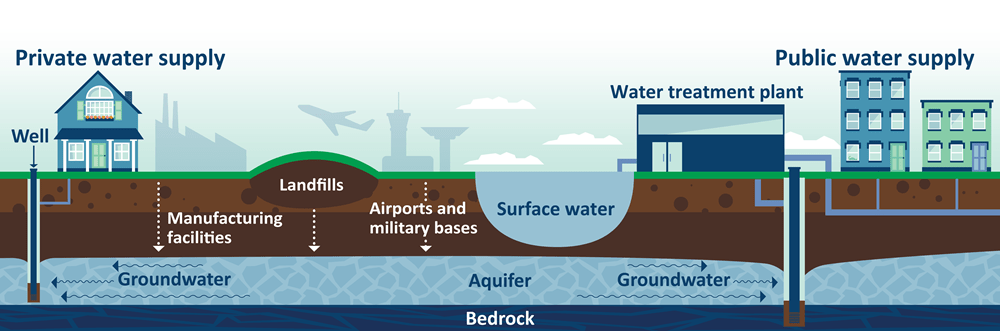
  • Illustration showing various sources of PFAS contamination in drinking water, including farmland runoff, unlined landfills, manufacturing facilities, and airports and military bases.

    PFAS are persistent chemicals, meaning they do not easily break down in the environment. PFAS also move easily around the environment in water and other materials. They have been found nearly everywhere. In Michigan, current data shows that airports, military bases, manufacturing facilities and landfills have some of the highest levels of PFAS.

    • Airports and Military Bases. PFAS have been and continue to be used in firefighting foam. Drinking water contaminated with PFAS near airports and military bases is often associated with the use of firefighting foams.
    • Manufacturing Facilities. PFAS used in manufacturing can be released into lakes and rivers during production or as wastewater. PFAS may be in industrial waste that can seep into the soil and drinking water sources.
    • Unlined Landfills. PFAS are used in many different consumer products that eventually end up in landfills. PFAS in unlined landfills can seep from the soil into drinking water sources.

    To learn about sites in your area, visit the PFAS Sites and Areas of Interest page.

  • Nursing mother, baby with toy in its mouth, baby in crib, firefighter

    Some children and adults may have higher exposure to PFAS than others.

    • Infants who:
      • Drink formula mixed with PFAS-contaminated water.
      • Drink breastmilk from persons exposed to PFAS.
        • Due to the many benefits of breastfeeding, the Centers for Disease Control and Prevention (CDC) and American Academy of Pediatrics recommend that most nursing people continue to breastfeed. For more information, please visit PFAS and Breastfeeding.
        • Clinicians can assist patients in deciding whether to breastfeed based on factors specific to the patient and the child.
    • Young children: Young children crawl on floors and put things in their mouths which leads to a higher risk of exposure to PFAS in carpets, household dust, toys, and cleaning products.

    Some people have higher exposures to PFAS than others because of their occupations or where they live

    • Workers: People whose work involves the making or processing of PFAS and materials that contain PFAS are more likely to be exposed than the general population. Workers may be exposed by touching or swallowing PFAS or PFAS-containing materials or by breathing in associated dust, aerosols or fumes. For more information on worker exposures, please visit the National Institute for Occupational Safety and Health PFAS webpage.
    • People who live, work or play around PFAS sites.
  • Michigan is leading the nation in addressing PFAS contamination. Click on the images below to learn more about our actions, projects and collaborations across the state.

    Hands together in a circleThe Michigan PFAS Action Response Team (MPART)
    MPART is a team of seven state agencies, including MDHHS, established to identify sources of PFAS, address PFAS contamination at the sources and work with local health departments to protect people in areas where groundwater is impacted by PFAS. Learn more here.



    List of datesA Short History of PFAS in Michigan
    View this timeline to see how PFAS has been addressed in Michigan in the past.



    Scientist looking in a microscopeMDHHS Biomonitoring and PFAS Health Studies
    Explore the various MDHHS biomonitoring projects and PFAS health studies underway.



    Close up of a hand drawing a line on a chartRegulatory and Health-Based Values to Protect Your Health
    Learn more about how regulatory values, like maximum contaminant levels (MCLs) and health-based values, like MDHHS comparison values, are developed and used to protect your health.



    Stack of reportsHealth Consultations and Reports
    Read MDHHS health consultations and reports.



    Woman giving a presentation before a large audiencePFAS Basics
    View videos exploring the basics of PFAS.

  • Call the MDHHS Environmental Health Hotline to talk to a toxicologist about your exposure concerns: 800-648-6942

    Visit Michigan.gov/PFASResponse for information on how Michigan is addressing PFAS in the environment.

    Visit Michigan.gov/CareforMiDrinkingWater to learn more about drinking water contamination.

    View PFAS fact sheets.